Current Affairs
Delimitation in India: Lok Sabha Expansion, Women’s Reservation, and the Federal Debate
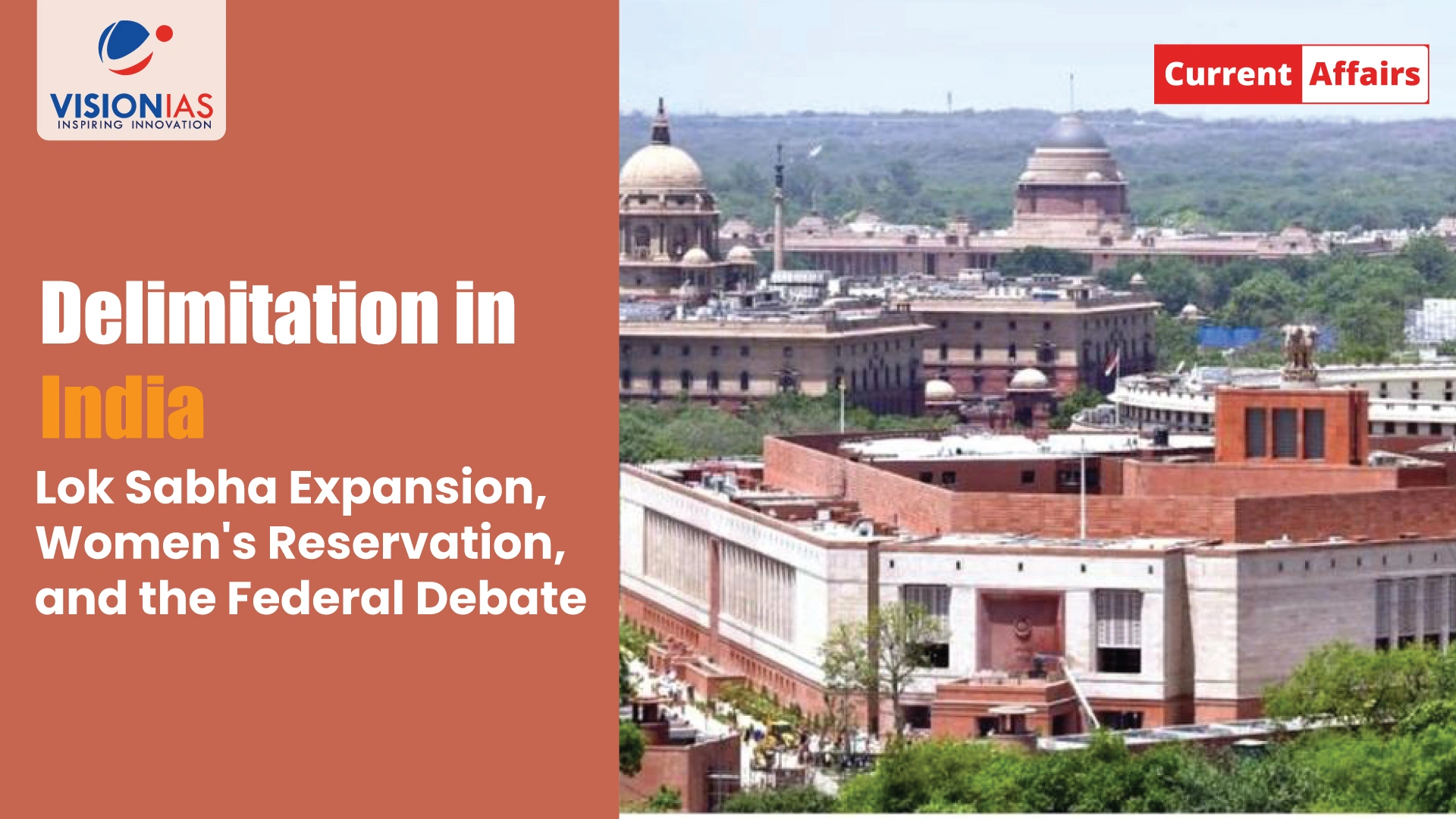


















The 131st Constitution Amendment Bill aims to increase Lok Sabha seats to 850, enabling smaller constituencies and facilitating the timely implementation of the 33% women’s reservation.
The Union Government has introduced the Constitution (131st Amendment) Bill, 2026, which could fundamentally change representation in India. The proposal to increase Lok Sabha seats from 543 to 850 centers on delimitation. This process is intertwined with women’s reservation, federal balance, and the future of democracy in India.
What is Delimitation and Why Does it Matter?
Delimitation is the process of redefining the boundaries of parliamentary and assembly constituencies to ensure each constituency represents a relatively equal share of the population, thereby maintaining fairness in elections. While the physical boundaries of constituencies were last adjusted using 2001 Census data, the total number of seats allocated to each state has remained frozen based on 1971 population levels for over five decades.
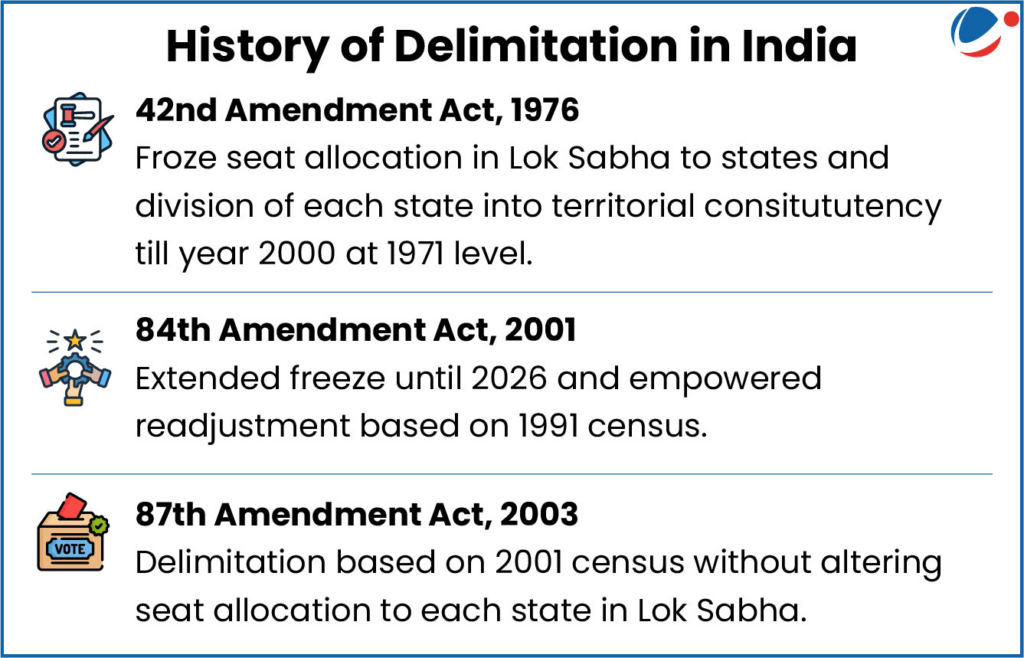
The crux lies in Article 82 of the Constitution, which currently pauses delimitation until the Census conducted after 2026. The 131st Amendment Bill proposes to eliminate this condition and grants Parliament the authority to determine delimitation timing. This change has significant implications for seat allocation, women’s reservation, and the distribution of political power among states.
131st Amendment Bill: Expanding the Lok Sabha to 850 Seats
The Basics
The Constitution (131st Amendment) Bill, 2026 proposes to increase the Lok Sabha seats from 543 to a maximum of 850 seats with 815 allocated to States and 35 to Union Territories. This change will result in smaller constituencies, allowing Members of Parliament (MPs) to represent fewer people, which is intended to enhance governance and accountability.
Removing the Freeze
Since 1976, a constitutional freeze has prevented adjustments of seats based on population changes. The 131st Amendment Bill seeks to remove this freeze and initiate a new delimitation process. Rather than waiting for the Census after 2026, Parliament will have the option to use the 2011 Census as the baseline for immediate delimitation.
Along with the Constitution Amendment Bill, the Centre is also moving the Delimitation Bill 2026, to repeal and replace the Delimitation Act, 2002. A Delimitation Commission will be established to execute this process. It will be chaired by a sitting or former Supreme Court Judge, and include the Chief Election Commissioner and the concerned State Election Commissioner. The Commission will have ten associate members per state, consisting of five MPs and five state legislators, who will serve in an advisory capacity without voting rights.
The Commission is responsible for determining Lok Sabha seat allocation, defining State Assembly strength, redrawing constituency boundaries, and identifying seats reserved for Scheduled Castes (SCs), Scheduled Tribes (STs), and women. The Commission’s orders, once published in the Gazette of India, will carry the force of law and cannot be contested in court.
Connection to Women’s Reservation
Delimitation is crucial for implementing women’s reservation. The Constitution (106th Amendment) Act, 2023, or Nari Shakti Vandan Adhiniyam, mandates that one-third of seats in the Lok Sabha, State Legislative Assemblies, and the Legislative Assemblies of Union Territories be reserved for women, including women belonging to Scheduled Castes and Scheduled Tribes.
As per the Act, Women’s Reservation could only be enacted post-delimitation which is to be carried out after the first Census after the 2023 enactment. The delay of the Census could have postponed implementation of the provisions. The 131st Amendment Bill’s removal of this Census linkage allows delimitation to take place sooner, facilitating the operationalization of women’s reservation earlier than estimated.
The present Bill proposes to amend Article 334A on women’s reservation to this effect. Expanding the Lok Sabha to 850 seats will also accommodate women parliamentarians without reducing seats for general candidates, thereby minimizing political resistance to implementation.
Women’s representation in the 17th Lok Sabha was approximately 14.4%, with state assemblies averaging below 10%. The Women’s Reservation Bill, upon activation through delimitation, aims to address this disparity. Reserved seats will be allotted by rotation across constituencies, ensuring geographic distribution. This reservation will remain in effect for 15 years from implementation, subject to extension by Parliament.
Federal Fault Line: North Versus South
The debate surrounding delimitation presents complexity. Should population be the basis for delimitation, states with higher growth rates gain more seats. Northern states such as Uttar Pradesh and Bihar stand to benefit, while Southern states such as Tamil Nadu, Kerala, Andhra Pradesh, Telangana, and Karnataka that have successfully managed population growth risk diminishing seat allocation.
The amendment is arguably seen as undermining federal balance as states should not face penalties for responsible governance and policy implementation.
Conclusion
Delimitation, beyond a technical process, has wider implications. It is pivotal for enabling women’s reservation, potentially restructuring federal dynamics, and shaping the future of India’s democracy.
The 131st Amendment Bill and the Delimitation Bill, 2026, together represent a significant restructuring of India’s electoral landscape. The effectiveness of these reforms in achieving genuine gender-inclusive governance and equitable federal representation will depend on the thoughtful design and implementation of the processes involved.
Master Digital Age Governance & Technology Trends withVisionIAS Comprehensive Current Affairs →
Delimitation in India FAQs
1. What is the official name of the Women’s Reservation Act 2023?
Ans. Nari Shakti Vandan Adhiniyam.
2. What fraction of legislative seats does the Women’s Reservation Act reserve for women?
Ans. One-third.
3. How many seats will the Lok Sabha have after the 131st Amendment Bill?
Ans. 850 seats.
4: Who will chair the Delimitation Commission established under the Delimitation Bill 2026?
Ans. A sitting or former Supreme Court Judge.
5: Why do southern states oppose the population-based delimitation proposed in the 131st Amendment Bill?
Ans. Because states that successfully controlled population growth risk losing seats to northern states, penalising responsible governance.