Current Affairs
India Cuts Excise Duty on Petrol and Diesel: What It Means for Fuel Prices
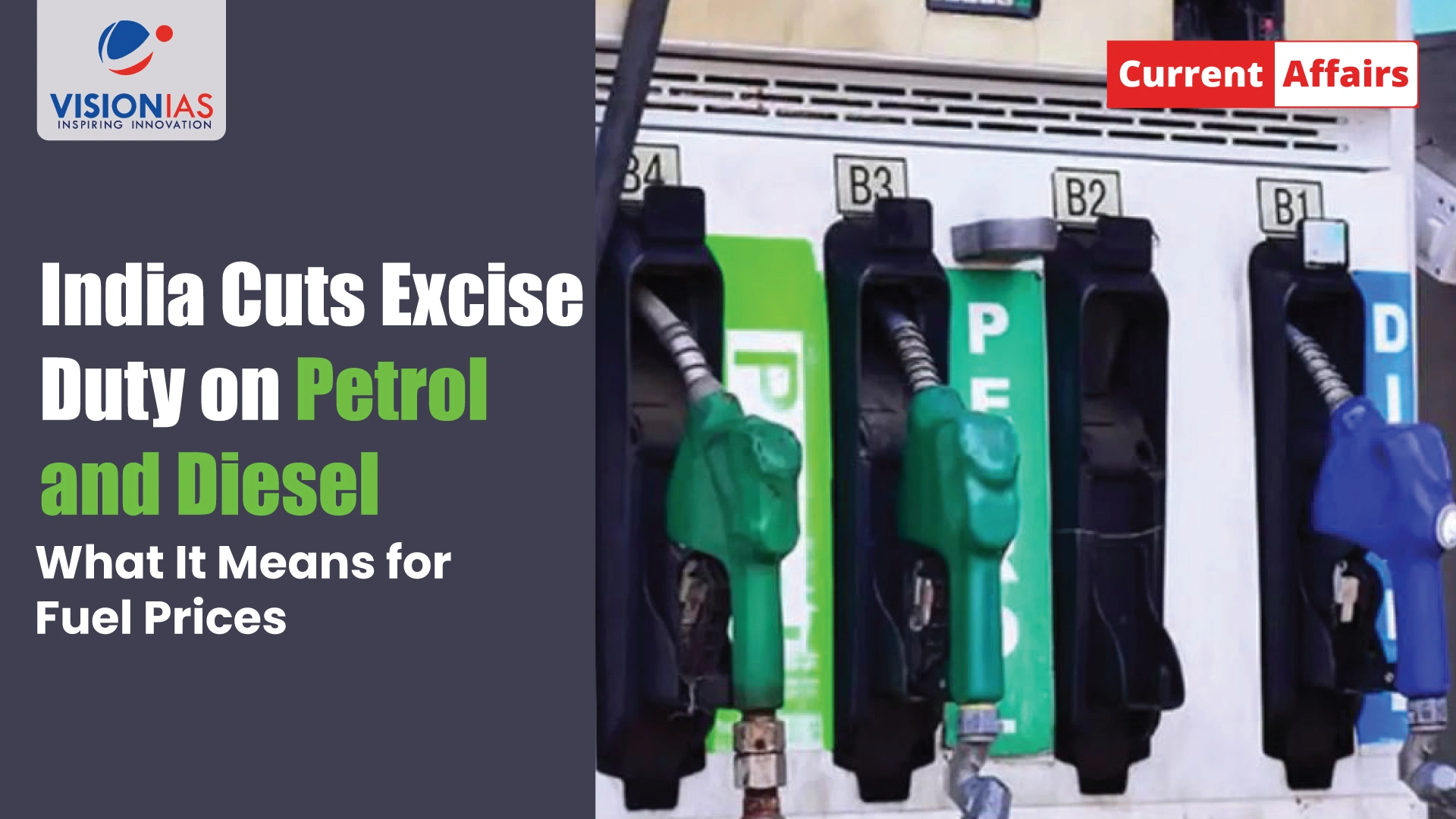


























Amid fears of a fuel price spike due to the US-Israel war on Iran, the Indian government cut excise duty on petrol and diesel by ₹10 per litre each, reducing it to ₹3 for petrol and zero for diesel.
On 27 March, 2026, the Government of India announced a sharp reduction in excise duty on petrol and diesel, cutting the duty on petrol from ₹13 to ₹3 per litre and bringing it down to zero on diesel. This effectively translates into a reduction of ₹10 per litre on both fuels. Alongside this move, the government has also imposed an export tax on petrol and diesel to ensure that domestic supply is not diverted to international markets where prices are significantly higher.
This policy decision comes at a time when global crude oil prices have witnessed a steep surge from around $70 to nearly $122 per barrel within a month. The spike has been driven largely by escalating geopolitical tensions in West Asia, particularly the US-Israel conflict with Iran and the resulting disruption of shipping routes, including concerns over the Strait of Hormuz.
In response to global pressure and diplomatic engagement, Iran has allowed “friendly nations,” including India, to continue energy transit through the Strait, preventing a complete supply shock.
Global Context: Why the Government Acted
The surge in global crude oil prices has had widespread repercussions, affecting fuel costs across regions. Countries worldwide have experienced significant increases in retail fuel prices, with governments adopting varied strategies ranging from passing on the burden to consumers to offering subsidies or tax relief.
India, in this instance, chose to absorb part of the burden through fiscal measures rather than allowing a direct pass-through of global prices to consumers. This approach is consistent with the government’s earlier response during the Russia-Ukraine conflict in 2022, when similar price shocks were managed through tax adjustments and controlled pricing.
To better understand the magnitude of the global fuel price increase:
- South East Asia has witnessed a rise of approximately 30 to 50%
- North America has seen an increase of around 30%
- Europe has experienced a comparatively lower but still significant rise of about 20%
- Africa has recorded increases of up to 50%
In this global backdrop, India’s decision to cut excise duties appears to be a calibrated effort to shield consumers and industries from the full impact of rising energy costs, while also maintaining macroeconomic stability.
Will Retail Fuel Prices Come Down?
Despite the reduction in excise duty, retail fuel prices are unlikely to decline in the immediate term. This is because Oil Marketing Companies (OMCs) are currently incurring substantial losses estimated at around ₹48.8 per litre due to the gap between elevated global crude oil prices and relatively stable domestic retail prices.
The excise duty cut helps reduce this burden but does not fully compensate for the losses. As a result, OMCs are likely to use the relief to partially offset under-recoveries rather than pass on the benefit directly to consumers.
Although fuel pricing in India is officially deregulated, in practice, OMCs tend to avoid frequent price revisions during periods of volatility. Instead, they absorb losses temporarily to prevent sharp price fluctuations that could fuel inflation and public discontent. In this context, the excise duty reduction functions more as a price stabilisation tool rather than a price reduction mechanism.
Thus, consumers may not see an immediate drop in fuel prices, but the measure helps prevent further increases in an already strained global environment.
Broader Economic Impact
India’s heavy reliance on imports of nearly 90% of its crude oil requirements makes it particularly vulnerable to global price fluctuations. Sustained high oil prices can have far-reaching implications for the economy.
According to various estimates:
- If crude oil averages around $100 per barrel through 2026–27, India’s current account deficit (CAD) could widen from a projected 0.7–0.8% of GDP to 1.9–2.2% of GDP (Credit Rating Agency ICRA).
- Government expenditure could increase by approximately ₹3.6 trillion (Elara Securities), primarily due to higher subsidies and fiscal interventions
In a more adverse scenario, where oil prices reach $130 per barrel, GDP growth could decline to around 6–6.4%. According to Chief Economic Advisor’s (CEA) testimony before the Parliamentary Standing Committee on Finance, such a shock could also raise inflation, and to maintain its fiscal deficit target of 4.3% of GDP, the government may be compelled to cut spending in key areas like infrastructure, potentially affecting long-term growth prospects.
Sectoral Impact
The impact of rising energy costs extends beyond macroeconomic indicators to affect multiple sectors of the economy, particularly those dependent on petrochemical inputs or energy-intensive processes.
- Agriculture and Fertilisers: Higher energy costs raise fertiliser production expenses, increasing subsidy needs. Continued import dependence especially for urea feedstock and P&K fertilizers exposes farmers to global price volatility, raising input costs and potentially food prices.
- Textiles: The sector is facing rising costs due to increased prices of petrochemical-based dyes and chemicals, which have surged by 30 to 50%. Polyester fibre prices have also risen by about 15%, affecting margins and export competitiveness.
- Steel Industry: Disruptions in the supply of coking coal of which India imports nearly 95% have pushed input costs up by around 10%. This could lead to higher steel prices and impact construction and infrastructure sectors.
- Glass Manufacturing: The industry relies heavily on natural gas for continuous furnace operations. Any curtailment in gas supply can lead to shutdowns, causing production losses that are difficult and costly to reverse.
Conclusion
The reduction in excise duty on petrol and diesel is a strategic fiscal intervention aimed at stabilising domestic fuel prices amid a sharp rise in global crude oil prices. While it may not immediately reduce retail fuel prices, it plays a crucial role in preventing further increases and easing the financial burden on oil marketing companies.
Iran’s decision to allow continued access through the Strait of Hormuz for friendly nations, including India, offers temporary relief on the supply front. However, the broader economic and sectoral challenges posed by sustained high oil prices remain significant.
Master Digital Age Governance & Technology Trends with VisionIAS Comprehensive Current Affairs →
Excise Duty Cut FAQs
1. What are the key changes India made to excise duty on petrol and diesel in March 2026, and what is the new rate after the reduction?
Ans. India cut excise duty by ₹10 per litre on both fuels, bringing petrol duty down to ₹3 per litre and diesel duty to zero.
2. How much of India’s crude oil requirement is imported?
Ans. Nearly 90%.
3. Why did India cut excise duty on fuel in March 2026?
Ans. To shield consumers from a global crude oil price spike driven by US-Israel-Iran geopolitical tensions.
4. Will retail petrol and diesel prices fall after India’s excise duty cut?
Ans. No, because Oil Marketing Companies are absorbing losses of approximately ₹48.8 per litre and will use the relief to offset under-recoveries.
5. Why has India imposed an export tax on petrol and diesel alongside the excise duty cut?
Ans. To prevent domestic fuel supply from being diverted to higher-priced international markets.