Current Affairs
India-Israel Relations 2026: Indian PM’s Visit, Elevated Partnership & Major Takeaways
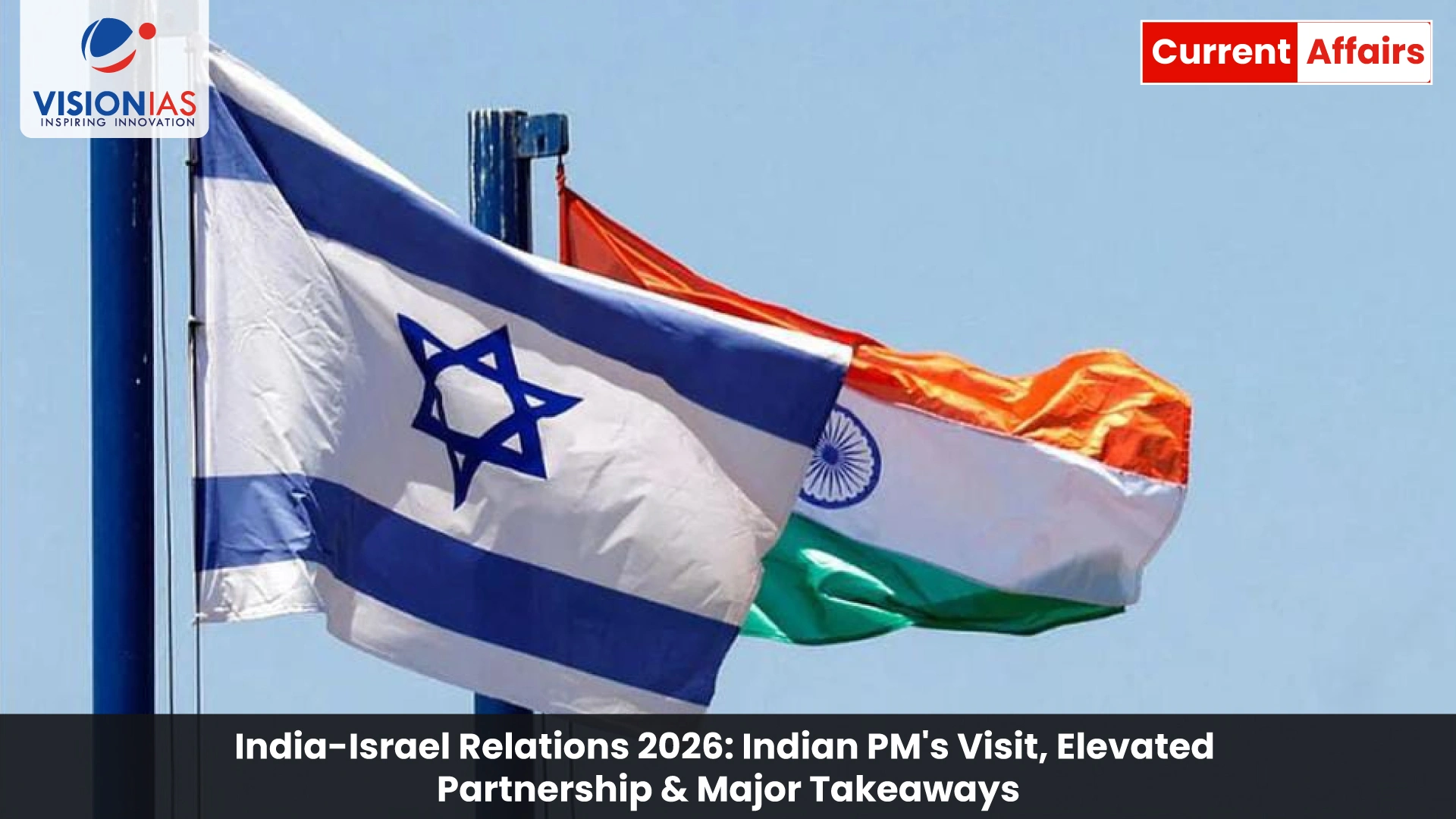



















The Prime Minister (PM) of India visited Israel reaffirming the countries’ strong strategic partnership in defence, technology, innovation, and economic cooperation.
The Indian Prime Minister’s state visit to Israel on February 25-26, 2026 elevated the bilateral ties to a ‘Special Strategic Partnership for Peace, Innovation & Prosperity’. This is the highest diplomatic tier in bilateral engagement. The visit produced major bilateral outcomes, including MoUs, Protocols, and Declarations spanning technology, agriculture, cybersecurity, digital payments, labour mobility, and education.
Background: Journey of India-Israel Relations
India announced its recognition of Israel on September 17, 1950. Subsequently, India and Israel established full diplomatic relations in 1992. The relationship gained further momentum after the Indian Prime Minister’s 2017 visit to Israel, the first-ever by an Indian Prime Minister, followed by PM Netanyahu’s visit to India in 2018.
Over the past three decades, India-Israel relations have grown across diverse domains: defence, agriculture, water technology, cyber security, and space research. Bilateral merchandise trade stood at approximately USD 3.62 billion in FY 2024–25, with untapped potential in sectors like machinery, chemicals, textiles, and advanced technologies.
The 2026 PM’s visit is built on this foundation, institutionalising the relationship through bilateral mechanisms.
Elevation to Special Strategic Partnership
The key announcement of the visit was the elevation of the bilateral relationship to a ‘Special Strategic Partnership for Peace, Innovation & Prosperity’. This upgrade reflects the deepening convergence between the two knowledge-driven economies.
Both leaders recognised a complementary synergy. Israel is a global powerhouse of technology and innovation, while India is a hub of talent, manufacturing, and entrepreneurial energy. This partnership strengthens India’s vision of Atmanirbhar Bharat and Viksit Bharat 2047.
Key Outcomes Across Critical Sectors
Technology, AI, and Critical & Emerging Technologies
Technology cooperation is at the heart of the upgraded India-Israel Special Strategic Partnership. Both sides signed a Memorandum of Understanding (MoU) on Cooperation in Artificial Intelligence (AI), covering ethical AI development, civilian applications, academic research, and public-private partnerships. Key institutional upgrades include the Joint Commission on Science & Technology being raised to the Ministerial level.
Other notable tech agreements include:
- Geophysical exploration: An MoU on cooperation in geophysical exploration strengthens collaboration in mineral exploration using advanced geophysical and AI technologies. This promotes sustainable resource development, investment, and geological data sharing.
- Tech-Gateway Initiative: Facilitates collaborative R&D, technology validation, and pilot projects between the two innovation ecosystems.
- Critical & Emerging Technologies (CET) Initiative: Led by National Security Advisors to synergise both countries’ strengths in niche technologies.
- Horizon Scanning Mechanism: A Declaration of Intent for strategic foresight, technology planning, and risk assessment using AI and data tools.
- India-Israel Industrial R&D and Innovation Fund (I4F): Joint Research Calls strengthened with contributions increased from USD 1 million to USD 1.5 million each.
Cybersecurity Cooperation
Both leaders signed a Letter of Intent to establish an India-Israel Cyber Centre of Excellence in India. This Centre will serve as a hub for cybersecurity best practices, emerging technologies, and digital resilience, bringing together government, industry, and academia.
A multi-year cybersecurity roadmap was committed to, covering human capacity building, AI-integrated security, ‘Security by Design’ principles, and regular joint cyber exercises. The India-Israel Cyber Policy Dialogue held in March 2025 set the foundation for this cooperation.
Trade, Investment & Free Trade Agreement (FTA)
A notable development in India-Israel relations is the launch of Free Trade Agreement negotiations. The first round of FTA talks was held in New Delhi from February 23–26, 2026, covering trade in goods and services, rules of origin, intellectual property rights, digital trade, and more. The next round will be held in Israel in May 2026.
Additional trade and financial milestones include Unified Payments Interface (UPI) linkage with Israel’s MASAV payment system for cross-border remittances; an MoU between International Financial Services Centres Authority (IFSCA) and Israel Securities Authority (ISA) for fintech and regtech (Regulatory Technology) collaboration; and the launch of an India-Israel Financial Dialogue. Both leaders also encouraged Indian participation in Israel’s major infrastructure projects in metro, rail, airports, and desalination.
Agriculture, Fisheries, Water, and Environmental Cooperation
The India-Israel Innovation Centre for Agriculture (IINCA) will be established through an MoU between Indian Council of Agricultural Research (ICAR) and MASHAV. It will drive precision farming, satellite-based irrigation, advanced machinery, and integrated pest management.
Moreover, MoU on Fisheries and Aquaculture expands cooperation in sustainable and technology-driven fisheries, including mariculture, disease management, seaweed cultivation, innovation, training, and Centres of Excellence.
Over 35 Centres of Excellence in agriculture are already operational across India, with 8 more being jointly set up. Additionally, 20 Joint Fellowships in Agricultural Research were launched for Indian researchers at the Volcani Agriculture Research Organization in Israel.
Labour Mobility: Expanding Opportunities for Indian Workers
Three new Implementation Protocols were signed, enabling Indian workers to access employment in Israel across the Commerce & Services, Manufacturing, and Restaurant sectors. These cover retail, logistics, textiles, electronics, chemicals, food processing, and hospitality.
Both leaders agreed that up to 50,000 additional Indian workers may travel to Israel over the next five years. The Joint Coordination Committee (JCC) has been tasked to meet frequently to address worker-related issues. Opportunities in high-skill sectors like data science, AI, and hi-tech are also being explored.
Education, Culture and Academic Cooperation
An MoU on Cooperation in Education through AI was signed, focusing on innovative pedagogy, teacher development, equitable AI access, and data literacy for future-ready education. The launch of the India-Israel Academic Cooperation Forum (I2I Forum) for high-level dialogue between research and academic institutions.
The Cultural Exchange Programme (2026–2029) deepens people-to-people ties through cooperation in music, theatre, dance, visual arts, festivals, workshops, and expert exchanges. India and Israel also signed an MoU supporting the development of the National Maritime Heritage Complex (NMHC) at Lothal, Gujarat, promoting joint exhibitions, research collaboration, publications, and maritime heritage awareness.
Additionally, the MoU between Nalanda University and Hebrew University of Jerusalem (HUJI) enables exchanges in Buddhist studies, archaeology, mathematics, and international relations. The India-Israel Parliamentary Friendship Group was also established to strengthen people-to-people ties at the legislative level.
Geopolitical Significance and Regional Connectivity
The visit also addressed regional and global developments. Both leaders condemned terrorism in all its forms, including the October 7, 2023 Hamas attack on Israel, the Pahalgam terror attack in J&K (April 22, 2025), and the Red Fort terror incident (November 10, 2025).
Both sides reaffirmed commitment to the I2U2 Quadrilateral Partnership (India-Israel-UAE-USA) and the India-Middle East-Europe Economic Corridor (IMEC), both of which align with India’s vision for regional connectivity and supply chain resilience.
The leaders also welcomed US President Trump’s plan to end the Gaza conflict and underlined the need for a just and durable peace, freedom of navigation, and stability in the region.
Conclusion
The state visit to Israel deepened India-Israel relations, transforming them from a bilateral partnership into a comprehensive Special Strategic Partnership. With agreements spanning AI, cybersecurity, trade, agriculture, labour mobility, and education, this summit marks a new chapter in bilateral engagement.
For India, this partnership reinforces the vision of Viksit Bharat 2047 by integrating Israel’s technological ecosystem while expanding market access, safeguarding worker rights, and strengthening regional connectivity through frameworks like IMEC and I2U2.
Master Digital Age Governance & Technology Trends with VisionIAS Comprehensive Current Affairs →
India-Israel Relations FAQs
1. Which two institutions signed an MoU enabling exchanges in Buddhist studies and archaeology?
Ans. Nalanda University and Hebrew University of Jerusalem (HUJI).
2. Which countries are involved in the I2U2 grouping?
Ans. India, Israel, UAE, and USA.
3. What payment systems were linked to enable India-Israel cross-border remittances?
Ans. India’s UPI and Israel’s MASAV payment system.
4. What is the India-Israel Cyber Centre of Excellence intended to do?
Ans. It will serve as a hub for cybersecurity best practices, emerging technologies, and digital resilience.
5. When did India and Israel establish full diplomatic relations?
Ans. 1992.