Current Affairs
India-Malaysia Relations: Strategic Partnership Deepens with 11 Key Agreements in 2026
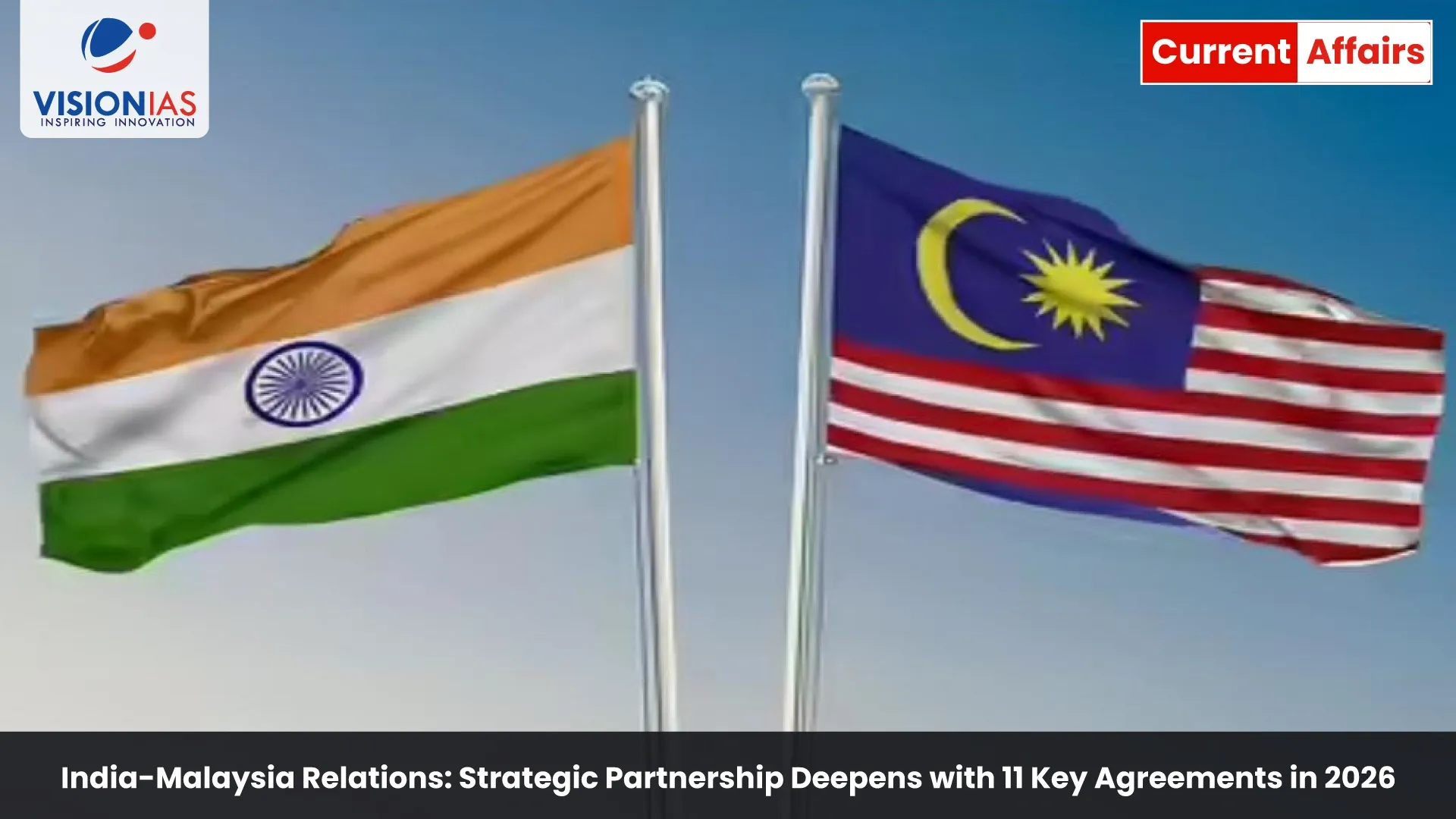
















At Malaysia’s invitation, the Indian Prime Minister visited on 7–8 February 2026, reaffirming deep ties and commitment to the Comprehensive Strategic Partnership.
The official visit by the Indian Prime Minister to Malaysia from February 7-8, 2026, has marked a transformative moment in India-Malaysia relations. This engagement in Putrajaya reaffirmed the Comprehensive Strategic Partnership (CSP) established in August 2024, showcasing both nations’ commitment to building a relationship that extends beyond traditional diplomatic ties.

2026 Putrajaya Summit: Milestone in Bilateral Cooperation
The visit served as a platform for operationalizing the CSP through concrete institutional mechanisms. During the summit, both sides exchanged 11 bilateral agreements and memoranda of understanding that provide a framework for cooperation across strategic sectors including semiconductors, digital economy, disaster management, security, and healthcare.
Strategic Agreements Shaping the Future
Semiconductor and Technology Cooperation
The Exchange of Notes on Semiconductor Cooperation stands as one of the key outcomes of the summit. Malaysia contributes approximately 13-15% to the global semiconductor back-end value chain, while India is scaling its electronic manufacturing capabilities. This agreement facilitates joint research, workforce development, and technology transfer, combining Malaysian industrial expertise with Indian design capabilities and market scale.
Complementing this is the Exchange of Notes on Vocational Education and Training (TVET), which addresses the human capital requirements of the semiconductor and digital sectors. By standardizing training certifications and ensuring skilled worker mobility, both nations are creating a labor corridor for 21st-century industries.
Digital Economy and Financial Integration
A landmark achievement in India-Malaysia relations is the collaboration between NPCI International Payments Ltd (NIPL) and Malaysia’s PayNet to establish bilateral digital payment linkages. This integration will enable seamless, low-cost remittance and payment solutions for tourists, students, and small businesses through QR-based systems like UPI and DuitNow.
Both leaders emphasized the importance of promoting local currency settlement in bilateral trade. The Reserve Bank of India and Bank Negara Malaysia are working to facilitate invoicing and settlement of trade in Indian Rupee (INR) and Malaysian Ringgit (MYR), reducing dependency on the US Dollar and enhancing macroeconomic resilience for businesses, particularly Small and Medium Enterprises (SMEs).
Security and Counter-Terrorism
Security cooperation forms a cornerstone of the strategic partnership. The Memorandum of Understanding on Combating and Preventing Corruption between India’s Central Bureau of Investigation and the Malaysian Anti-Corruption Commission facilitates information exchange and best practices in financial forensics.
The Exchange of Notes on Security Cooperation between the two National Security Councils provides a consultative mechanism for addressing transnational threats, including cybercrime, maritime piracy, and violent extremism. Both nations condemned terrorism in all its forms and agreed to strengthen cooperation in countering radicalization, terror financing, and the use of emerging technologies for terrorist purposes.
India and Malaysia are co-chairing the Counter-Terrorism Working Group under the ASEAN Defence Ministers’ Meeting Plus (ADMM-Plus) framework for 2024-2027, with Malaysia set to host a Table-Top Exercise on counter-terrorism in 2026.
Economic Dimensions: Trade, Investment, and Connectivity
Bilateral trade between India and Malaysia reached approximately $18.59 billion in 2025, reflecting the economic engagement between both countries. The leaders emphasized the importance of the Malaysia-India Comprehensive Economic Cooperation Agreement (MICECA) and welcomed the ongoing review of the ASEAN-India Trade in Goods Agreement (AITIGA) to make it more trade-facilitative and relevant to current global practices.
The 10th India-Malaysia CEO Forum, held in Kuala Lumpur on February 7, 2026, complemented governmental efforts to strengthen trade and investment relations. Both sides encouraged greater cooperation across priority sectors including infrastructure, renewable energy, advanced manufacturing, healthcare, fintech, artificial intelligence, and green technologies.
Energy and Food Security
Energy cooperation has emerged as a growth sector in India-Malaysia relations. Malaysian energy giant PETRONAS and its subsidiary Gentari are making investments in India’s renewable energy and green hydrogen landscape. Both nations emphasized the potential for collaboration in large-scale solar energy initiatives, leveraging Malaysia’s expertise to drive clean energy solutions and achieve mutual net-zero ambitions.
On food security, Malaysia reaffirmed its commitment to remain a supplier of sustainable palm oil, while both sides agreed to deepen collaboration in oil palm cultivation, value chain development, and downstream palm-based products. Regular dialogue and information exchange will help ensure stable, resilient, and sustainable supply chains.
Defense and Maritime Cooperation
The defense relationship between India and Malaysia continues to strengthen through regular exchanges, joint exercises, training courses, and defense industry collaboration. The conduct of the fifth edition of the India-Malaysia Joint Military Exercise, Harimau Shakti, in December 2025 in Rajasthan demonstrated the operational interoperability between both armed forces.
Maritime cooperation has seen enhancement, with regular goodwill visits by Indian naval vessels to Malaysian ports. The establishment of the Strategic Affairs Working Group (SAWG) and Su-30 Forum reflects the defense-industrial collaboration, particularly in aerospace maintenance and technical expertise sharing.
People-to-People Ties: The Living Bridge
Approximately 2.9 million people of Indian origin reside in Malaysia, constituting the third-largest Indian diaspora globally. The operationalization of the Thiruvalluvar Chair of Indian Studies and the establishment of the Thiruvalluvar Center at Universiti Malaya honor the shared cultural heritage, particularly the Tamil language spoken by 90% of the Indian diaspora in Malaysia. The establishment of an Indian Consulate General in Malaysia will further strengthen consular outreach and community engagement.
The announcement of Thiruvalluvar Scholarships for Malaysian nationals will facilitate greater educational exchanges. Both leaders welcomed ongoing visa liberalization and agreed to streamline the mobility of workers and professionals, strengthening the people-to-people connect that forms the foundation of bilateral ties.
Tourism cooperation received attention, with both sides committed to enhancing two-way visitor flows. India welcomed Malaysia’s Visit Malaysia 2026 campaign, while Malaysia appreciated the ‘Incredible India’ tourism initiative. Enhanced air and maritime connectivity will boost tourism, trade, and cultural exchanges.
Regional and Global Cooperation
Both nations are leveraging their bilateral partnership to shape regional and global governance structures. Malaysia welcomed India’s 2026 BRICS Chairmanship, while India reaffirmed its commitment to supporting Malaysia’s role as a BRICS Partner Country and noted Malaysia’s aspiration to become a full member of BRICS.
India appreciated Malaysia’s ASEAN Chairmanship in 2025 and thanked Malaysia for its support in strengthening the ASEAN-India Comprehensive Strategic Partnership. Both leaders reaffirmed their commitment to ASEAN Centrality and a free, open, rules-based, peaceful, and prosperous Indo-Pacific.
The Memorandum of Understanding on Disaster Management and the Exchange of Letters on UN Peacekeeping Cooperation highlight both nations’ commitment to global peace, stability, and humanitarian assistance.
Conclusion
The 2026 Putrajaya Summit has strengthened the Comprehensive Strategic Partnership between India and Malaysia, moving from a framework of intentions to concrete institutional outcomes. The 11 agreements signed across diverse sectors from semiconductors and digital payments to disaster management and peacekeeping reflect the breadth and depth of bilateral cooperation.
India-Malaysia relations have evolved into a partnership characterized by strategic trust, mutual benefit, and shared commitment to regional stability and global governance reform.
Master Digital Age Governance & Technology Trends with VisionIAS Comprehensive Current Affairs →

India-Malaysia Relations FAQs
1. When did the Indian Prime Minister visit Malaysia in 2026?
Ans. February 7-8, 2026.
2. How many agreements were signed during the 2026 India-Malaysia summit?
Ans. 11 bilateral agreements.
3. What percentage of the global semiconductor value chain does Malaysia contribute?
Ans. 13-15% of back-end operations.
4. Which digital payment systems are being integrated between India and Malaysia?
Ans. UPI and DuitNow.
5. What role does Malaysia hold in BRICS?
Ans. Malaysia is a BRICS Partner Country.