Current Affairs
Jal Jeevan Mission 2.0 Guidelines: Reforms, Funding & What It Means for Rural India
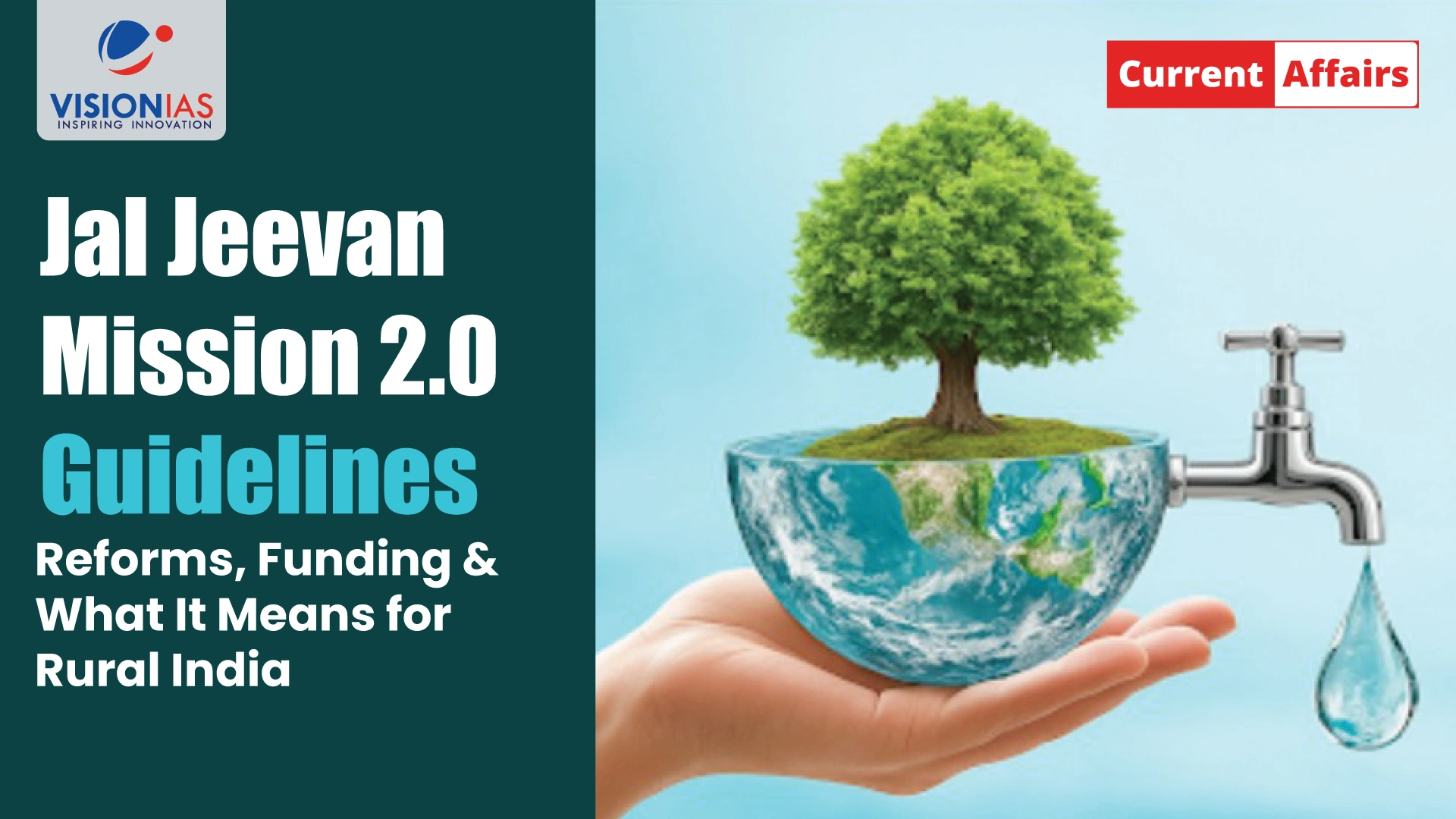




On 22nd March, the Ministry of Jal Shakti released the Operational Guidelines of Jal Jeevan Mission (JJM) 2.0 on the occasion of World Water Day.
On World Water Day, March 22, 2026, the Department of Drinking Water and Sanitation (DDWS), Ministry of Jal Shakti, released the Jal Jeevan Mission 2.0 Guidelines, a landmark step in India’s journey toward ensuring safe and reliable drinking water for every rural household.
The Jal Jeevan Mission 2.0 Guidelines focus on policy shifts from simply building infrastructure to ensuring long-term service delivery. With the Union Cabinet approving an enhanced outlay of approximately ₹8.69 lakh crore and extending the mission till December 2028, JJM 2.0 charts a more accountable, community-driven path to achieving Har Ghar Jal meaning ‘tap water in every home’.
From Infrastructure to Service Delivery
The first phase of the Jal Jeevan Mission, launched on August 15, 2019, set an ambitious goal: provide at least 55 litres of potable water per person per day through a functional household tap connection to every rural household. While rapid infrastructure expansion was achieved, concerns emerged over the sustainability, functionality, and quality of water services on the ground.
The Jal Jeevan Mission 2.0 Guidelines directly address these gaps. The revised framework moves decisively from an infrastructure-creation model to a service-delivery-oriented model, with emphasis on:
- Assured service delivery with defined performance standards
- Clear accountability at State, District, and Gram Panchayat levels
- Long-term sustainability through source protection, water conservation, and community ownership
Key Reforms Under JJM 2.0
The Jal Jeevan Mission 2.0 Guidelines introduce 11 key structural reform areas, grouped under the Reform-Linked Memoranda of Understanding (MoUs) being signed with States. These cover:
- Institutional architecture for drinking water governance
- Service utility framework for rural water supply
- Technical compliance and efficient scheme implementation
- Citizen-centric water quality governance
- Source sustainability and water security framework
- Digital data governance in rural drinking water systems
- Participatory governance through Jan Bhagidari
- Capacity building framework
- Human resource and skilling ecosystem
- Operational and financial sustainability of water supply schemes
- Research, innovation, and knowledge ecosystem
Nine States had signed Reform-Linked MoUs by the time of the Jal Mahotsav 2026 culmination, reaffirming their commitment to sustainable rural drinking water delivery.
Sujalam Bharat: The Digital Backbone
The introduction of Sujalam Bharat in December 2025, a uniform national digital framework to map the entire drinking water supply system from source to tap.
What Does Sujalam Bharat Entail?
- Every village will be assigned a unique Sujal Gaon/Service Area ID, digitally mapping all rural water supply infrastructure.
- Gram Panchayats and Village Water & Sanitation Committees (VWSCs) will be involved in the commissioning and formal handover of water schemes.
- A Gram Panchayat can declare itself ‘Har Ghar Jal’ only after confirming that adequate Operation & Maintenance (O&M) mechanisms have been established by the State Government.
This digital accountability framework is designed to address the irregularities reported in the first phase, where inflated project costs and quality concerns drew scrutiny.
Community Participation: The Jan Bhagidari Model
The Jal Jeevan Mission 2.0 Guidelines place community ownership at the centre of water governance. The concept of ‘Jal Sanchay se Jan Bhagidari’ meaning people’s participation in water conservation was the theme of Jal Mahotsav 2026, a 15-day nationwide campaign (March 8–22, 2026).
Ground Realities from Sujal Gram Samvad
The 5th Sujal Gram Samvad on World Water Day showcased how communities across five States are already practising JJM 2.0 principles:
- Uttarakhand (Hatnur village): A 24×7 gravity-based water supply system managed by a local O&M team funded through community contributions.
- Haryana (Tepla village): ₹40/household/month user charges collected for maintenance; universal functional tap connections achieved.
- Chhattisgarh (Salhebhat village): ₹50/household/month user charges; women actively involved in water governance.
- Odisha (Bhanagan village): Improved school attendance among girls due to reliable rural drinking water access.
- Madhya Pradesh (Hardot village): FTK-trained women conducting water quality testing; ₹100/household user charges supporting O&M.
Source Sustainability: Non-Negotiable Foundation
The Jal Jeevan Mission 2.0 Guidelines underline a critical insight: without source sustainability, water services cannot be reliable. Therefore, the guidelines call for strong convergence on:
- Rainwater harvesting
- Greywater management
- Aquifer recharge
- Water conservation at the Gram Panchayat level
This source sustainability framework addresses a fundamental gap in Phase 1, where tap connections were created but the underlying water sources were not always protected or replenished.
Significance and Challenges of JJM 2.0
The Jal Jeevan Mission 2.0 Guidelines mark a decisive shift in India’s rural water governance by the introduction of fiscal discipline and digital transparency that were largely absent in Phase 1. However, JJM 1.0 laid a strong foundation for this transformation. The first phase achieved rapid expansion of tap water infrastructure across rural India, bringing functional household tap connections to millions of households.
The social impact is equally significant. Reliable rural drinking water access has reduced the burden on women and girls, improved school attendance, and encouraged responsible water use at the household level. The Jan Bhagidari model, where communities collect user charges and manage local systems, ensures water governance becomes a people’s movement rather than a government-driven exercise alone.
Despite its comprehensive design, JJM 2.0 faces real implementation hurdles:
- Legacy of Phase 1 irregularities: Concerns over inflated costs and poor-quality work continue to shadow the programme’s credibility.
- Difficult terrain: Remote and geographically challenging areas, as seen in Chhattisgarh’s Kondagaon district, slow down equitable coverage.
- Source sustainability pressures: Groundwater depletion and erratic rainfall threaten the long-term viability of functional tap connections, making rainwater harvesting and aquifer recharge non-negotiable.
- O&M financing gaps: Scaling user-charge models consistently across all rural households especially in poorer communities remains a significant challenge.
- Gram Panchayat capacity: Effective implementation of the Jal Jeevan Mission 2.0 Guidelines requires VWSCs and local bodies to have adequate technical and financial management skills, which must be built systematically.
Conclusion
The Jal Jeevan Mission 2.0 Guidelines represent India’s most comprehensive attempt to move beyond the politics of tap connections toward the promise of functional, safe, and sustainable rural drinking water. By combining digital accountability (Sujalam Bharat), structural reform-linked funding, community ownership, and source sustainability, JJM 2.0 sets a new benchmark for how welfare programmes can be reimagined for long-term impact.
As India marches toward Har Ghar Jal and the larger vision of Viksit Bharat @2047, the success of JJM 2.0 will depend on one critical factor: whether every Gram Panchayat can become a true Sujal Gram, a village where clean water flows not just through taps, but through the collective responsibility of its people.
Master Digital Age Governance & Technology Trends with VisionIAS Comprehensive Current Affairs →
Jal Jeevan Mission 2.0 FAQs
1. When were the Jal Jeevan Mission 2.0 Guidelines released?
Ans. March 22, 2026 (World Water Day).
2. Which ministry released the JJM 2.0 Guidelines?
Ans. Ministry of Jal Shakti.
3. Which fundamental right is linked to access to water in India?
Ans. Article 21 (Right to Life).
4. What is Sujalam Bharat in the context of JJM 2.0?
Ans. It is a national digital framework that maps the entire rural drinking water supply system from source to tap.
5. What does ‘Har Ghar Jal’ mean?
Ans. Tap water in every home.