Preparation Strategy
UPSC Prelims 2026 Common Doubts Explained: Preparation, Revision, Tests, and Exam Strategy















Every year, thousands of capable and hardworking aspirants fail to clear the UPSC Preliminary Examination not because they did not study enough, but because they misunderstand the nature of the examination itself. Prelims is not a test of brilliance. It is not a test of memory alone. And it is certainly not a test of how many books one has collected.
Prelims is, at its core, a test of judgment under uncertainty. It examines how you think when two options look equally tempting, how you behave when you are not fully sure, how you manage pressure when the clock is ticking, and how disciplined you remain when panic pushes you towards poor decisions. In that sense, most Prelims failures are not academic failures. They are psychological and strategic failures.
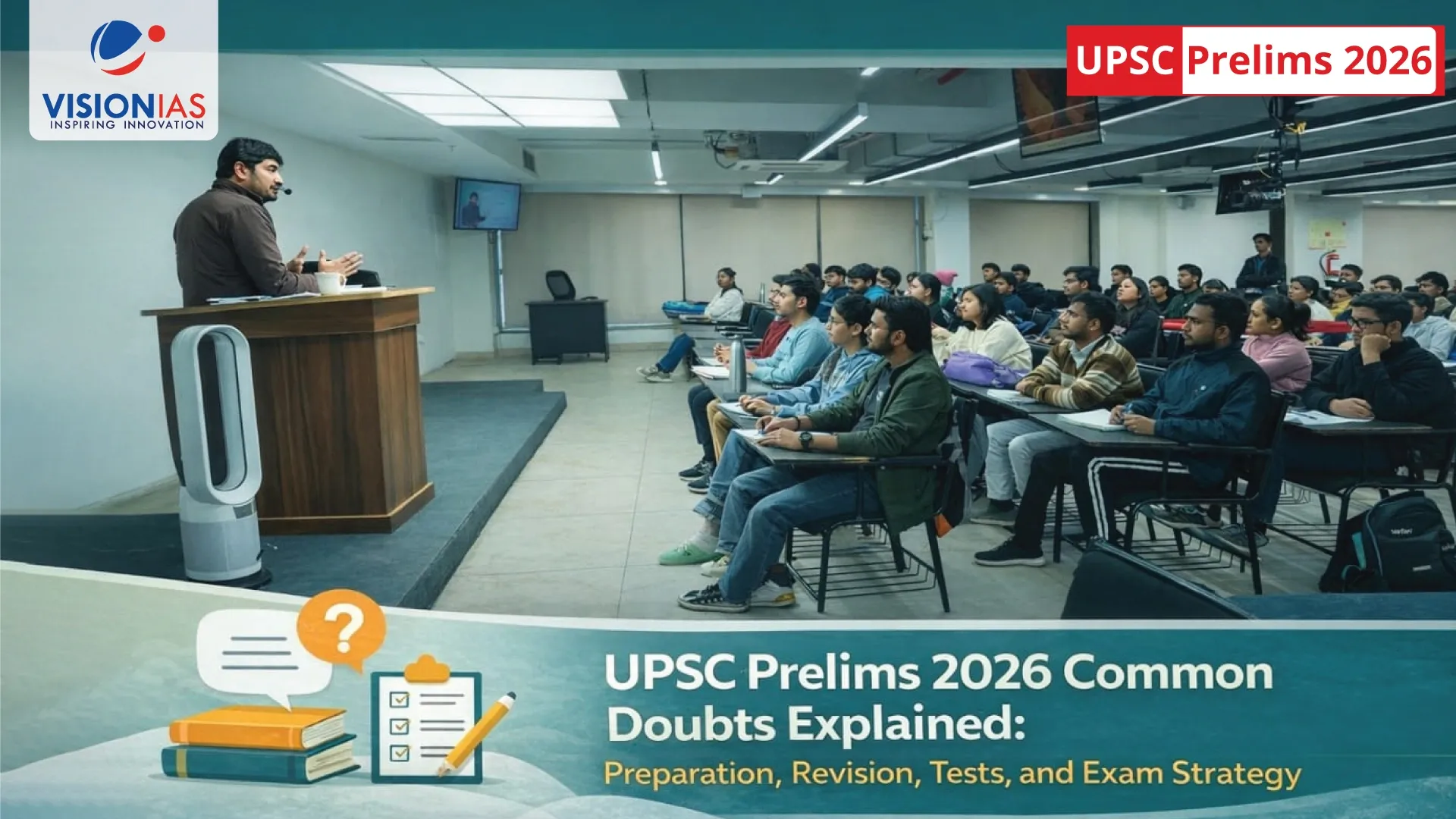
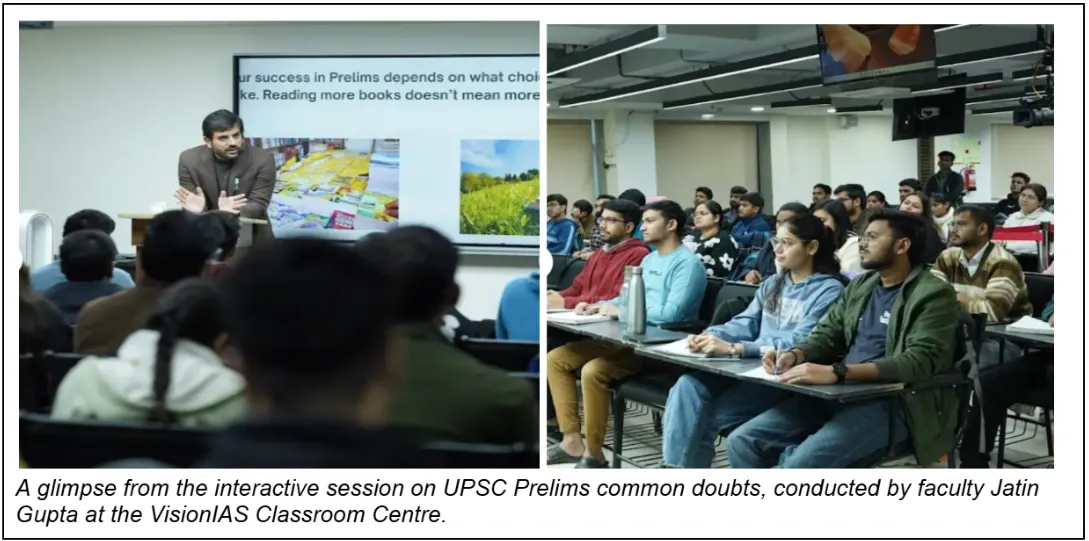
Recently, in an interactive session with aspirants, Jatin Gupta sir addressed many of the most common doubts related to Prelims preparation—doubts not just about books or sources, but about revision, tests, confidence, and decision-making.
Watch: Interactive Session on UPSC Prelims Common Doubts with Jatin Gupta Sir
What became clear in that discussion was that most doubts are not really technical. They are about how one thinks and chooses under uncertainty. It is in this context that the common doubts around Prelims need to be understood—not as isolated questions, but as part of a larger strategy and mindset.
Let us look at these doubts, and more importantly, the logic behind them.
The Confidence Crash Problem: Why You Suddenly Feel You Know Nothing
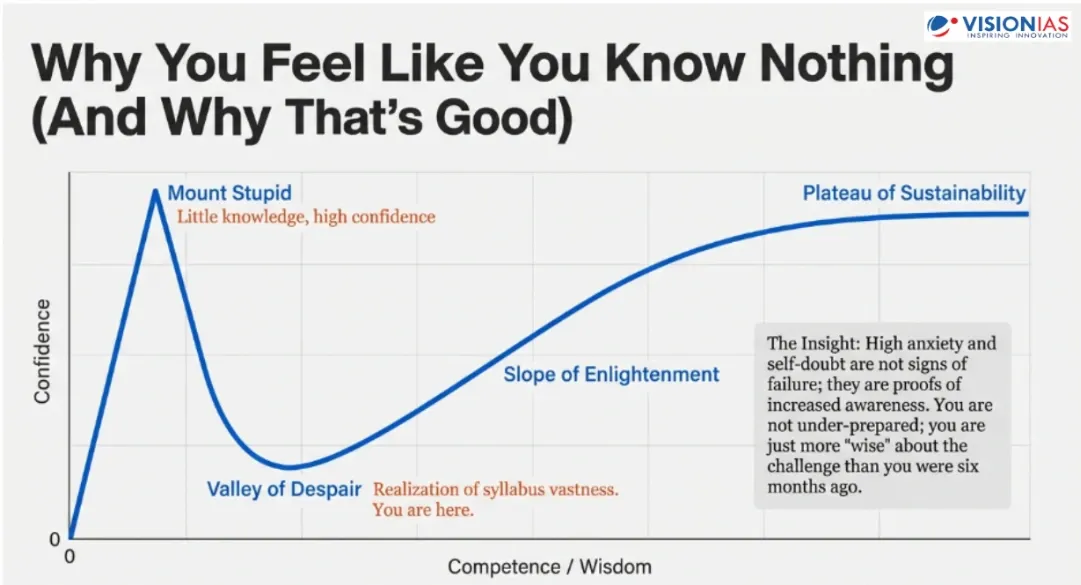
Almost every serious aspirant experiences a phase where confidence drops sharply. The syllabus begins to feel endless. Questions start appearing unpredictable. Options seem dangerously close to each other. Many aspirants even feel that they were more confident six months ago than they are today.
This phase is not a sign of decline. It is a sign of intellectual progression.
Psychology explains this using the Dunning–Kruger Effect. In the early stages of learning, knowledge is shallow but confidence is high. As understanding deepens, the learner becomes aware of the true complexity of the subject, and confidence temporarily falls. Only after sustained effort does stable and realistic confidence emerge.
In UPSC preparation, this “confidence crash” is actually a marker that you are finally beginning to see the exam at its real depth. The danger is not low confidence. The real danger is false confidence. Prelims does not punish those who are cautious. It punishes those who are careless.
The Fog Effect: Why Thinking Too Far Ahead Paralyzes Preparation
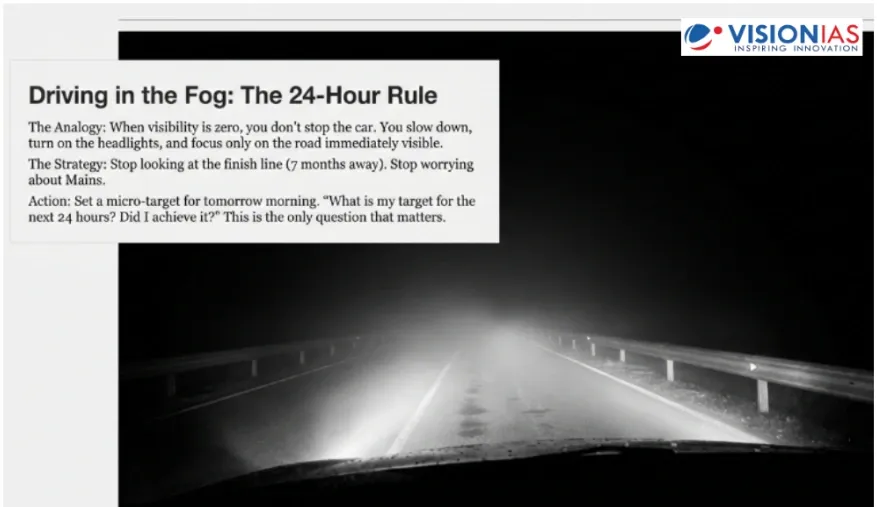
Prelims preparation often feels like driving in dense fog. You cannot clearly see the destination. You cannot accurately judge how far you have come. When aspirants constantly think about selection, cutoffs, or future stages, the mind becomes overloaded with anxiety rather than clarity.
In psychology, this is a classic case of cognitive overload. When the brain is forced to process too many future uncertainties, decision quality in the present starts deteriorating.
The only sustainable strategy in such conditions is to narrow your focus to the next actionable step. Just as a driver in fog focuses only on the visible stretch of road, a serious aspirant must focus on daily execution rather than distant outcomes.
Long-term success in Prelims is not built by dramatic motivation. It is built by quiet, boring, repetitive discipline.
The Resource Accumulation Trap: Why More Books Reduce Retention

One of the most common strategic mistakes in UPSC preparation is the belief that adding more sources automatically strengthens preparation. Every new book creates short-term emotional comfort and the illusion of progress.
In reality, Prelims performance depends far more on how many times you revise a limited set of core sources than on how many sources you have touched once.
From a memory-science perspective, every additional source reduces repetition. And repetition is the only thing that converts information into long-term recall. Over time, this leads to scattered memory, low confidence, and hesitation inside the exam hall.
UPSC does not reward how much you have seen. It rewards what you can reliably recall under pressure.
The Re-reading Illusion: Why Familiarity Is Not the Same as Memory
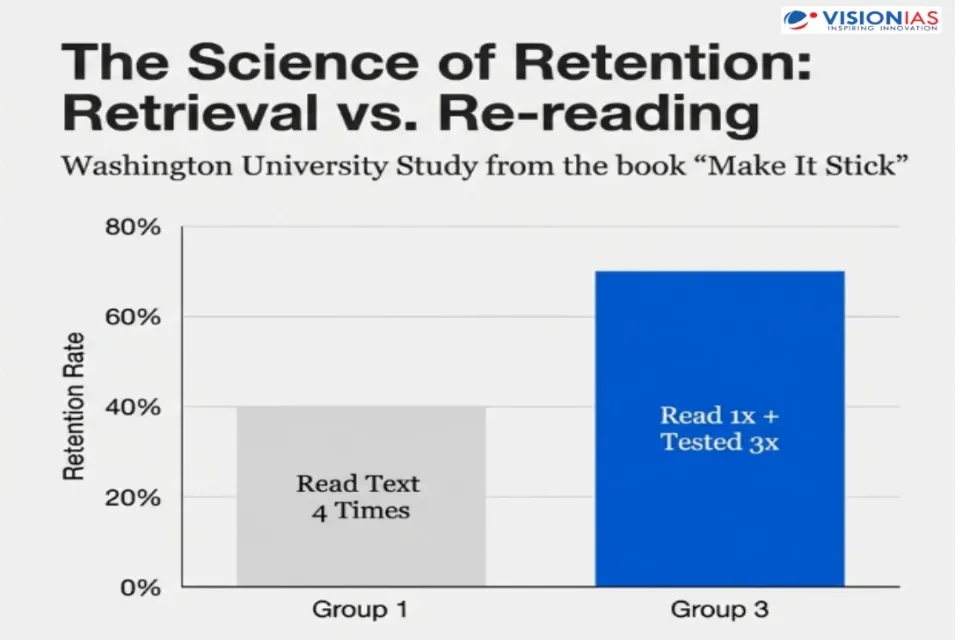
There is a fundamental difference between recognition and recall.
Re-reading creates recognition. When you see the page, it looks familiar, and the brain feels reassured. But in the exam hall, the book is not present. The brain must retrieve information independently.
Cognitive psychology clearly shows that retrieval practice (testing yourself after studying) creates far stronger and more durable memory than passive re-reading. This is why many aspirants feel they have “covered everything” but still blank out in the paper.
The brain remembers what it is trained to pull out, not what it is trained to see again. Real revision is uncomfortable because it exposes gaps. But this discomfort is exactly what makes memory exam-proof.
The Forgetting Curve Problem: Why Spaced Revision Is Non-Negotiable
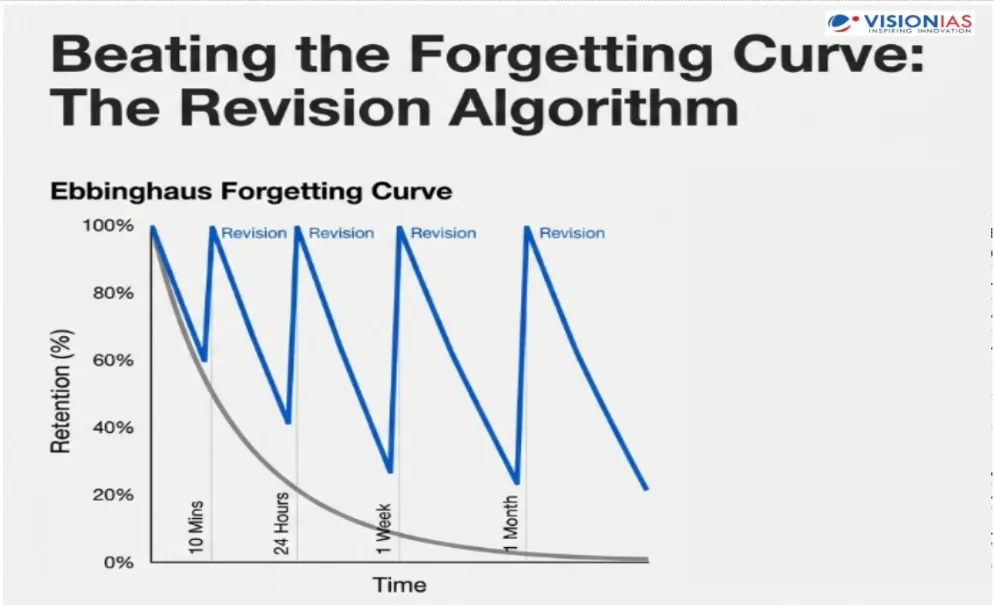
Hermann Ebbinghaus demonstrated through the Forgetting Curve that without revision, most learned information fades rapidly from memory.
However, memory behaves very differently when revision is spaced over time—for example, once after one day, once after one week, and once after one month. Each repetition strengthens the same neural pathway, making recall faster and more reliable.
Most Prelims failures do not happen because aspirants never studied something. They happen because what was studied did not survive in memory till the exam. The real goal is not syllabus completion. The real goal is memory survival.
The Mock Test Misuse Problem: Why Tests Are Training Tools, Not Judgments
A mock test is not a verdict. It is a diagnostic instrument. Its purpose is not to predict your rank. Its purpose is to show:
- Where conceptual clarity is weak
- Where memory is unreliable
- Where attention slips
- Where decision-making collapses under pressure
Mock scores fluctuate because test difficulty fluctuates. This creates noise. The real signal lies in error patterns over time. In exams, improvement is rarely linear. What matters is that the nature and frequency of mistakes gradually reduces.
This is also why serious aspirants should periodically test themselves in a real exam-like environment through full-length All India Tests.
Register: VisionIAS All India GS Prelims Test Series with Sandhan
The Analysis Gap: Why Post-Test Work Decides Real Progress
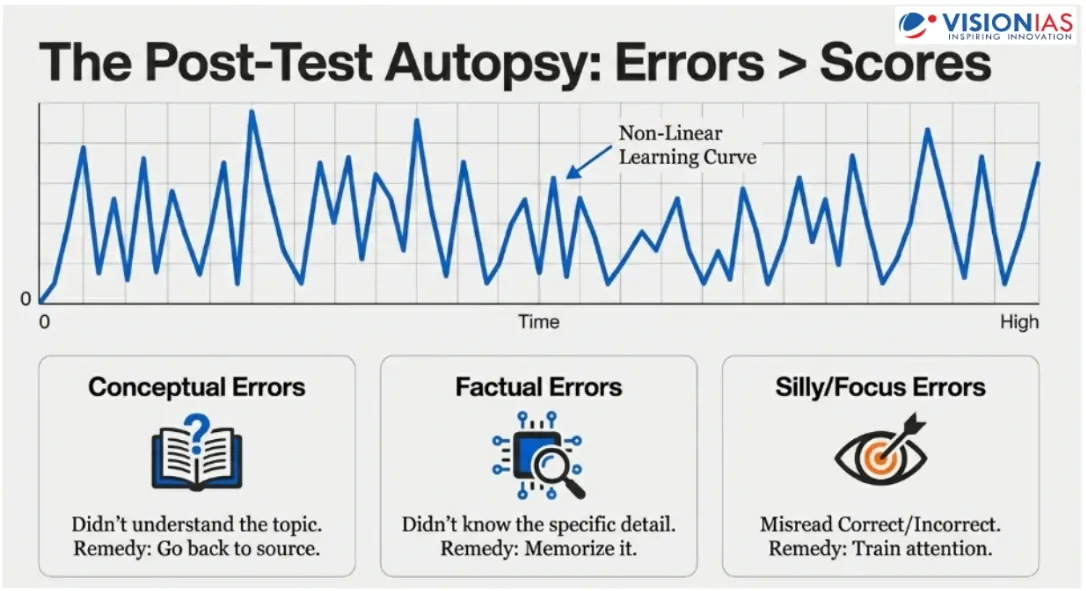
The real value of a test begins after the test. Mistakes typically fall into three categories:
- Conceptual errors (you never truly understood the topic)
- Factual errors (you never memorized the detail)
- Attention errors (you misread, rushed, or panicked)
Each type requires a different corrective strategy. Simply writing more tests without fixing the root cause only repeats the same mistakes in a more sophisticated way. Prelims is ultimately won by systematically shrinking your error space.
The Role Confusion: PYQs and Mocks Serve Different Purposes
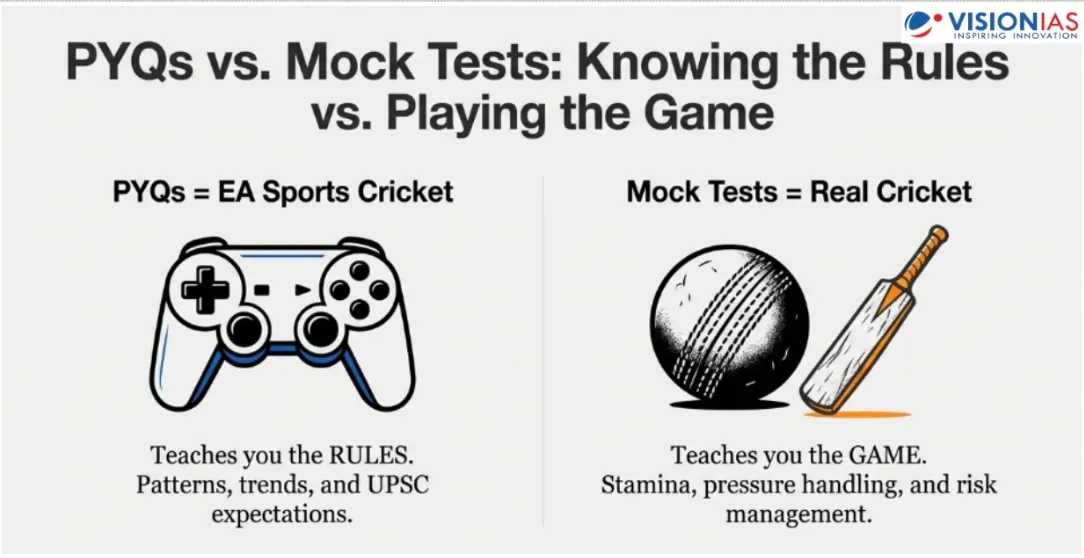
Previous Year Questions reveal the character, preferences, and framing logic of UPSC. They show what kind of ambiguity is acceptable, what kind of traps are common, and what kind of thinking is rewarded.
Mock tests, on the other hand, build execution capacity—stamina, timing, emotional control, and risk management. One builds understanding. The other builds performance. Both are indispensable.
The Environment Shock: Why Real Exam Conditions Change Performance
The exam is not just an intellectual exercise. It is a situational and psychological event.
Sitting in a hall with thousands of candidates, managing noise, suppressing nervousness, and maintaining focus for two hours changes how even familiar questions feel. This is why exposure to real exam-like conditions is critical. It trains not just knowledge, but nervous system stability.
Even a single serious attempt in a full-length open mock changes how the real exam feels.
Attempt: VisionIAS All India Prelims (GS & CSAT) Open Mock Test
The Foundation Problem: Why Prelims Is Won from the Core, Not the Edges
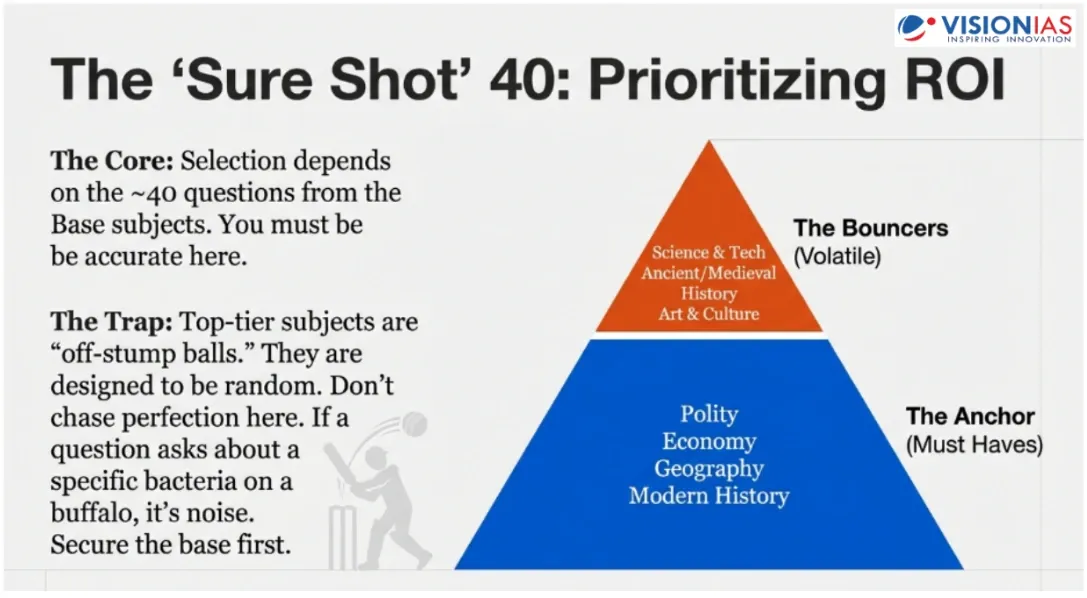
Most successful attempts are built on strong performance in Polity, Economy, Geography, Modern History, and basic Environment.
Sections like Art & Culture, Ancient History, or Science & Tech are volatile and unpredictable. They contribute bonuses, not foundations.
Prelims is not about knowing everything. It is about not being weak where it is safe to be strong.
The Aggression Error: Why Prelims Is About Selective, Not Total, Attack
Two extreme strategies consistently fail:
- Attempting everything out of panic or excitement
- Attempting too little out of fear
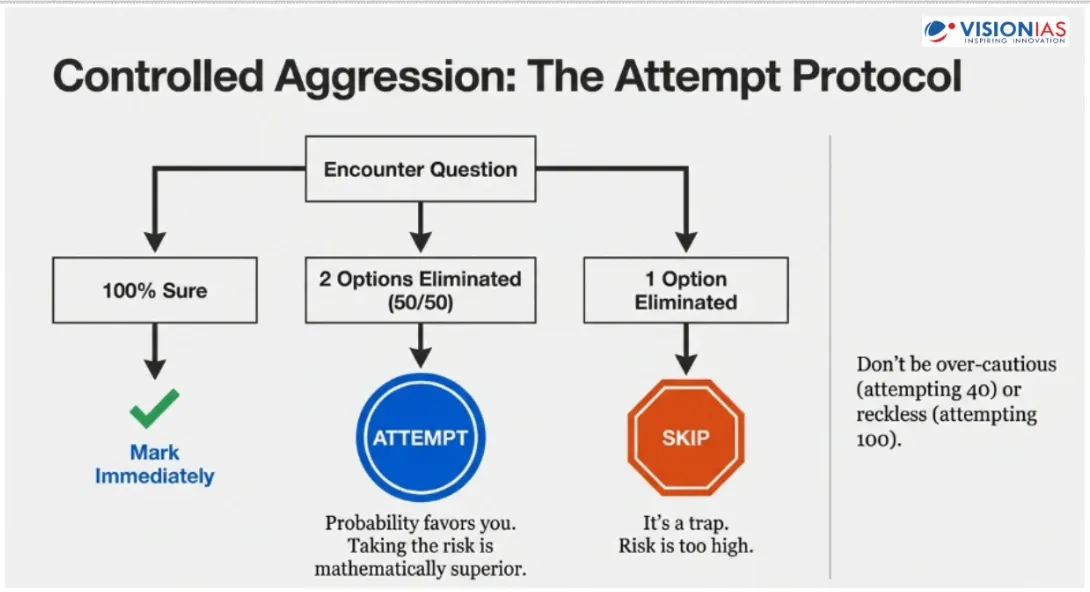
Selection usually happens in a controlled middle zone, driven by intelligent skipping and calibrated risk-taking. The goal is not to maximize attempts. The goal is to maximize net score. A sound principle governs intelligent attempts:
- If you are sure → attempt
- If you can eliminate two options → attempt depending on situation
- If you cannot eliminate even two → skip
Some risk is necessary. But unplanned bravery is the fastest way to lose marks. Many attempts are destroyed not by ignorance, but by one bad phase of emotional decision making, a few reckless guesses, a sudden strategy shift, or a desperate attempt to “recover” marks.
The exam tests emotional control as much as knowledge. Often, the simple, conservative choice wins. Flashy decisions under pressure usually cause damage.
The Time-Deficit Reality for Working Professionals or Late Starters
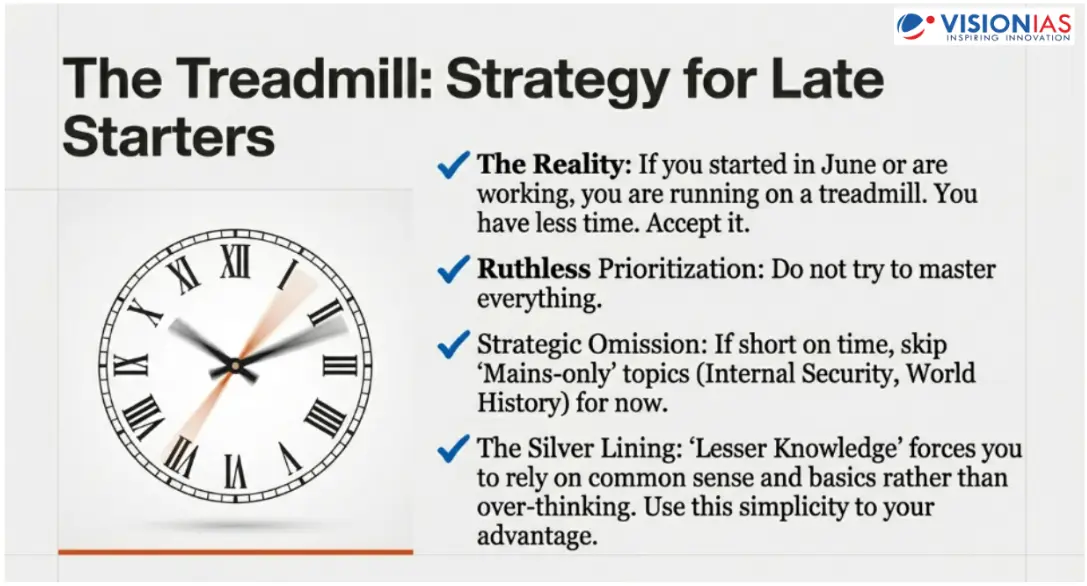
Some aspirants start late or prepare alongside work. They often feel they are running but not moving forward.
In such situations, ruthless prioritization is more important than ambition. Strategic omission is not a weakness. It is realism. It is better to be very strong in fewer areas than average in everything.
The Biology Factor: Why Sleep, Routine, and Timing Decide Scores
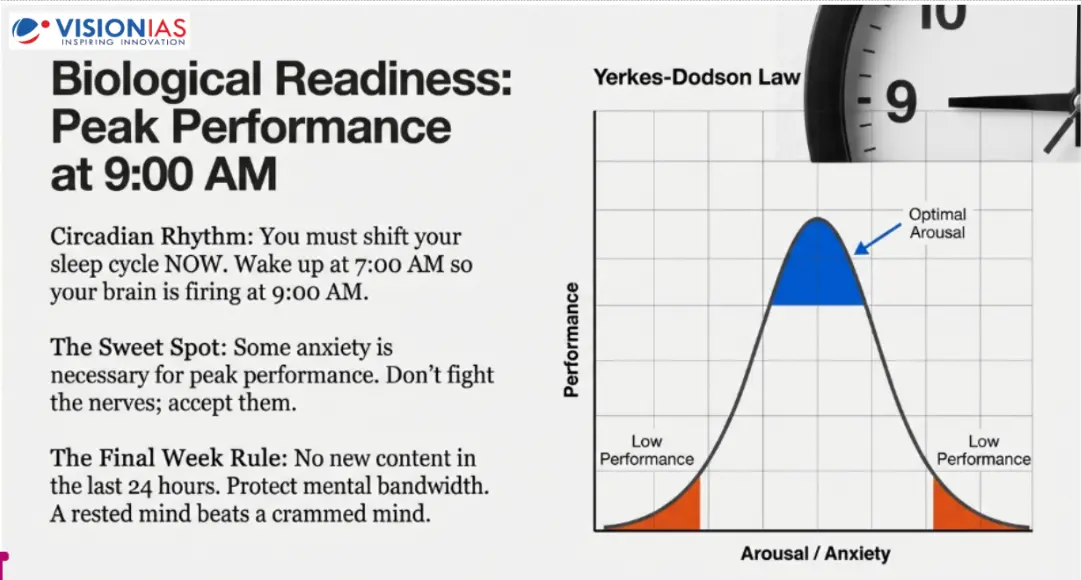
Performance is not only psychological. It is also biological. The brain performs best at moderate levels of arousal, described by the Yerkes–Dodson Law. Too much stress or too little alertness both reduce performance.
Sleep, routine, and aligning your biological clock with exam timing directly influence decision quality. A tired brain makes bad choices—even when it knows the answer.
In the final days, the objective is not to learn new things. It is to protect what you already know. A calm, rested, stable mind always outperforms a frantic, overloaded one.
The Real UPSC Prelims Manifesto
Over time, successful preparation converges to a few quiet truths:
Revision matters more than new resources. Retrieval matters more than reading. Discipline matters more than motivation. Calmness matters more than brilliance.
Prelims is not a test of how smart you are. It is a test of how well you think when you are not sure.
Those who clear Prelims are not the ones who know everything. They are the ones who make fewer mistakes, panic less, choose better and stay within their limits. That is the real Science of Certainty.