UPSC News
UPSC Cadre Allocation Policy 2026 for IAS, IPS & IFoS: Rules, Procedure & Download PDF

















Cadre allocation is the final and most consequential step after selection into the All India Services—the Indian Administrative Service (IAS), Indian Police Service (IPS), and Indian Forest Service (IFoS). It determines where an officer will serve and is therefore not merely an administrative formality, but a carefully structured national-level exercise designed to balance federal requirements, administrative efficiency, and social justice principles.
Cadre allocation is not decided by luck or preferences alone. It follows a rule-based mechanism that takes into account:
- Cadre-wise and category-wise vacancies
- Merit rank and category of the candidate
- Insider–outsider principle
- Reservation roster requirements
- Cycle-based distribution across groups of states
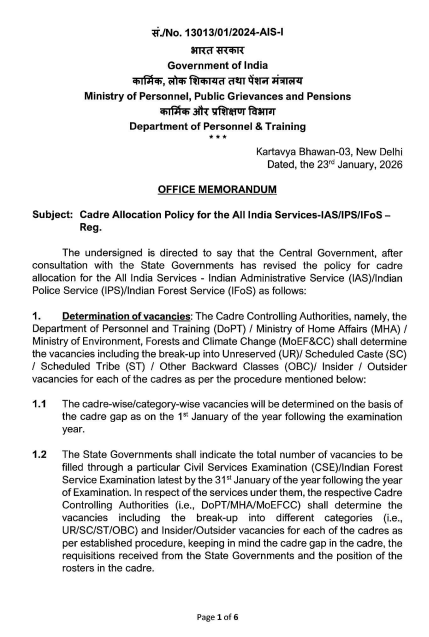
For CSE/IFoS 2026, the Government has issued a revised Cadre Allocation Policy through an Office Memorandum of the Department of Personnel & Training (DoPT), , which supersedes the earlier policy and will govern all future allocations. The official memorandum is also available in the attached PDF.
UPSC Cadre Allocation Policy 2026 Download PDF (Official)
What the 2026 Cadre Allocation Policy Covers
The new policy lays down the complete framework for:
- How cadre-wise vacancies are calculated
- How states and joint cadres are grouped
- How insider (home cadre) allocation is done
- How unfilled insider vacancies are handled
- How outsider allocation is carried out, including special provisions for PwBD candidates
- How group order is rotated in subsequent years
The objective is to ensure predictability, fairness, administrative balance, and compliance with reservation policy, while also preserving the national character of the All India Services.
Determination of Vacancies (Cadre-wise and Category-wise)
The starting point of the cadre allocation process is the determination of vacancies. Before any preference or allocation exercise begins, the Government prepares a detailed cadre-wise and category-wise vacancy position.
A few important points to note:
- State Governments are required to communicate their vacancy requirements within the prescribed timeline. Any requisitions received after this deadline are not taken into account while determining the vacancy position for that year.
- EWS is treated within the UR category for recruitment purposes and is adjusted against UR points in the roster. In other words, EWS does not create a separate or additional vacancy pool in the cadre roster.
- The policy reiterates that cadre rosters and the insider–outsider principle continue to follow established procedures while determining category-wise distribution of vacancies.
For aspirants, the key takeaway is that even before preferences are filled, a “vacancy map” is prepared cadre-wise and category-wise, and this vacancy structure ultimately drives the entire allocation process.
Grouping of States/Cadres (The 4-Group Framework)
The 2026 Cadre Allocation Policy organizes all State Cadres and Joint Cadres into four groups and uses these groups for the purpose of cycle-based allocation.
This grouping is a structural feature of the allocation system. It determines the sequence in which cadres are considered during outsider allocation, ensuring a balanced and rotational distribution across different regions over successive cycles.
The grouping is as follows:
This grouping becomes important because the outsider allocation proceeds in cycles that move from one group to another in a defined sequence.
Allocation Against Insider Vacancies (Home State/Cadre)
What counts as “Insider”?
“Insider” allocation refers to allotment to the candidate’s home state/cadre, subject to:
- The candidate indicating willingness for home cadre, and
- Availability of an insider vacancy in that cadre and category, and
- The candidate’s rank/merit position within their category list.
How insider allotment proceeds
Separate merit lists are prepared category-wise (UR/OBC/SC/ST), and insiders are allotted strictly by rank against insider vacancies, provided the candidate is eligible and has opted accordingly.
The “cycle logic” within insider allotment
Since the number of cadres/joint cadres is 25, the policy uses cycles like 1–25, 26–50, 51–75, and so on.
Candidates who can get home cadre are placed into the allocation chart cycle-wise based on their serial number and merit position.
This “cycle” framework is not a separate preference rule; it is an operational method to distribute insider allotments in a structured way across the cadre list.
What Happens If an Insider Category Vacancy Cannot Be Filled?
In some cadres, it may happen that an insider vacancy exists for a particular category, but no eligible insider candidate is available in that category.
To handle this, the policy provides a structured exchange and adjustment mechanism:
- If a particular category insider vacancy cannot be filled, it may be adjusted using an insider candidate of another category, provided a corresponding outsider vacancy exists to balance the exchange in that cadre.
- PwBD candidates within the relevant category are given priority in such adjustment situations.
- If even after the exchange process the insider vacancy cannot be filled, it is converted into an outsider vacancy and filled accordingly. Such vacancies are not carried forward to the next year.
This mechanism ensures that cadres do not remain understaffed while still respecting the overall roster logic.
Allocation Against Outsider Vacancies
After all possible insider allotments are completed, the remaining vacancies are filled through outsider allocation.
Priority for PwBD Candidates
PwBD candidates who do not get their home cadre are considered first in the outsider allocation process.
At the time of indicating home state, a PwBD candidate may also indicate one additional cadre preference (other than the home cadre). If a vacancy is available in that preferred cadre in the relevant category, the candidate may be allotted there. If not, the system allows accommodation through a special operational adjustment.
Outsider Allocation for Non-PwBD Candidates
For other candidates, outsider allocation proceeds through a cycle-based, group-wise process:
- In the first cycle, starting with one group, cadres that did not receive insiders are allotted one outsider each in merit order, subject to vacancy availability.
- The process continues in successive cycles, moving group to group in a defined sequence.
If a candidate, during outsider allocation, gets allotted to their home cadre, an exchange is made with the next eligible candidate to preserve the insider–outsider balance.
Rotation of Group Order in Succeeding Years
To ensure long-term fairness, the policy provides that the group order changes every year.
The group which is placed first in one year goes to the bottom in the next year, and the remaining groups move up in sequence. This ensures that no single region consistently gets first priority in allocation cycles.
When Will UPSC Cadre Allocation Take Place?
Cadre allocation for IAS is to be completed as early as possible, preferably before the commencement of the professional course. Allocation for IPS and IFoS is done soon after appointments are made.
Applicability of the New Cadre Allocation Policy
This Cadre Allocation Policy supersedes all earlier policies and is applicable from:
- Civil Services Examination 2026, and
- Indian Forest Service Examination 2026
All candidates selected through these examinations and thereafter will be governed by this framework.
FAQs on UPSC Cadre Allocation Policy 2026
1. What is the UPSC cadre allocation policy?
It is the rule-based system used to allot selected IAS, IPS and IFoS officers to state cadres based on rank, category, vacancies, and insider–outsider principles.
2. Can I get my home state cadre in UPSC?
Yes, you can get your home cadre if you opt for it and an insider vacancy is available in your category at your rank.
3. What does “insider” and “outsider” mean in cadre allocation?
“Insider” means your home state cadre, while “outsider” means any cadre other than your home state.
4. Does rank matter in cadre allocation?
Yes, cadre allocation is strictly based on merit rank within your category and availability of vacancies.
5. From which year is the new cadre policy applicable?
The new Cadre Allocation Policy is applicable from CSE 2026 and IFoS 2026 onwards.