National Mission On Edible Oils – Oil Palm (NMEO-OP) - Ministry of Agriculture & Farmers Welfare | Current Affairs | Vision IAS

Upgrade to Premium Today

Start Now
MENU
Home
Quick Links

High-quality MCQs and Mains Answer Writing to sharpen skills and reinforce learning every day.

Watch explainer and thematic concept-building videos under initiatives like Deep Dive, Master Classes, etc., on important UPSC topics.

A short, intensive, and exam-focused programme, insights from the Economic Survey, Union Budget, and UPSC current affairs.

ESC

National Mission On Edible Oils – Oil Palm (NMEO-OP)

Updated: 16 Oct 2025
Ministry: Ministry of Agriculture & Farmers Welfare
Beneficiary: Farmers

Overview

The NMEO-OP is a Centrally Sponsored Scheme aiming to boost domestic edible oil production through oil palm cultivation, reducing import dependence, with focus on the Northeast and Andaman & Nicobar Islands until 2025–26.

Quick facts

  • Type: Centrally Sponsored Scheme
  • Purpose: To reduce dependence on edible oil imports
  • Special focus regions: North east and Andaman and Nicobar Islands
  • Tenure: Upto 2025-26


Objectives

  • To enhance the edible oilseeds production by harnessing Oil Palm area expansion. 

Salient features
  • Background: The mission was launched in 2021, subsuming oil palm development programme of National Food Security Mission (NFSM- Oil palm programme).
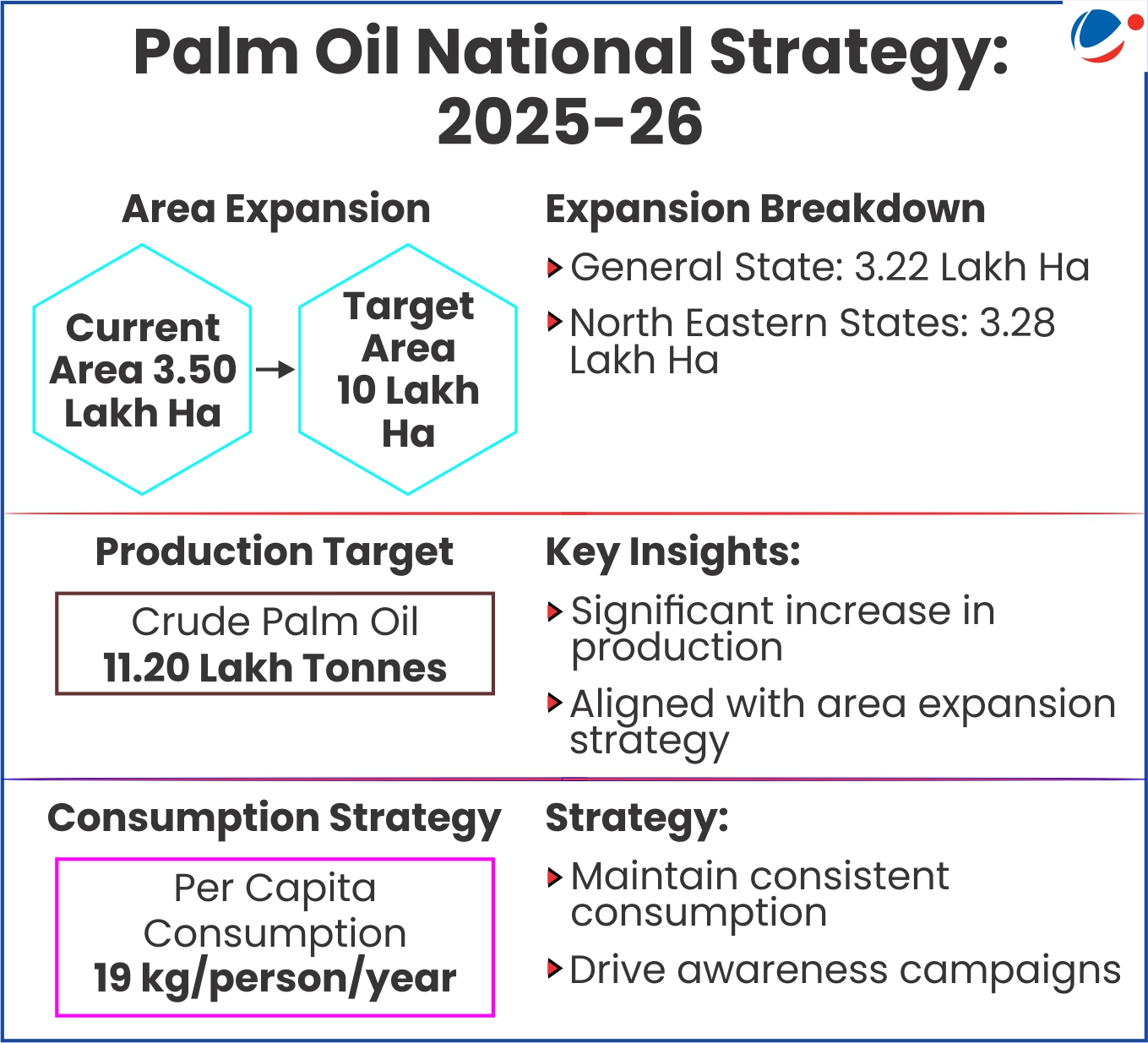
Infographic presenting Palm Oil National Strategy 2025-26 with area expansion from 3.50 to 10 lakh hectares (3.22 lakh in general states, 3.28 lakh in NE states), crude palm oil production target of 11.20 lakh tonnes, and per capita consumption strategy of 19 kg/person/year with consistent consumption maintenance and awareness campaigns.
  • Two major focus areas: 
    • Price Assurance: Fresh Fruit Bunches (FFB) prices, currently linked to international CPO price fluctuations, will now be supported by the Government's Viability Price (VP). VP shields farmers from international price volatility. 
    • Increased Assistance: Support for planting material, intercropping inputs (up to 4 years), maintenance, seed gardens, nurseries, and water infrastructure (bore wells, pump sets, etc.).
  • Efficient water management: Emphasis has been given to promote micro irrigation and water conservation in oil palm. 
  • Current Status of scheme: Scheme is presently operational in 15 states nationwide, covering a potential area of 21.75 lakh hectares.

About Oil Palm

  • Oil Palm, originated from West Africa is comparatively a new crop in India and has highest vegetable oil yielding capability per ha.
  • It produces two distinct oils, i.e., palm oil and palm kernel oil, which are used for culinary as well as industrial purposes. India imports 57% of the total edible oil.
  • Domestic supply is ~12.4 million tonnes (MT) whereas import is ~16.5 MT.