Soil Health Card Scheme - Ministry of Agriculture & Farmers Welfare | Current Affairs | Vision IAS

Upgrade to Premium Today

Start Now
MENU
Home
Quick Links

High-quality MCQs and Mains Answer Writing to sharpen skills and reinforce learning every day.

Watch explainer and thematic concept-building videos under initiatives like Deep Dive, Master Classes, etc., on important UPSC topics.

A short, intensive, and exam-focused programme, insights from the Economic Survey, Union Budget, and UPSC current affairs.

ESC

Soil Health Card Scheme

Updated: 16 Oct 2025
Ministry: Ministry of Agriculture & Farmers Welfare
Beneficiary: Farmers

Overview

The Soil Health Card Scheme, part of the RKVY Cafeteria Scheme, provides farmers with soil health reports every three years to promote nutrient-based farming and improve soil fertility management nationwide.

Quick facts 

  • Purpose: To facilitate farmers for better understanding of soil and Integrated Nutrient Management (INM)
  • Subcomponent of: RKVY cafeteria scheme (Soil Health & Fertility componenet) 
  • Soil Health card (SHC): A printed report card issued to farmers in once in three years indicating the status of his soil in terms of 12 parameters
  • SHC Portal: Facilitates facilitate generation of SHCs in a uniform and standardized format.

Objectives

  • To assist State Governments to issue soil health cardsto all farmers in the countryso as to provide a basis to address nutrient.
  • To develop and promote soil test based nutrient management in the districts for enhancing nutrient use efficiency.
  • To strengthen functioning of Soil Testing Laboratories (STLs) through capacity building, involvement of agriculture students and effective linkage with Indian Council of Agricultural Research (ICAR).

Salient Features
  • Background: SHC scheme was launched in 2014-15 as a component of: National Mission for Sustainable Agriculture (NMSA). However, from 2022-23 the scheme is merged in Rashtriya Krishi Vikas Yojana (RKVY) cafeteria scheme.
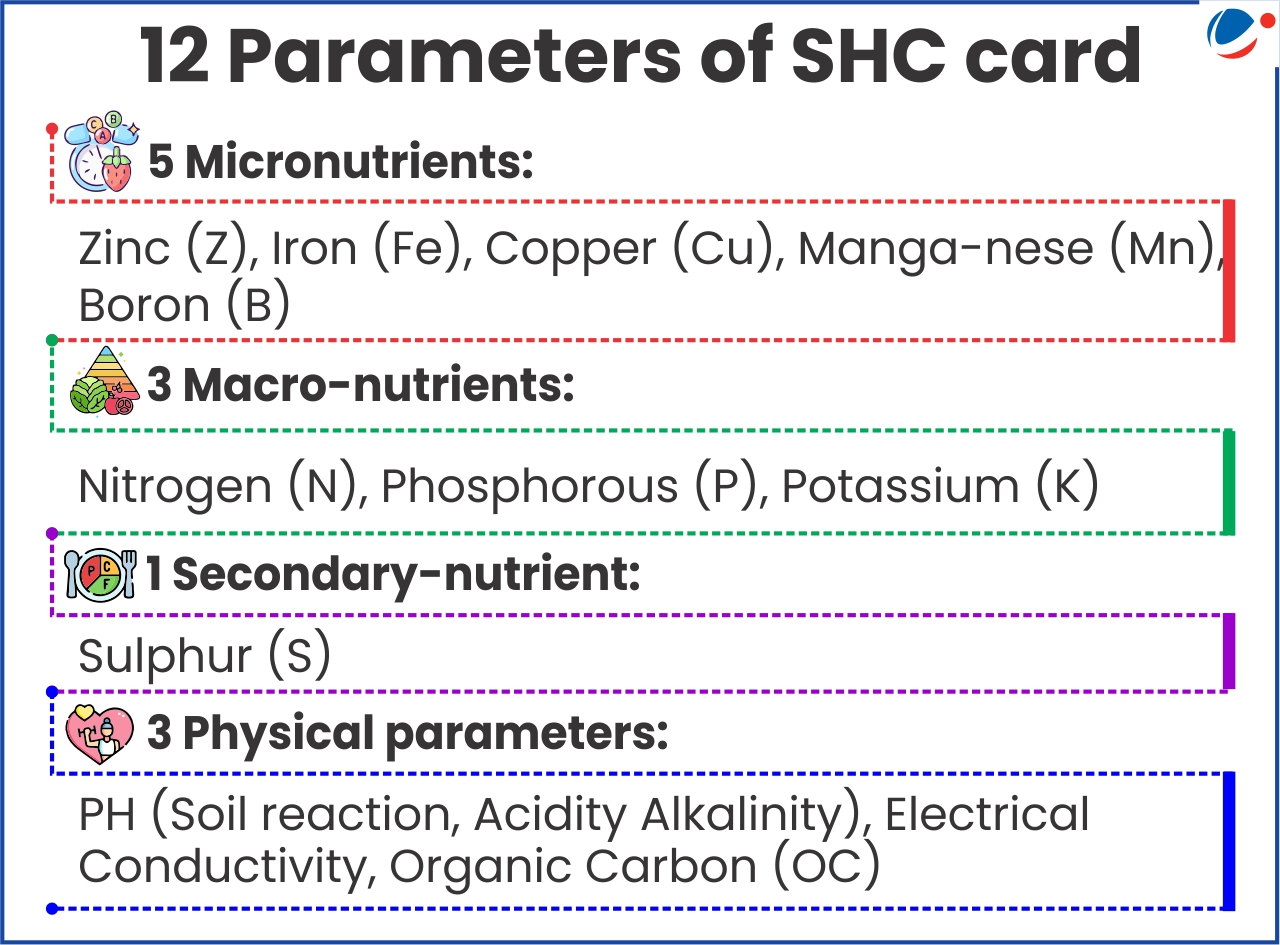
Infographic listing the 12 parameters tested in Soil Health Card: 5 micronutrients (Zinc, Iron, Copper, Manganese, Boron), 3 macro-nutrients (Nitrogen, Phosphorous, Potassium), 1 secondary-nutrient (Sulphur), and 3 physical parameters (pH/soil acidity-alkalinity, electrical conductivity, and organic carbon).
  • RKVY cafeteria scheme is a Centrally Sponsored scheme. 
  • It aims at making farming a remunerative economic activity through strengthening the farmer's effort, risk mitigation and promoting agri-business entrepreneurship.
  • Integrated development of major food and fodder crops, Agriculture mechanization, enhancement of soil health, Integrated Pest Management schemes, Promoting Extension Services, etc. are
  • Soil Health card (SHC): It indicates the status of soil in terms of 12 parameters (refer to the infographics).
    • It is also accompanied by an advice on the various fertilizers and other soil amendments he is supposed to make.
    • It can be printed in various major languages and Dialects.
  • Soil Testing: Soil samples are tested as per the approved standards for all the 12 parameters at:
    • STL owned by the Department of Agriculture and by their own staff or by an outsourced agency.
    • ICAR Institutions including KVKs and SAUs.
    • laboratories of the Science Colleges/Universities by the students under supervision of a Professor/ Scientist.
  • Ensuring quality of soil test: State Government is mandated to refer 1% of all the samples in a year to a 'Referral Laboratory' to analyse and certify on the results of Primary Laboratory.
    • The State Government is also required to support the establishment of Referral Laboratories.
  • Village Level Soil testing Labs or Mini labs: Mini labs at village level is required to promote location and crop specific sustainable soil health management. 
    • They can be set up by individual entrepreneurs i.e., rural youth and community-based entrepreneurs i.e., SHGs, Farmers Producers Organisation (FPO), Schools, Agriculture Universities etc. 
    • District level empowered committee (DLEC) is responsible to select beneficiaries/entrepreneurs to run Mini labs with the support from government
  • Payment Per Sample: Centre a provides a sum of Rs. 190 per soil sample to State Governments to cover the cost of collection of soil sample, its test, generation and distribution of SHC to the farmer.
    • There is no burden on farmer to generate Soil health card.
  • Technological interventions 
    • SHC Portal:  It has been revamped and integrated with a Geographic Information System (GIS) system so that all the test results are captured and seen on a map.
    • Mobile Application:  To ensure authenticity of sample collection and correctness of the information, Sample tracking and alerts to farmers through SMS.