Current Affairs
India’s Extreme Heatwave 2026: Causes, Impacts and Climate Adaptation Strategies


















India is facing severe heatwave conditions, with 98 of the world’s 100 hottest cities in the country, raising concerns over rising temperatures.
India is in the grip of an early onset of summer and extreme heat events in 2026, with 98 of the world’s 100 hottest cities currently located within its borders. Temperatures have surged past 45°C across northern, central, and eastern India, with cities like Orai and Auraiya in Uttar Pradesh, and Jaisalmer and Phalodi in Rajasthan recording extreme highs.
The India Meteorological Department (IMD) has issued advisories urging precautions against heat-related illnesses, warning that heatwave conditions will persist across multiple regions. Adding to this, weather experts predict that a ‘super El Niño’ could develop this year, potentially sending temperatures even higher and triggering more extreme heat events across the country.
What Is a Heatwave?
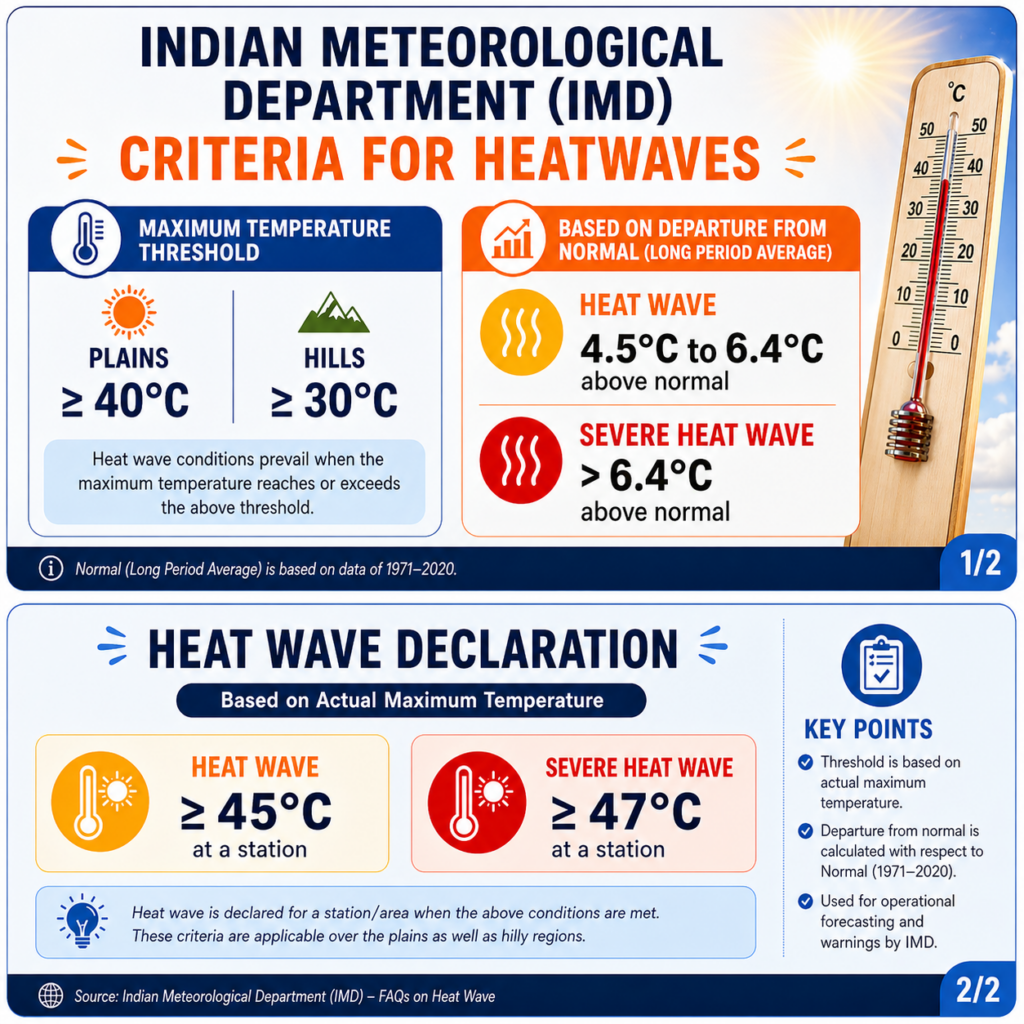
A heatwave is a period of unusually high temperatures compared to what is normally expected over a region. India’s geography spanning coastal plains, river basins, deserts, and hill stations means the threshold for declaring a heatwave varies significantly across the country.
What Is Driving Extreme Heat Events in India?
India’s vulnerability to extreme heat events is shaped by several interconnected factors. Meteorological conditions such as absence of cloud cover, low wind speeds, and high-pressure systems trap heat near the surface. A key driver of the current episode is a ‘heat dome’ that has trapped hot air over the Indo-Gangetic plains and eastern India. Western disturbances that bring snow to hills and rain to plains have also become weakened and infrequent this year.
The urban heat island effect has made Indian cities significantly warmer than surrounding areas, driven by rapid construction, reduced tree cover, and heat from vehicles and industry. Cities like Delhi, Nagpur, and Ahmedabad now regularly record temperatures several degrees above their rural surroundings.
Human-induced global warming and environmental degradation through deforestation, loss of wetlands, and deteriorating green cover have weakened India’s natural buffers against heat. The early onset of summer in 2026, with peak temperatures arriving weeks ahead of historical norms, is a direct consequence of these compounding pressures.
How Heatwaves Are Affecting India
On Public Health
The human cost of heatwaves in India is well documented. Heat cramps, characterised by oedema (swelling) and syncope (fainting), are among the early symptoms. In severe cases, heat stroke involves body temperatures of 104°F or more, accompanied by delirium, seizures, or coma. According to IMD data, between 2000 and 2020, over 10,000 people lost their lives to heatwaves in India.
India’s most vulnerable populations including the elderly, outdoor labourers, children, and the urban poor face the greatest risk.
On Environment
Extreme heat events in India accelerate environmental degradation in multiple ways. Heatwaves trigger droughts and wildfires across central and peninsular India, damaging forest cover and biodiversity. High temperatures cause rapid evaporation of soil moisture, affecting agricultural land and long-term soil health.
Deteriorating air quality during heatwaves compounded by dust storms from Rajasthan and wildfire smoke creates a compounding public health burden, particularly in north Indian cities.
On Economy and Society
The economic consequences for India are significant and growing. According to a study by the United Nations Economic and Social Commission for Asia and the Pacific (UNESCAP), India is projected to lose approximately 5.8% of daily working hours due to rising temperatures by 2030, a loss felt most acutely in agriculture and construction.
Reduced crop yields under extreme heat stress threaten food security for millions of farmers. The social dimension is equally serious, as heat-driven migration from rural and peri-urban areas adds pressure on already strained urban infrastructure.
India’s Institutional Response to Heatwaves
India has developed a multi-layered institutional framework to manage the heatwave risk:
- National Guidelines on Heat Wave Management by NDMA provide a structured protocol for states, district administrations, and health departments to follow during extreme heat events.
- State Heat Action Plans have been implemented across 23 heat-prone states, prepared by IMD in collaboration with NDMA. These plans cover early warning systems, inter-agency coordination, and public health advisories specific to each state’s climate profile.
- National Action Plan on Heat-Related Illnesses (2021) developed by the Ministry of Health and Family Welfare (MoH&FW) to prepare India’s healthcare system to respond to heat emergencies at scale.
- IMD Colour-Coded Warnings issued jointly with NDMA to guide public and administrative action: Green (no action), Yellow (stay updated), Orange (be prepared), and Red (take immediate action).
- Rescheduling of Working Hours through central advisories directing states to adjust outdoor work timings during peak heat hours, particularly for construction workers and agricultural labourers.
Gaps in the Current Heat Response Measures
Despite the existing framework, India’s response to extreme heat faces several challenges.
- Many State Heat Action Plans remain underfunded, which affects implementation on the ground.
- In several cases, plans are prepared at the state level without sufficiently reflecting district- or community-specific vulnerabilities.
- The identification of at-risk groups, including migrant workers, informal settlements and elderly populations, also remains uneven.
- Limited monitoring and periodic review of outcomes can make it difficult to assess effectiveness and improve responses over time.
Building India’s Resilience
Strengthening India’s resilience to heatwaves requires a shift from reactive management to long-term climate adaptation across sectors. India needs to expand public cooling infrastructure, including cooling centres for vulnerable populations, especially in dense urban and labour settlements. Heat-resilient urban planning through cool roofs, passive ventilation, tree cover and green buffers is essential to reduce the urban heat island effect.
Ecological restoration, including reforestation, wetland conservation and urban greening, must be integrated into adaptation strategies to rebuild natural temperature buffers. State Heat Action Plans need stronger budgets, localised vulnerability mapping and clear accountability for effective implementation. Further, indigenous and traditional knowledge, from climate-responsive architecture to community practices, should be incorporated to make adaptation strategies more grounded and cost-effective.
Conclusion
India’s 2026 heatwave, marked by the early onset of summer and record-breaking temperatures across the country, is a defining test of the nation’s climate resilience. The convergence of the urban heat island effect, environmental degradation, and accelerating global warming has made extreme heat events a near-permanent feature of
Master Digital Age Governance & Technology Trends with VisionIAS Comprehensive Current Affairs →
Heatwaves FAQs
1. What climate event could push India’s temperatures even higher in 2026?
Ans. Super El Niño.
2. What meteorological phenomenon is trapping hot air over the Indo-Gangetic plains in 2026?
Ans. A heat dome
3. How many Indian states have Heat Action Plans?
Ans. 23 states.
4. What causes the urban heat island effect in Indian cities?
Ans. Rapid construction, reduced tree cover, and heat from vehicles and industry.
5. Which organisation collaborated with IMD to prepare India’s State Heat Action Plans?
Ans. NDMA.