Current Affairs
NEET -UG 2026 Paper Leak: Failure of India’s Exam Ecosystem
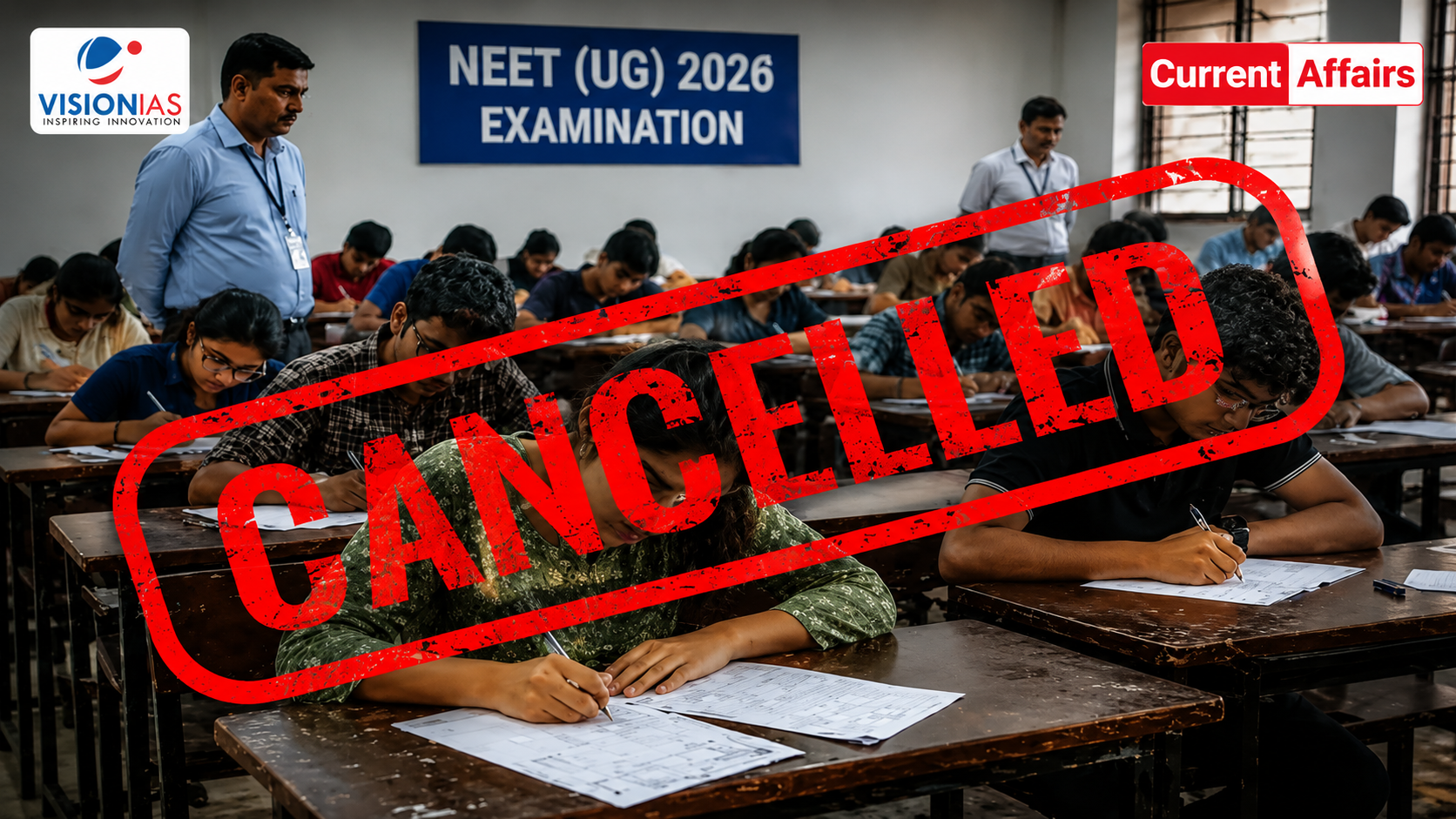
























The cancellation of the National Testing Agency (NTA) NEET UG 2026 exam after the paper leak reflects a larger concern of failure of the exam ecosystem in India.
Millions of students across India prepare for the National Eligibility cum Entrance Test (NEET – UG), the gateway to undergraduate medical admissions in the country. The 2026 edition of the exam, held on May 3, saw over 22 lakh students appear across nearly 5,500 centres in 550 cities.
Within days of the exam, evidence emerged of a pre-circulated guess paper with overlap with the actual question paper. The examination was cancelled, investigations were launched, and the credibility of the National Testing Agency (NTA) came under scrutiny. The incident has renewed the conversation on building an examination system in India that is transparent, secure, and merit-based.
The NTA was established in 2017 under the Societies Registration Act, 1860, to standardise entrance examinations in India. Its mandate is to ensure secure and fair examinations. The NEET- UG 2026 paper leak and a similar leak incident in 2024, points to gaps in how question papers are handled, transported, and secured at the centre level.
Understanding the Root Causes
The NEET-UG paper leak reflects structural vulnerabilities in India’s examination ecosystem.
Systemic and Logistical Weaknesses
• Scale of operations: Conducting a single exam for over 22 lakh students across thousands of centres in one day creates logistical complexity with multiple points of vulnerability.
• Dependence on physical paper: Printed question papers are handled by multiple intermediaries before reaching students, creating vulnerabilities for interception and leakage.
• Reliance on private operators: NTA’s dependence on private examination centre operators and third-party logistics providers has been identified as a weak link in the security chain.
• Weak cybersecurity: Gaps in digital security in the preparation and distribution of question papers expose the process to unauthorised access.
Educational Inequality and Coaching Culture
Disparities in the quality of schooling between CBSE, State Boards, and other curricula mean that students from less privileged backgrounds often enter the exam at a structural disadvantage.
This inequality has fuelled a private coaching industry that operates without oversight in many parts of the country. When students and families seek any possible edge, conditions are created in which dishonest actors can exploit that pressure. Addressing educational inequality is as important as enforcing accountability.
Reforms in the Examination Process
Medical professionals and education administrators have called for reforms to the NEET-UG examination process. Their recommendations span technology, regulation, and institutional design.
1. Shift to a Computerised, Online Examination
The reform endorsed by most experts is moving NEET-UG to an online, computerised format. Former President of the Indian Medical Association (IMA), Cochin, explains that digitising the examination keeps questions encrypted and accessible only at the moment a candidate sits for the test, making advance leakage difficult.
On 15 May 2026, the Union Education Minister announced that NEET UG will shift from the current OMR-based format to a Computer-Based Test system from next year.
2. Introduce Psychometric Normalisation
A concern with multi-session testing is fairness across sessions of varying difficulty. Experts point to psychometric normalisation as the solution. This statistical technique converts raw marks into percentile scores, measuring each student’s performance relative to others who faced the same paper.
This approach neutralises differences in difficulty across sessions, ensuring that merit is determined by a student’s relative standing and not by which version of the paper they received.
3. Minimise Human Handling of Question Papers
Experts recommend that human handling of printed question papers be minimised. One step is printing papers at exam centres at the time of the exam, rather than transporting pre-printed papers across the country.
Additional safeguards he advocates include:
- Regular audits of examination processes and centre operations.
- Accountability for officials involved in the examination chain.
- CCTV surveillance at all examination centres, with footage preserved for review.
- A culture of ethics among all personnel involved in the examination process.
4. Regulate NEET Coaching Centres
The Doctors’ Association for Social Equality has called for compulsory registration and regulation of all NEET coaching centres by Central and State governments. Many centres operate without oversight and charge fees that are beyond the reach of most families.
Proposed measures include fixing regulated fee structures to protect students and families, and establishing free coaching centres with boarding facilities for students from economically weaker sections. Reducing the access gap also reduces the pressure that leads to malpractice.
Question of State-Government Medical Seats
One structural reform gaining attention is the proposal to exempt State government controlled undergraduate, postgraduate, and super-specialty medical seats from the NEET process. The argument is that reducing the number of students appearing in a single exam lowers the scale of risk and allows States to develop admission processes suited to their educational contexts.
Education is a subject on the Concurrent List of the Indian Constitution, giving both the Centre and States jurisdiction. A framework that preserves national standards while allowing States to manage government-quota seats could reduce systemic pressure without compromising merit.
Legal Framework: What Exists and What Is Needed
India has the Public Examination (Prevention of Unfair Means) Act, 2024, enacted to address leaks and organised malpractice in recruitment and entrance examinations. Under the accompanying rules:
- Venue-in-charges are mandated to file FIRs in cases of examination malpractice.
- Committees are required to probe the role of management and service providers, not just individual candidates.
- Penalties for organised malpractice are more stringent than those for individual cheating.
Experts note that legislation is only as effective as its implementation. The Act must be backed by institutional accountability and independent oversight across the examination process, from question paper setting to result declaration.
Radhakrishnan Committee: Recommendations Awaiting Implementation
Following the 2024 controversy, the government constituted a committee headed by former ISRO Chairperson K. Radhakrishnan to suggest improvements to NTA’s operations. The committee recommended a digital-first approach to examination delivery and strengthened accountability mechanisms.
Experts note that these recommendations remain partially implemented. NTA has continued to rely on private operators linked to previous leaks. Implementation of the Radhakrishnan Committee’s recommendations is seen as an immediate priority before broader structural reform can take effect.
Conclusion
Every student who appeared for the exam on May 3 deserved a process that was transparent, secure, and merit-based. The NEET-UG 2026 paper leak is a failure of that commitment, and addressing it is a priority for the examination system.
The way forward includes moving to an online examination format, regulating the coaching sector, implementing pending reform recommendations, and building accountability across the examination process. These steps are necessary to restore trust in the system.
Master Digital Age Governance & Technology Trends with VisionIAS Comprehensive Current Affairs →
NEET-UG 2026 paper leak FAQs
1. Why was NEET-UG 2026 cancelled?
Ans. The exam was cancelled after evidence emerged of a pre-circulated guess paper overlapping with the actual question paper.
2. Which government body conducts the NEET-UG exam?
Ans. The National Testing Agency (NTA), established in 2017.
3. What is the biggest recommended reform for preventing future NEET paper leaks?
Ans. Shifting to an online, computerised examination format with encrypted, session-time question access.
4. What is psychometric normalisation in the context of NEET?
Ans. A statistical technique that converts raw marks into percentile scores to ensure fairness across multi-session exams of varying difficulty.
5. Which law governs malpractice in Indian public examinations?
Ans. The Public Examination (Prevention of Unfair Means) Act, 2024.