Current Affairs
WHO Declares Ebola Outbreak in Congo and Uganda a Global Health Emergency
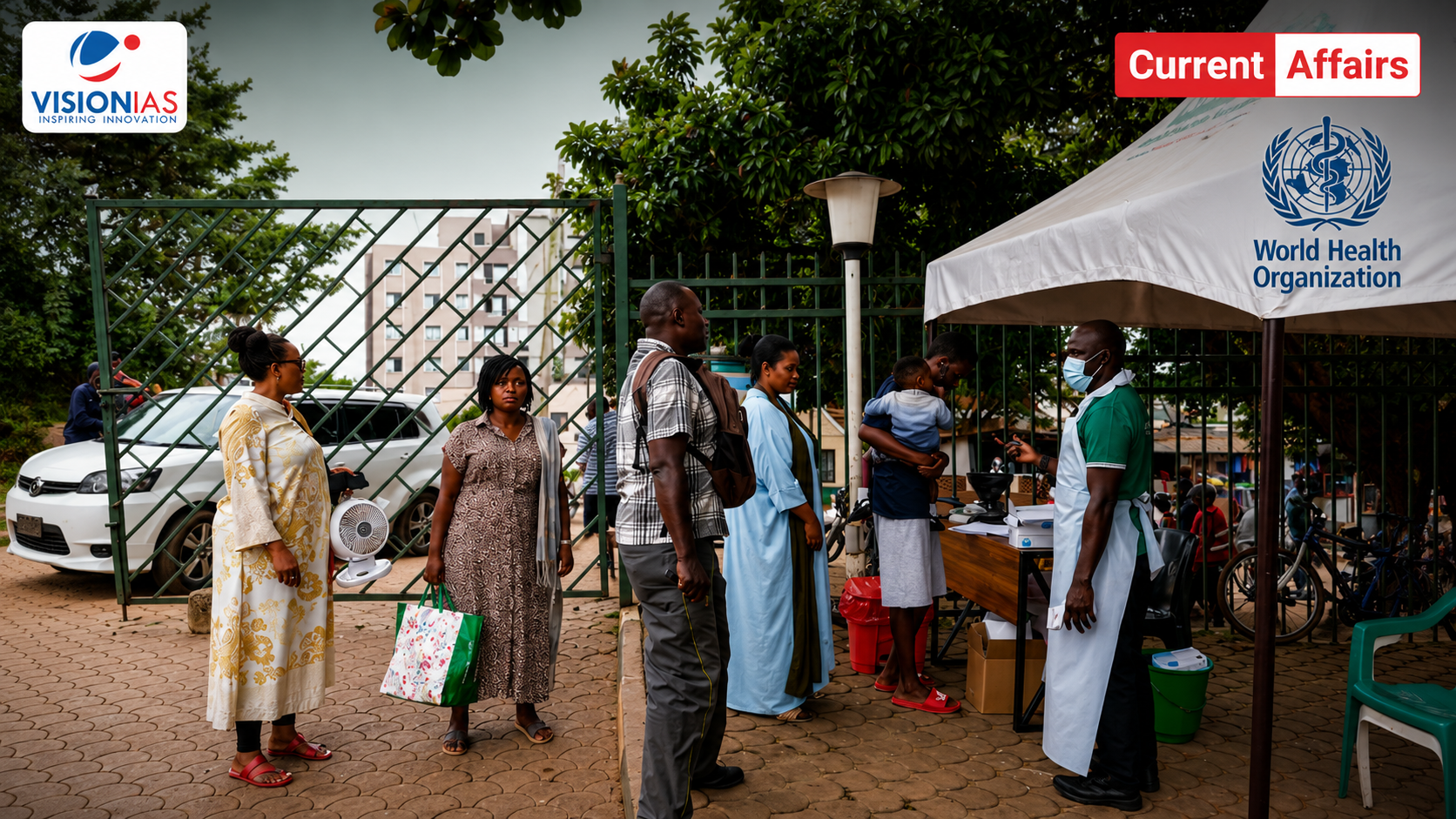

















The WHO has declared the Ebola outbreak in the Democratic Republic of the Congo and Uganda a PHEIC over concerns of cross-border spread.
On May 16, 2026, the World Health Organization (WHO) declared the Ebola outbreak in the Democratic Republic of the Congo (DRC) and Uganda a Public Health Emergency of International Concern (PHEIC), the highest level of global health alert under the International Health Regulations (IHR).
The strain driving this Ebola outbreak is the Bundibugyo virus (BDBV), a rare variant for which no approved vaccine or treatment exists. The outbreak has spread across multiple health zones in eastern DRC and has reached Uganda, raising concern about cross-border transmission and the limits of existing surveillance systems.
What is the Bundibugyo Ebolavirus?
The Bundibugyo Ebolavirus belongs to the Filoviridae family of viruses. It was first identified in Uganda’s Bundibugyo District in 2007 and has appeared only twice since, making the 2026 event only the third documented occurrence of this strain.
Unlike the Zaire ebolavirus strain, which has an approved vaccine (rVSV-ZEBOV/Ervebo), the Bundibugyo virus has no approved therapeutics or vaccines. Healthcare teams are limited to supportive care such as IV fluids and symptom management.
Key clinical features of Bundibugyo virus disease (BVD):
- Incubation period: 2 to 21 days; the patient is non-infectious during this phase.
- Early symptoms: Fever, headache, fatigue, sore throat, symptoms that overlap with malaria and typhoid, potentially delaying diagnosis.
- Later symptoms: Vomiting, diarrhea, bleeding from mucous membranes and wound sites.
- Case fatality rate: 25 to 50%, lower than Zaire ebolavirus but significant.
- Transmission: Direct contact with blood, bodily fluids, or organs of infected individuals or animals.
Why did WHO declare this a PHEIC?
A Public Health Emergency of International Concern (PHEIC) is declared when an event meets three criteria under the IHR. This Ebola outbreak meets all three.
1. The event is extraordinary
The Bundibugyo strain has appeared across multiple health zones simultaneously, with community deaths and healthcare worker fatalities recorded in the early stages.
2. It poses a risk of international spread
International spread has already occurred. Two unlinked confirmed cases in Kampala (Uganda) were reported within 24 hours of each other, indicating cross-border transmission via road travel corridors in East Africa. Countries sharing land borders with the DRC are considered at high risk for further spread.
3. It requires coordinated international action
The event requires international coordination and cooperation to understand the extent of the outbreak, to coordinate surveillance, prevention and response efforts, to scale up and strengthen operations and ensure ability to implement control measures.
Conflict, Aid Cuts, and Community Mistrust
Containing the Ebola outbreak is challenging due to structural factors in the region, especially in places like Ituri Province and Mongbwalu, where 88 deaths were recorded. Some key structural factors are:
- Active armed conflict: Ituri is home to militia groups, including Islamic State-backed militants, who conduct regular attacks, making contact tracing in remote mining areas dangerous for health workers.
- Weakened infrastructure: Civil unrest over decades has deprived local laboratories of basic infrastructure like PPE, diagnostic reagents, and molecular testing kits.
- Foreign aid cuts: Reductions in Western aid have weakened laboratory networks across East and Central Africa.
- Community resistance: Mistrust of healthcare workers has led to resistance against medical interventions in some areas, complicating outbreak response.
Global Response
WHO has released $500,000 from its Contingency Fund for Emergencies and deployed response teams to Bunia, Rwampara, and Mongbwalu. An Emergency Committee is being convened to issue Temporary Recommendations to all member states.
Africa CDC Director-General deployed the Incident Management Support Team (IMST) to Ituri and convened over 130 participants from affected countries, donor nations, and pharmaceutical partners.
Experimental Therapeutics Under Evaluation
Since no approved treatment exists for the Bundibugyo virus, health agencies are evaluating experimental candidates.
- MBP134AF (Monoclonal Antibody Cocktail): MBP134AF is a dual-antibody cocktail that targets a conserved region on the Ebola glycoprotein shared across Zaire, Sudan, and Bundibugyo strains. In preclinical trials on non-human primates, a single dose achieved 100% protection against lethal BDBV exposure, even when administered up to 7 days after exposure. It is the leading candidate for compassionate-use trials.
- Obeldesivir (Oral Antiviral): Obeldesivir is an orally administered prodrug that inhibits viral RNA replication. Unlike conventional treatments requiring hospital-based infusions, it can be taken as a pill, making administration easier and more accessible. Preclinical studies have also shown promising results, providing 80–100% protection in macaque models.
- Multivalent mRNA Vaccine (Oxford and Moderna): This Coalition for Epidemic Preparedness Innovations (CEPI)-funded initiative, backed by $26.7 million, is developing a vaccine targeting the glycoproteins of Zaire, Sudan, Bundibugyo, and Marburg viruses. The candidates are in early clinical development.
WHO Recommendations for All States Parties
WHO has stated that no country should close its borders or restrict trade and travel. Such measures are not supported by evidence and push the movement of people to informal border crossings that are not monitored, increasing the risk of spread.
WHO advises all countries to:
- Provide travelers to affected areas with accurate risk information
- Follow WHO guidance on travel rather than imposing independent restrictions
- Be prepared to facilitate evacuation or repatriation of exposed nationals
- Note that entry screening for passengers from affected regions is not currently recommended outside the outbreak zone
Conclusion
The WHO declaration of the Ebola outbreak as a PHEIC reflects both the scale of the current crisis and the structural gaps it has exposed. A four-week detection gap allowed this outbreak to cross an international border before it was identified.
The 2026 Bundibugyo Ebolavirus outbreak highlights the need for:
- Multiplex diagnostic systems capable of detecting all filovirus strains, not just Zaire ebolavirus
- Research investment in non-Zaire Ebola strains, which have historically received limited funding
- Sustained foreign aid to laboratory networks in Central and East Africa
- Community-centered response strategies that work through local trust structures
The outcome of this Ebola outbreak will depend not only on the availability of experimental treatments but on the speed with which surveillance gaps are closed and international coordination is translated into action on the ground.
Master Digital Age Governance & Technology Trends with VisionIAS Comprehensive Current Affairs →
WHO declares Ebola outbreak in Congo, Uganda FAQs
1: What did WHO declare on May 16, 2026?
Ans. A Public Health Emergency of International Concern (PHEIC) over the Ebola outbreak in DRC and Uganda.
2: Which Ebola strain is driving the 2026 outbreak?
Ans. Bundibugyo virus (BDBV).
3: What is the leading experimental treatment for the Bundibugyo ebolavirus?
Ans. MBP134AF, a dual-antibody cocktail showing 100% protection in preclinical primate trials.
4: Why is containing the BDBV ebola outbreak particularly difficult?
Ans. Due to regional structural issues like active armed conflict, weakened health infrastructure, foreign aid cuts, and community mistrust of healthcare workers.
5: How is the Ebola virus transmitted?
Ans. Through direct contact with blood, bodily fluids, or organs of infected individuals or animals.