Current Affairs
International Day of Zero Waste 2026: Tackling Food Waste Through Circular Economy Practices
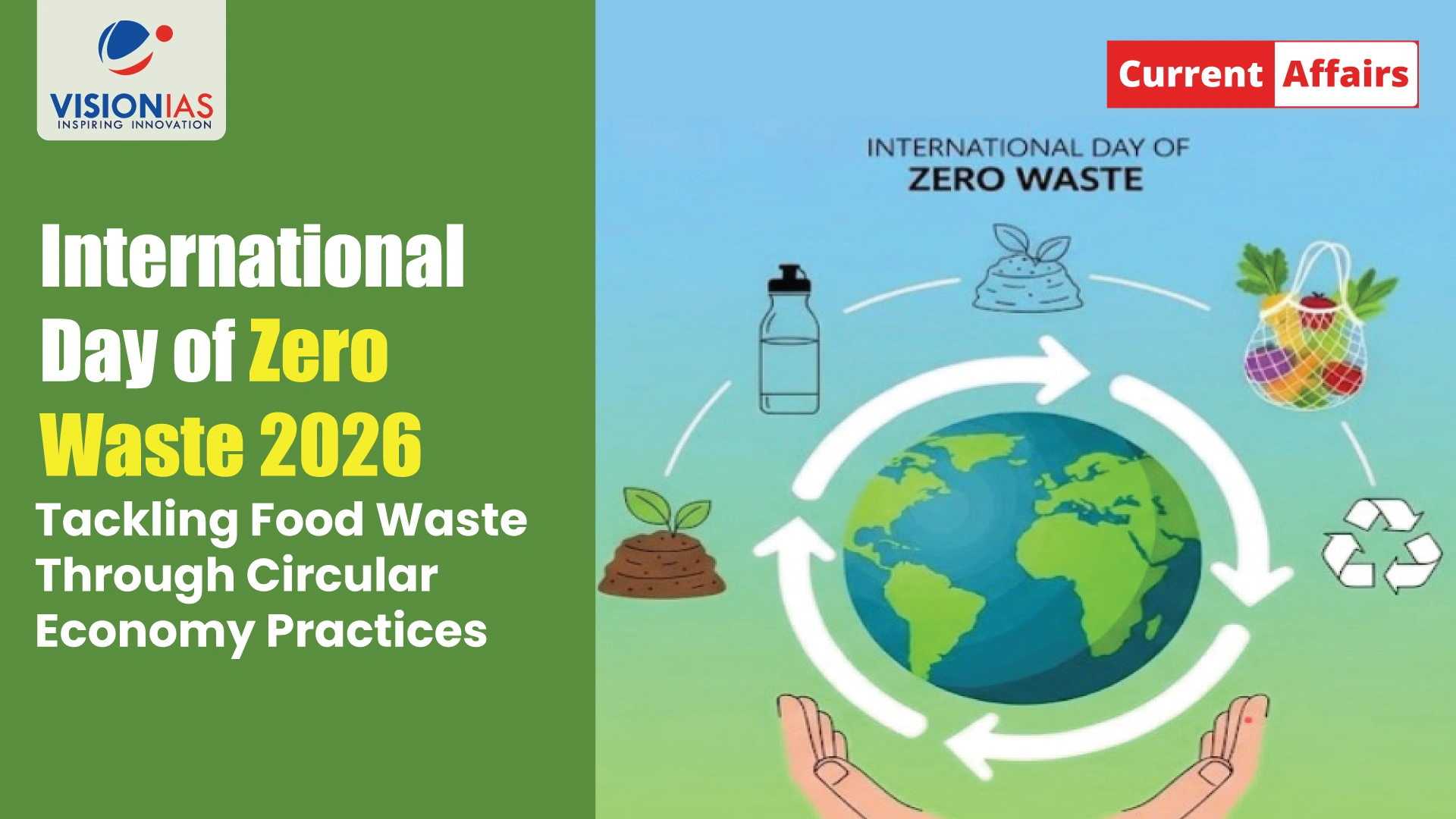


















International Day of Zero Waste is observed globally to promote sustainable consumption and responsible waste management.
On March 30, the world observes the International Day of Zero Waste 2026, a UN-mandated global observance jointly facilitated by UNEP and UN-Habitat. This year’s observance focuses on food waste, a critical yet preventable driver of environmental harm.
What Is the International Day of Zero Waste?
The International Day of Zero Waste was established by the UN General Assembly on December 14, 2022. Observed every March 30, the day spotlights the need to overhaul how humanity produces, consumes, and disposes of resources.
While the 2025 theme focused on the fashion industry’s environmental damage, the International Day of Zero Waste 2026 pivots to food waste, framing it not as an inconvenience but as a systemic failure of our economic and ecological order.
The core message is clear: a linear “use-and-dispose” economy is incompatible with a planet under stress. The solution lies in transitioning to a circular economy that prioritises prevention, efficiency, and the mindful use of resources.
Scale of the Problem: Nearly 1 Billion Tonnes Wasted
In 2022, over 1.05 billion tonnes of food was wasted globally, nearly 19% of all food available to consumers. This happened while approximately 783 million people faced chronic hunger.
The breakdown of responsibility is as follows:
| Sector | Share of Global Food Waste |
| Households | 60% (631 million tonnes) |
| Food Service | 28% (290 million tonnes) |
| Retail | 12% (131 million tonnes) |
A common misconception is that food waste is a rich-world problem. The UNEP Food Waste Index Report 2024 challenges this: household waste levels across high-income and lower-middle-income countries differ by only 7 kg per capita per year. Countries with higher average temperatures generate more food waste per capita, driven by rapid spoilage and weak cold chain infrastructure.
Why Food Waste Is a Climate Emergency
Food waste reduction is not just about saving food, it is a climate intervention, and one that demands action from governments, businesses, and consumers alike.
- Food loss and waste account for 8–10% of annual global greenhouse gas emissions, nearly five times the aviation sector’s total.
- If food waste were a country, it would be the third-largest emitter of GHGs globally, after the US and China.
- Rotting food in landfills produces methane (CH₄), a greenhouse gas with a global warming potential 25–28 times that of CO₂ over a 100-year horizon.
- Food that goes to waste occupies 28–30% of the world’s agricultural land, accelerating biodiversity loss and freshwater depletion.
- The annual economic loss stands at US$1 trillion.
Halving food waste by 2030, the target under SDG 12.3 could reduce global methane emissions by up to 7%, making it one of the most cost-effective climate actions available today. Achieving this requires governments to embed food waste reduction into climate policy, businesses to set measurable targets and innovate across supply chains, and consumers to shop, store, and prepare food more mindfully.
India’s Food Waste Paradox
Food waste in India presents a paradox. India ranks 102th out of 127 countries on the 2025 Global Hunger Index, with a score of 25.8, classifying its hunger level as “serious”. The country has the second-highest child wasting rate in the world at 18.7%, alongside a child stunting rate of 32.9%.
Yet Indian households waste approximately 55 kg of food per person per year, totalling 78.2 million tonnes annually making India the second-largest food-wasting nation after China. The economic cost stands at ₹92,000 crores lost every year.
Post-Harvest Losses: India’s “Missing Middle”
Beyond household waste, India loses approximately 74 million tonnes of food annually to post-harvest losses roughly 22% of its foodgrain output. The most affected commodities:
- Livestock produce (eggs, fish, meat): ~22% loss due to heat and lack of refrigerated transport
- Fruits: 15–19% loss from improper handling and absent cooling infrastructure
- Vegetables: 11–18% loss from inadequate storage
The root cause is India’s “Missing Middle” in supply chains, a shortage of temperature-controlled transport wagons and cold storage at rural markets (Gramin Agricultural Markets). This infrastructure gap causes a third of all produce to spoil before reaching the consumer.
India’s Policy Response: Mission LiFE and FSSAI
India has two frameworks that stand out in the national response to food waste in India:
Mission LiFE (Lifestyle for Environment)
Launched by the Indian Prime Minister at COP26, Mission LiFE promotes a shift from “use-and-dispose” patterns to sustainable consumption habits. Among its 75 individual actions, several address food and circularity:
- Using smaller plates to reduce plate waste
- Composting food waste at home
- Contributing wet waste to biogas plants under the GOBARDHAN scheme
- Feeding vegetable scraps to cattle instead of discarding them
The mission envisions a global network of “Pro-Planet People” (P3), making sustainability a cultural norm, a Jan Andolan (mass movement).
FSSAI’s “Save Food, Share Food” Initiative
The Food Safety and Standards Authority of India (FSSAI), through its Eat Right India movement, operates the Indian Food Sharing Alliance (IFSA), a network of NGOs, food recovery agencies, and food businesses that redistribute surplus food to the needy. This is backed by the Food Safety and Standards (Recovery and Distribution of Surplus Food) Regulations, 2019, which legally institutionalise food donation with clear hygiene standards.
Circular Economy Innovations: India’s Startup Ecosystem
India’s startup ecosystem is converting the circular economy from concept to practice:
- Loopworm uses Black Soldier Fly larvae to bioconvert wet organic waste which reduces waste volume by 80% while producing high-protein animal feed and organic fertiliser.
- Phool upcycles temple flower waste into natural incense and Fleather™, a vegan leather alternative that won the Earthshot Prize.
- TrashCon automates mixed waste segregation with 95% accuracy using its “TrashBot,” converting dry waste into alternatives to plywood.
Global Best Practices Worth Emulating
Two international models offer India and developing nations a policy roadmap:
France’s Loi Garot (2016): This law made it illegal for large supermarkets to destroy unsold edible food, mandating donation to charities. Within a year, donation volumes rose by 15–50%. Today, 93% of targeted supermarkets have active donation contracts, helping France achieve one of the EU’s lowest food waste rates.
South Korea’s RFID Pay-As-You-Throw System: Households pay for food waste by weight via RFID-linked bins. Direct financial accountability has proven far more effective than shared-cost community systems in driving behavioural change.
Conclusion
The International Day of Zero Waste 2026 reminds us that food is not an infinite resource. With nearly 1 billion tonnes wasted annually against a backdrop of mass hunger and climate breakdown, the imperative for food waste reduction has never been clearer.
For India, a nation simultaneously grappling with a “serious” hunger crisis and post-harvest losses, this observance is both a mirror and a mandate. From FSSAI regulations and Mission LiFE to startups and grassroots redistribution networks like the Robin Hood Army, the architecture for change is being built. The circular economy’s future begins on every plate, in every policy room, and in every supply chain decision made today.
Master Digital Age Governance & Technology Trends with VisionIAS Comprehensive Current Affairs →
International Day of Zero Waste FAQs
1. What is the theme of International Day of Zero Waste 2026?
Ans. This year’s observance focuses on food waste, a critical yet preventable driver of environmental harm.
2. Which UN bodies jointly facilitate the International Day of Zero Waste?
Ans. UNEP and UN-Habitat.
3. What is India’s “Missing Middle” in the context of food waste?
Ans. It refers to the shortage of cold storage and temperature-controlled transport in rural supply chains, causing a third of produce to spoil before reaching consumers.
4. Which French law made it illegal for supermarkets to destroy unsold edible food?
Ans. The Loi Garot (2016).
5. What is the SDG target for reducing food waste globally?
Ans. SDG 12.3 aims to halve food waste by 2030.