Current Affairs
National Maritime Day: India’s Blue Economy Vision and the Road to 2047
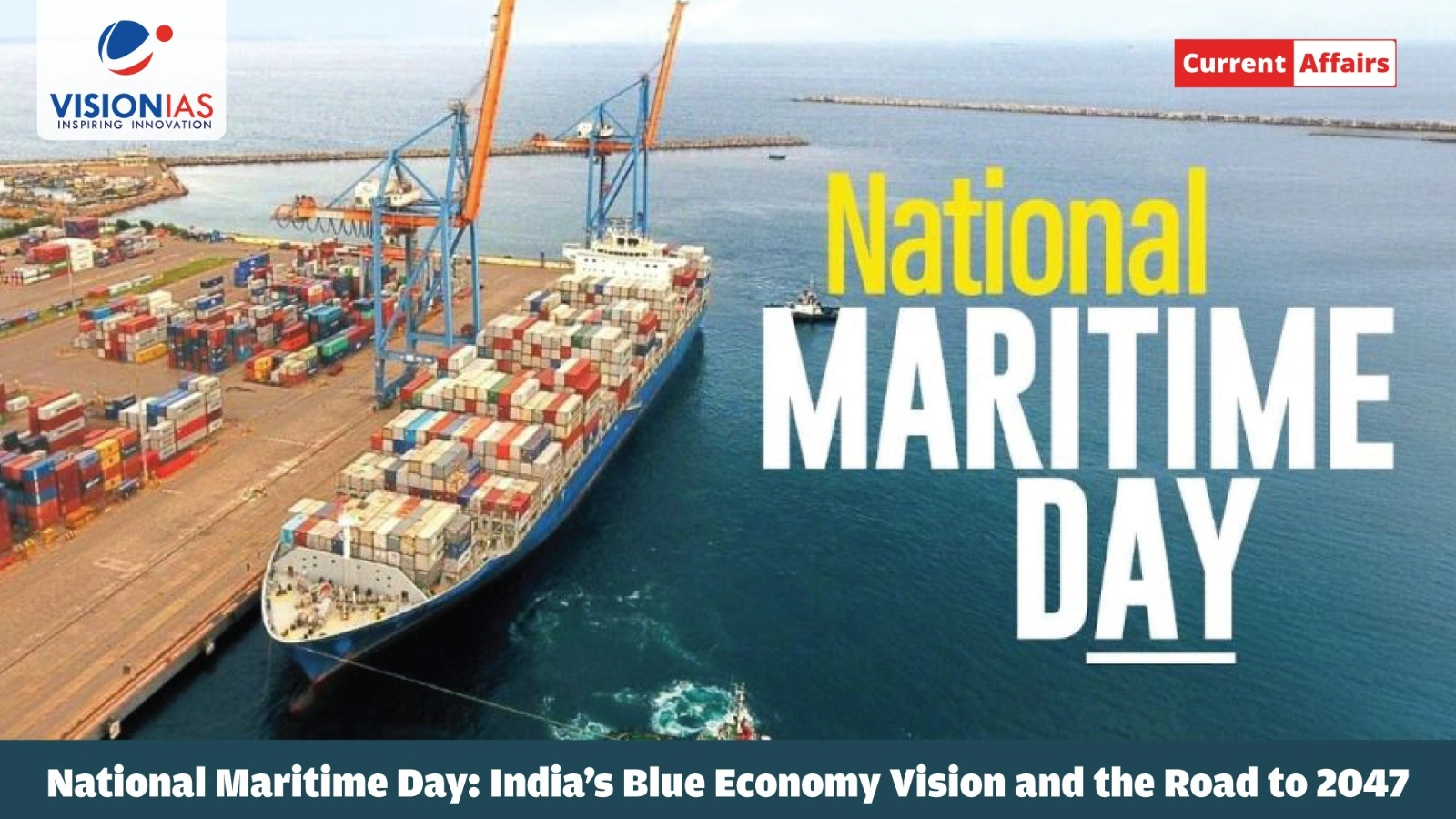


















The annual observance of National Maritime Day in India, celebrated on April 5, constitutes a cornerstone of the nation’s identity as a preeminent seafaring power.
Every year on April 5, India observes National Maritime Day, a mark of its seafaring history and a moment to assess where the maritime sector stands today. It draws attention to a sector that carries nearly 95% of India’s trade by volume through sea routes.
From port infrastructure to shipping laws to green fuel targets, National Maritime Day reflects the state of India’s blue economy and the direction it is heading.
Historical Roots of National Maritime Day
The origins of National Maritime Day go back to April 5, 1919, when the SS Loyalty, owned by the Scindia Steam Navigation Company, set sail from Mumbai to London. It was the first international voyage by an Indian-owned merchant vessel.
The journey was an act of economic resistance against British maritime monopoly. Industrialists like Walchand Hirachand and Narottam Morarjee founded the company knowing they would face predatory pricing from British firms. The SS Loyalty completed the voyage regardless, establishing that Indian enterprise could operate in deep-sea trade.
India officially declared April 5 as National Maritime Day in 1964. Since then, the date has served as the anchor of Merchant Navy Week, a period dedicated to recognising the contributions of seafarers and the port sector to national growth.
State of India’s Maritime Sector in 2026
Record Cargo Performance
In FY 2025–26, India’s major ports handled 915.17 million tonnes (MT) of cargo, surpassing the annual target of 904 MT. This marks a year-on-year growth of 7.06%.
Top performing ports by volume:
- Deendayal Port Authority — 160.11 MT
- Paradip Port Authority — 156.45 MT
- Jawaharlal Nehru Port Authority (JNPA) — 102.01 MT
Top performing ports by growth rate:
- Mormugao Port Authority — 15.91%
- Kolkata Dock System — 14.28%
- JNPA — 10.74%
The Ministry of Ports, Shipping and Waterways attributed this growth to infrastructure investment, digital port initiatives, improved multimodal connectivity, and increased handling of coal, crude oil, containers, fertilisers, and petroleum products.
Turnaround Time and Operational Efficiency
A key metric for global port competitiveness is vessel turnaround time. India reduced this from 93 hours in 2014 to 48 hours in 2025. At ports like Mundra, container ship turnaround now aligns with global benchmarks at under 25 hours.
Total port capacity has grown from 1,400 MMTPA to 2,762 MMTPA over the past decade. The net annual surplus of major ports rose to ₹9,352 crore, up from ₹1,026 crore, while the operating ratio improved from 73% to 43%.
These numbers reflect a sector that is not only growing in volume but becoming more efficient and financially sustainable.
Legislative Reform: Modernising India’s Shipping Laws
One of the more consequential developments for India’s blue economy in recent years has been the overhaul of maritime legislation.
Merchant Shipping Act, 2024
This Act replaces the Merchant Shipping Act of 1958, a law that had governed India’s shipping sector for over six decades. The new legislation aligns India with international maritime standards and focuses on:
- Safety at sea and emergency response
- Reducing compliance burdens for vessel operators
- Promoting Indian-flagged tonnage
- Seafarer welfare and ship safety
Carriage of Goods by Sea Act, 2025
Passed by the Rajya Sabha in August 2025, this Act repeals the Indian Carriage of Goods by Sea Act, 1925, adopting the Hague-Visby Rules followed by countries including the United Kingdom. The objectives include:
- Simplifying maritime trade laws
- Reducing litigation risks
- Improving transparency in sea cargo movement
Maritime Amrit Kaal Vision 2047
The Maritime Amrit Kaal Vision 2047 is India’s long-term plan for the sector, with over 300 initiatives and investments of nearly ₹80 lakh crore across ports, coastal shipping, inland waterways, and shipbuilding.
Key targets include:
- Port capacity exceeding 10,000 MMTPA by 2047
- Indian-flagged vessels holding a larger share of global merchant fleet
- Smart Ports driven by AI, automation, and real-time data systems
- Ranking among the top 5 shipbuilding nations globally
To support shipbuilding, the government has set up the Maritime Development Fund (MDF) with a ₹25,000 crore corpus and the Shipbuilding Financial Assistance Scheme (SBFAS) worth ₹24,736 crore. These funds are aimed at reducing cost disadvantages that Indian shipyards face against competitors in South Korea, China, and Japan.
Inland Waterways: An Underutilised Corridor
India’s inland water transport sector has seen a shift in scale. The number of operational waterways grew from 3 in 2014 to 29 in 2026, and cargo movement via these waterways increased by 710% between 2014 and 2025.
In March 2026, foundation stones were laid for four river lighthouses along the Brahmaputra River, the first lighthouse infrastructure on an Indian inland waterway. This enables safe round-the-clock navigation and connects the Northeast region more firmly to the national logistics network.
The modal share of inland waterways in total cargo movement currently stands at approximately 2%. The government aims to raise this substantially by 2030, reducing dependence on road and rail for bulk freight.
Green Shipping and Sustainability Targets
India’s maritime sector is under pressure to reduce its environmental footprint, and the government has responded with a set of policy commitments.
The Harit Sagar Green Port Guidelines provide a framework for major ports to achieve carbon neutrality. Key targets include:
- Green hydrogen hubs at major ports by 2030
- 100% green fuel for inland vessels by 2045
- India’s first hydrogen fuel cell vessel has already been launched
India’s ship recycling industry ranks second globally. A ₹4,000 crore incentive package has been announced to expand capacity while maintaining safe and environmentally compliant practices.
These steps align with the International Maritime Organization’s decarbonisation targets, to which India is a signatory as a member of the IMO Council, a position reaffirmed at the 34th IMO Assembly Session in 2026, where India received the highest number of votes for a Category-B seat.
India’s Seafaring Workforce
India is one of the world’s top three suppliers of trained seafarers. The workforce has grown from 1.25 lakh to over 3 lakh in the past decade, accounting for approximately 12% of the global seafaring pool.
Training institutions such as the Samundra Institute of Maritime Studies and Anglo-Eastern Maritime Academy maintain standards recognised internationally. The Sagar Samman awards, conferred annually on National Maritime Day, recognise excellence and gallantry among Indian seafarers.
In 2026, the highest honour, the Sagar Samman Varuna Award was awarded posthumously to Late Capt. Harry Subramaniam, a figure central to Indian maritime education.
The government has also launched Sagar Mein Yog to address seafarer well-being, recognising that long voyages and isolation have a direct impact on mental health and operational performance.
Conclusion
National Maritime Day shows how far India’s blue economy has come and how much further it intends to go. From the maiden voyage of the SS Loyalty in 1919 to 915 MT of cargo handled in a single financial year, the sector has been central to national growth.
The legislative reforms of 2024 and 2025, the investment commitments under Vision 2047, and the expansion of inland waterways and green shipping infrastructure all point to a sector that is being reshaped with intent.
Master Digital Age Governance & Technology Trends with VisionIAS Comprehensive Current Affairs →
National Maritime Day
1. When is National Maritime Day celebrated in India?
Ans. April 5 annually.
2. Why is April 5 significant to India’s maritime history?
Ans. On April 5, 1919, the SS Loyalty became the first Indian-owned merchant vessel to complete an international voyage, from Mumbai to London.
3. What is India’s Maritime Amrit Kaal Vision 2047?
Ans. It is India’s long-term maritime development plan covering 300+ initiatives with nearly ₹80 lakh crore in investments across ports, shipping, shipbuilding, and inland waterways.
4. What legislation replaced India’s 1958 Merchant Shipping Act?
Ans. The Merchant Shipping Act, 2025.
5. What percentage of India’s trade by volume moves through sea routes?
Ans. 95%.