
Google has illegal monopoly over internet search and advertising market: US Court | Current Affairs | Vision IAS
MENU
Home

Periodically curated articles and updates on national and international developments relevant for UPSC Civil Services Examination.

Quick Links

High-quality MCQs and Mains Answer Writing to sharpen skills and reinforce learning every day.

Watch explainer and thematic concept-building videos under initiatives like Deep Dive, Master Classes, etc., on important UPSC topics.

ESC

A US District Court ruled that Google has violated Sherman Act (US’ anti-trust law) by maintaining its monopoly in two product markets – General Search Services (GSS) and General Text Advertising.

  • Anti-trust laws prohibit Anti-Competitive Practices and monopolizing conduct to protect consumers from predatory business practices. 

Google’s Monopoly (as highlighted by Judgement)

  • Google enjoys an 89.2% market share for GSS, which increases to 94.9% on mobile devices.
    • Google also controlled 88% of text advertising market in 2020.
  • Google maintained its monopoly and stifled competition through:
    • Near-complete control of key distribution channels, posing a major entry barrier for other search companies.
    • Striking deals with Apple, Samsung and Verizon to be default search engine on their respective devices. 
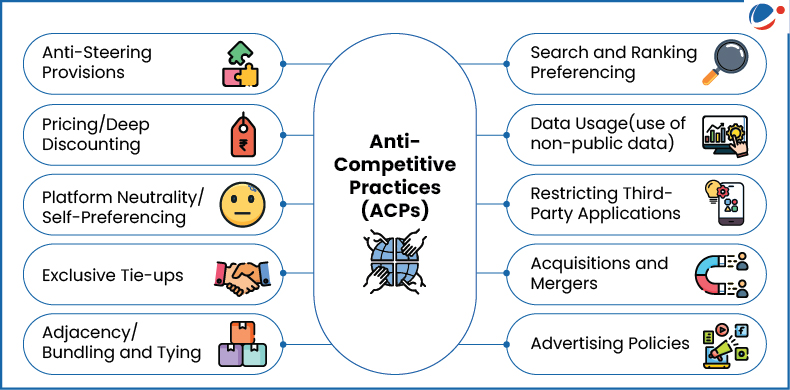
An infographic detailing out various Anti-Competitive Practices (ACPs) undertaken by large digital enterprises.

Issues with Monopolistic Tendencies of Big Tech Companies

  • Abuse of dominant position: Access to large datasets provides information control which may be misused for profit maximization or controlling the market.
  • Winner-take-most: Nature of digital market is conducive for quick scaling and domination, restricting democratic competition, discouraging new market participants and impacting local economies.
  • Anti-Competitive Practices (ACPs): India’s Parliamentary Standing Committee Report identified ten predominant ACPs undertaken by large digital enterprises (see infographic).


Regulation of Big Tech Companies in India

  • Competition Act, 2002 (as amended in 2023) prohibits anticompetitive agreements and abuse of dominance. 
    • It establishes Competition Commission of India (CCI) to eliminate ACPs, promote competition, protect consumers’ interest and ensure freedom of trade.
  • Draft Digital Competition Bill, 2024: It aims at predictive regulation based on potential anti-trust issues and identifying Systematically Significant Digital Enterprise (SSDE).
  • Consumer Protection Act, 2019: Aims to address unfair trade practices. 
Watch Video News Today

Explore Related Content

Discover more articles, videos, and terms related to this topic

RELATED VIDEOS

1
News Today (Aug 07, 2024)

News Today (Aug 07, 2024)

YouTube HD
Title is required. Maximum 500 characters.

Search Notes

Filter Notes

Loading your notes...
Searching your notes...
Loading more notes...
You've reached the end of your notes

No notes yet

Create your first note to get started.

No notes found

Try adjusting your search criteria or clear the search.

Saving...
Saved

Please select a subject.

Referenced Articles

linked

No references added yet

Subscribe for Premium Features