


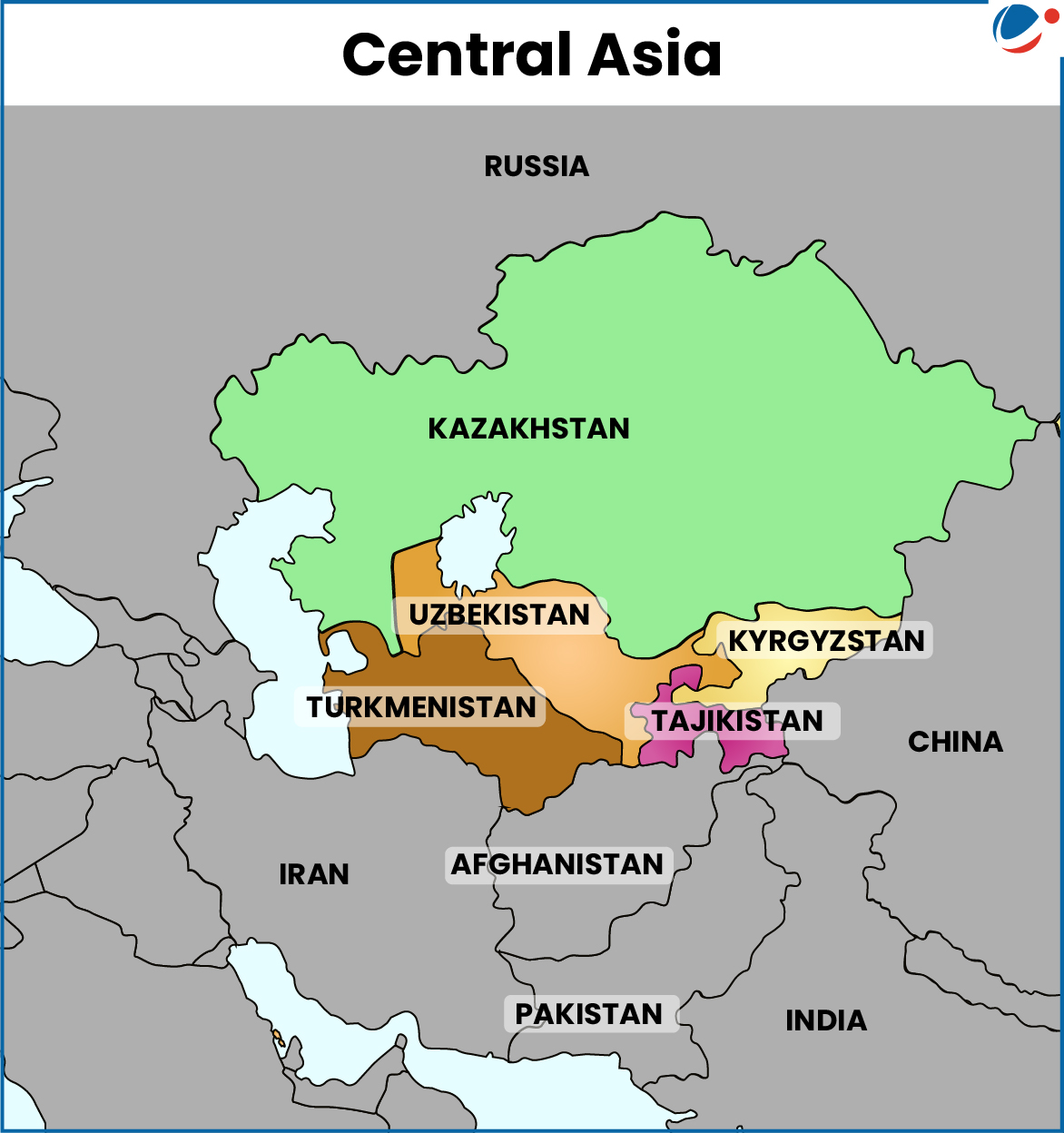
Ministers of Foreign Affairs of Republic of Kazakhstan, the Kyrgyz Republic, the Republic of Tajikistan, Turkmenistan and the Republic of Uzbekistan participated in dialogue.
Key Highlights of Joint Statement of 4th Dialogue:
- Central Asian nations condemned the Pahalgam terror attack and also expressed interest in joint exploration of rare earth & critical minerals.
- Ministers welcomed the designation of 2025 as the "International Year of Peace and Trust" in accordance with UN General Assembly Resolution.
- Ministers commended First High-Level International Conference on Glaciers' Preservation, held in Tajikistan as part of observing International year of Glaciers’ Preservation (2025).
India -Central Asia Relations:
- Age Old Ties: India's linkages with Central Asia date back millennia to at least the third century BCE.The two were connected through the silk road.
- In current times, Central Asian Republics constitute the extended neighborhood of India.
- Connectivity & Infrastructure Development: Through initiatives like the International North-South Transport Corridor (INSTC), Chabahar port etc.
- Energy Security: E.g. TAPI (Turkmenistan–Afghanistan–Pakistan–India) pipeline is a natural gas project designed to transport gas from Turkmenistan's Galkynysh field to India.
- India has been importing yellow cake (Uranium oxide) for its nuclear plants from Kazakhstan since 2009.
- Trade & Economic Cooperation: E.g. India and Kyrgyzstan’s Bilateral Investment Treaty, establishing India-Central Asia Business Council etc.
- Security and Defense: Through annual military exercises e.g. Khanjar ( Between India and Kyrgyzstan), “Kazind” (Between India and Kazakhstan).


