
India sees India-Middle East-Europe Economic Corridor (IMEC) as a strategic imperative | Current Affairs | Vision IAS
MENU
Home

Periodically curated articles and updates on national and international developments relevant for UPSC Civil Services Examination.

Quick Links

High-quality MCQs and Mains Answer Writing to sharpen skills and reinforce learning every day.

Watch explainer and thematic concept-building videos under initiatives like Deep Dive, Master Classes, etc., on important UPSC topics.

ESC

In Summary

  • The India-Middle East-Europe Economic Corridor (IMEC) aims to boost trade via ports, railways, and roads, connecting India to Europe.
  • IMEC offers India diversified trade routes, reduced logistics costs (up to 40% time, 30% cost), and port optimization, enhancing global value chain integration.
  • Challenges include geopolitical tensions, port capacity mismatches, and significant financing gaps requiring innovative funding solutions.

In Summary

About IMEC

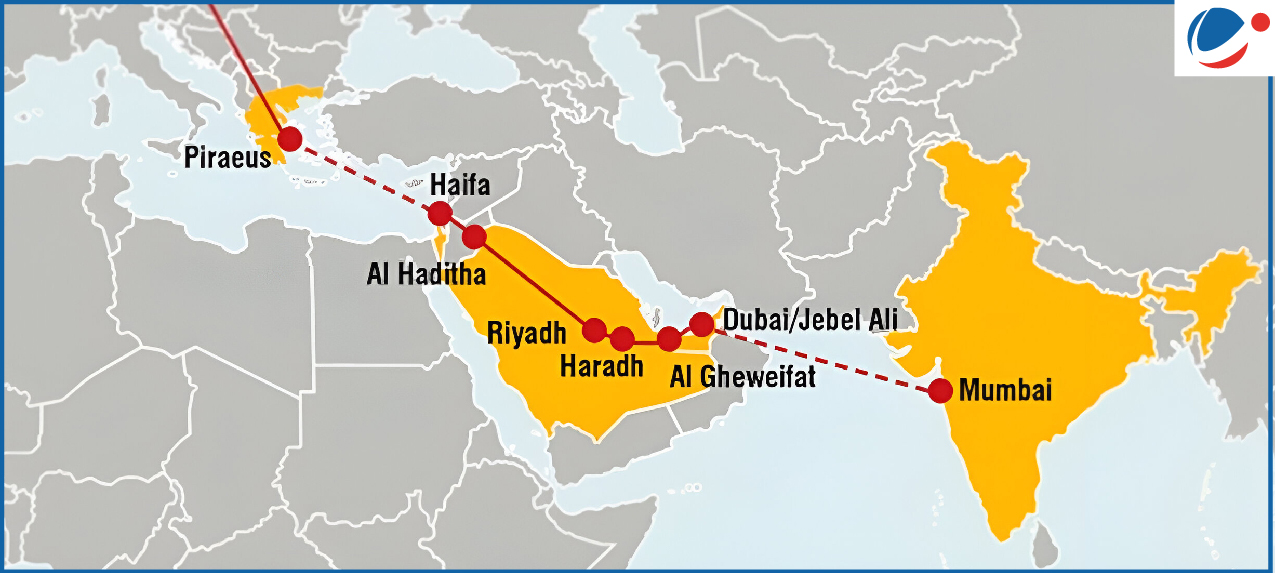
  • A multi-modal connectivity project, formalized by an MoU signed between India, the European Union, France, Germany, Italy, Saudi Arabia, the UAE, and the US at the G20 Summit (2023) in New Delhi.
  • Objective: Developing infrastructure of ports, railways, roads, sea lines and pipelines to enhance trade between India, the Arabian Peninsula, the Mediterranean region, and Europe.

Significance of IMEC for India

  • Trade Route Diversification: IMEC diversifies India–EU connectivity by reducing dependence on the Suez Canal.  
    • E.g., Houthi attacks on commercial shipping led to the Red Sea crisis of 2023-24
  • Lower Logistics Cost and Time: IMEC is expected to reduce transit time by up to 40% and logistics costs by around 30%, helping exporters avoid delays.
  • Port Optimization: It promises higher throughput for India's west coast ports (like Mumbai and Mundra) by integrating them more deeply into Mediterranean and Gulf logistics ecosystems.
  • Upgradation in Global Value Chains: Improved connectivity with Europe enables India to move from low-value assembly to higher-value manufacturing and services.        

Challenges

  • Geopolitical tensions: E.g., Hamas–Israel war 
  • Port Capacity Mismatches: E.g., while the Jebel Ali port in the UAE can handle 90 million tonnes annually, Haifa port in Israel is limited to approximately 30 million tonnes.
  • Financing Gaps: IMEC spans multiple countries with uneven fiscal capacities and credit profiles, making it difficult to secure traditional public funding.

To succeed, the IMEC requires a sophisticated financing structure that combines public investment, sovereign wealth capital, and multilateral guarantees, etc. 

Watch Video News Today

Explore Related Content

Discover more articles, videos, and terms related to this topic

RELATED VIDEOS

2
News Today (May 19-20, 2024)

News Today (May 19-20, 2024)

YouTube HD
Role of Indian Diaspora in Making India Self-Reliant

Role of Indian Diaspora in Making India Self-Reliant

YouTube HD

RELATED TERMS

3

Sovereign Wealth Capital

Investment funds controlled by a national government that are set up to invest a surplus of foreign currency reserves, typically for the benefit of the national economy.

Hamas–Israel war

A significant geopolitical conflict in the Middle East that has implications for regional stability and international trade routes, as highlighted by the impact on commercial shipping.

Global Value Chains (GVCs)

The full range of activities required to bring a product or service from conception to final consumption. The EPM aims to support MSME exporters' integration into GVCs, enhancing their participation in international trade.

Title is required. Maximum 500 characters.

Search Notes

Filter Notes

Loading your notes...
Searching your notes...
Loading more notes...
You've reached the end of your notes

No notes yet

Create your first note to get started.

No notes found

Try adjusting your search criteria or clear the search.

Saving...
Saved

Please select a subject.

Referenced Articles

linked

No references added yet