


Signed between India and Gulf Cooperation Council (GCC), ToR defines the scope, structure and modalities of the proposed India-GCC FTA.
- Framework Agreement of Economic Cooperation to explore the possibility of FTA between India and GCC was signed in New Delhi in 2004.
Significance of India-GCC FTA for India
- Unlock Full potential of a mutually-beneficial Economic relationship: GCC countries represent a market of 61.5 million people (2024) and US$ 2.3 trillion in terms of GDP at current prices.
- Diversifying India’s Energy Sources: Sectors like food processing, infrastructure, petrochemicals, and Information and Communication Technology (ICT) are expected to benefit largely from this.
- Reinforce Relations amidst prevailing global uncertainties: Helping strengthen long-term supply security and trade expansion.
- Enhance Trade and Investment: India’s trade with GCC stood at USD 178.56 billion in FY 2024-25, (15.42% of India’s global trade).
- Region is also a significant source of Foreign Direct Investment (FDI) with investments exceeding USD 31.14 billion (September 2025).
- Enhance People to people ties: GCC is home to nearly ten million members of Indian community.
About GCC
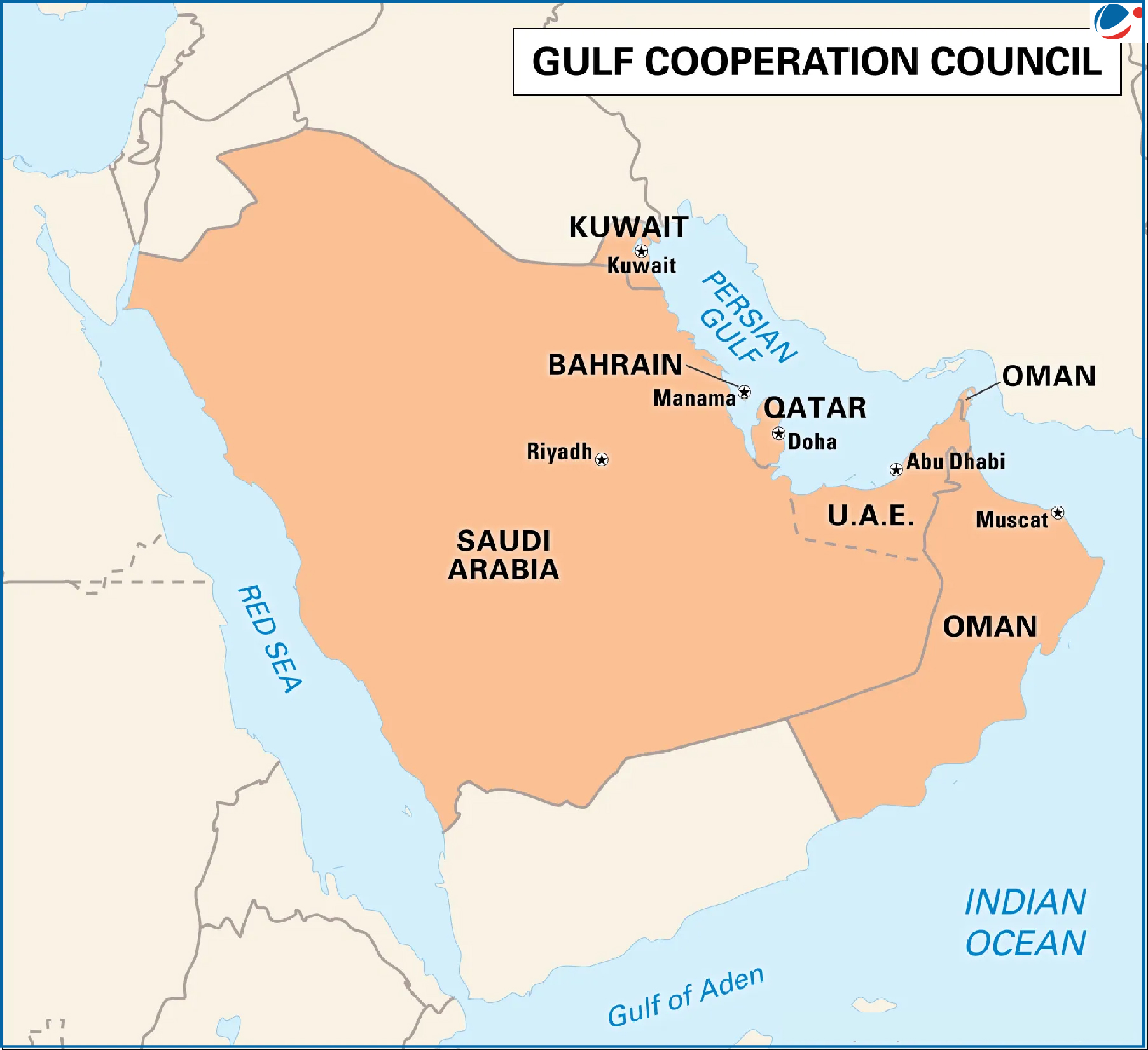
- Genesis: Cooperative agreement among six-nation bloc, established by an agreement concluded on 25 May 1981.
- Members (6): United Arab Emirates; Kingdom of Bahrain; Kingdom of Saudi Arabia; Oman; Qatar; Kuwait.
- Headquarters: Riyadh, Kingdom of Saudi Arabia.
- Objective: Effect coordination, integration and inter-connection between Member States to achieve unity between them.
- Main Organizations under GCC: Supreme Council with attached Commission for Settlement of Disputes; The Ministerial Council; The Secretariat General.




