
⁠ ⁠NITI Aayog releases Study Report on Agriculture | Current Affairs | Vision IAS

Upgrade to Premium Today

Start Now
MENU
Home
Quick Links

High-quality MCQs and Mains Answer Writing to sharpen skills and reinforce learning every day.

Watch explainer and thematic concept-building videos under initiatives like Deep Dive, Master Classes, etc., on important UPSC topics.

A short, intensive, and exam-focused programme, insights from the Economic Survey, Union Budget, and UPSC current affairs.

ESC

In Summary

  • Report emphasizes strategic sequencing for Viksit Bharat and Net Zero, focusing on resource efficiency like micro irrigation and fertilizer optimization.
  • Agriculture supports 46% of workforce, contributes ~14% to GVA, and faces challenges of food security and environmental footprints, accounting for ~14% of national GHG emissions.
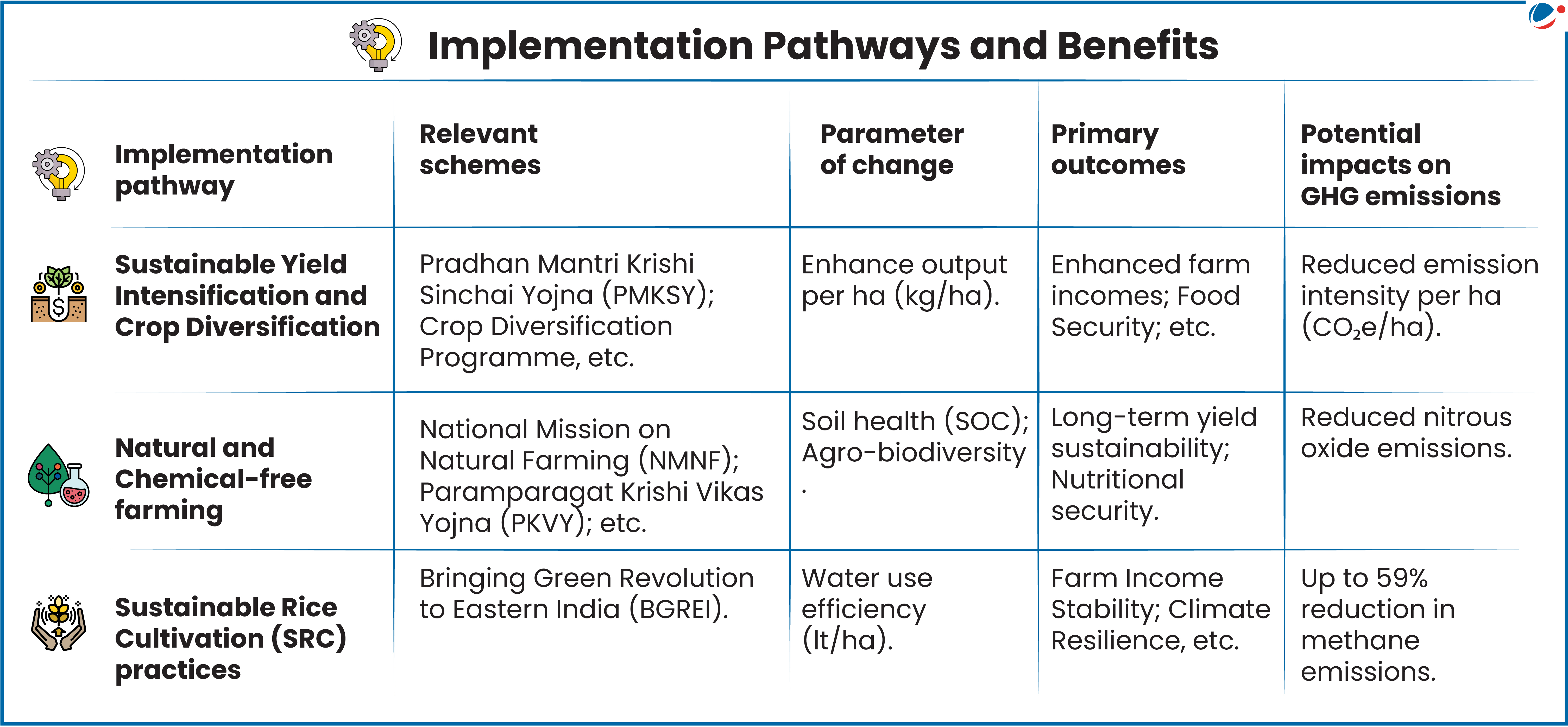
  • Net Zero Scenario projects ~25% mitigation co-benefits by 2070 compared to Current Policy Scenario, with implementation pathways including sustainable yield intensification, natural farming, and sustainable rice cultivation.

In Summary

The report on Scenarios Towards Viksit Bharat and Net Zero emphasises on ‘strategic sequencing’ as a transition strategy focussing on resource efficiency like micro irrigation and fertilizer optimization. 

  • Strategic scaling of pathways like crop diversification (away from rice, sugarcane), increasing share of solar and electric pumps could offer mitigation co-benefits and energy savings

Agriculture Sector of India

  • Contribution: Supports 46% of workforce and contributes ~14% to Gross Value Added (GVA). 
  • Role in Food Security: Between 2011 and 2019, food grain production increased to ~285 million tonnes and to ~332 million tonnes in 2023-24.
  • Key Challenges: 
    • Dominance of small and marginal farmers. 
    • Dual challenge of meeting food demand and managing environmental food prints:
      • Sector currently accounts for ~14% of national Greenhouse Gas (GHG) emissions, driven by methane from enteric fermentation and rice cultivation and nitrous oxide from agricultural soils. 
      • Consumes ~18% of national electricity primarily to power groundwater irrigation and expanding mechanisation.
  • Emission Scenario: 
    • Under Current Policy Scenario: Agricultural emissions (non-energy) are expected to rise from ~506 MtCO₂e in 2019 to ~531 MtCO₂e in 2070. 
    • Net Zero Scenario: Total emissions of ~399 MtCO₂e in 2070, offering ~25% mitigation co-benefits relative to the CPS. 
  • Key Policy Suggestions:Integrating both demand and supply side levers to create targeted roadmaps; Institutionalize integrated “agri-food” systems framework, etc.  
Watch Video News Today

Explore Related Content

Discover more articles, videos, and terms related to this topic

RELATED VIDEOS

3
News Today (Apr 05, 2024)

News Today (Apr 05, 2024)

YouTube HD
Circularity in Textile Structure

Circularity in Textile Structure

YouTube HD
Growth of Tier 2 and Tier 3 Cities in India

Growth of Tier 2 and Tier 3 Cities in India

YouTube HD

RELATED TERMS

3

Agri-food systems framework

An integrated approach to managing agriculture and food production, encompassing everything from farm to fork, with a focus on sustainability, efficiency, and food security.

MtCO2e

Million tonnes of carbon dioxide equivalent. A unit used to measure greenhouse gas emissions, where different gases are converted into an equivalent amount of CO₂ based on their global warming potential.

Enteric Fermentation

A digestive process in ruminant animals (like cattle and sheep) where microbes in their stomachs break down fibrous plant material, producing methane as a byproduct.

Title is required. Maximum 500 characters.

Search Notes

Filter Notes

Loading your notes...
Searching your notes...
Loading more notes...
You've reached the end of your notes

No notes yet

Create your first note to get started.

No notes found

Try adjusting your search criteria or clear the search.

Saving...
Saved

Please select a subject.

Referenced Articles

linked

No references added yet