
National Green Tribunal (NGT) cleared Great Nicobar Mega-infrastructure Project | Current Affairs | Vision IAS

Upgrade to Premium Today

Start Now
MENU
Home
Quick Links

High-quality MCQs and Mains Answer Writing to sharpen skills and reinforce learning every day.

Watch explainer and thematic concept-building videos under initiatives like Deep Dive, Master Classes, etc., on important UPSC topics.

A short, intensive, and exam-focused programme, insights from the Economic Survey, Union Budget, and UPSC current affairs.

ESC

In Summary

  • NGT upheld the Great Nicobar Project's environmental clearance, noting its strategic importance and compliance with CRZ norms.
  • The project aims to develop Great Nicobar Island into a major transshipment and defence hub, facing concerns over regulatory lapses, biodiversity loss, and tribal impact.
  • Strategically, the project enhances India's logistics by reducing reliance on foreign ports and improves its presence in the Indian Ocean region.

In Summary

NGT while noting the “strategic importance of the project” upheld its environmental clearance and compliance with ICRZ (Island Coastal Regulation Zone) and CRZ norms.
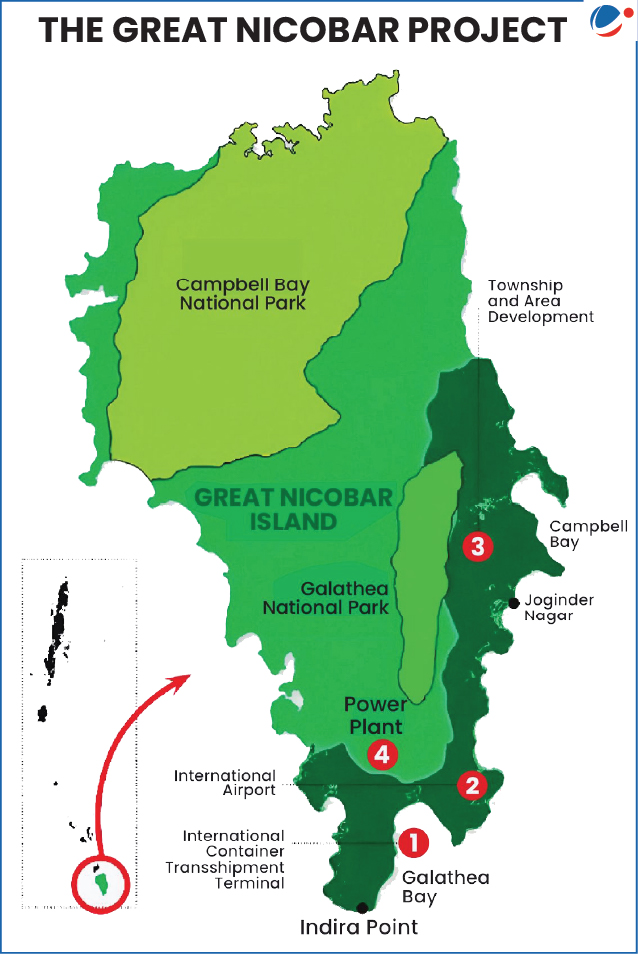
Map of Great Nicobar Island titled “The Great Nicobar Project,” showing locations of Campbell Bay National Park, Galathea National Park, proposed township and area development, international airport, international container transshipment terminal, power plant, Indira Point, Campbell Bay, and Joginder Nagar, with an inset map indicating the island’s position in the Andaman and Nicobar archipelago.

About the Great Nicobar Project 

  • Location: Great Nicobar Island (southernmost island of Andaman and Nicobar Islands) including parts of Galathea Bay,  Campbell Bay and Great Nicobar Biosphere Reserve.
  • Objective: Project envisions transforming the remote outpost into a major transshipment and defence hub with integrated township, 450 MVA Gas and Solar-based power plant,  dual-use civil-military airport, etc.
  • Implementing Agency: Andaman and Nicobar Islands Integrated Development Corporation along with the NITI Aayog.

Concerns associated with the Project

  • Regulatory Lapses: 
    • Environmental Impact assessment (EIA) relied on single-season data instead of comprehensive multi-season assessment.
      • Proposed compensatory afforestation in Haryana is inadequate to offset loss of a tropical rainforest ecosystem.
    • Forest Rights Act (FRA): Government has proceeded with project even after Tribal council withdrew its consent. 
  • Threat to Biodiversity: The project involves diverting approximately 130 sq. km of tropical rainforest (felling one million trees), home to the Nicobar megapode, Nicobar tree shrew, Giant leatherback turtles, corals, etc.
  • Social Impact: Project might negatively impact tribal population, e.g. Shompen (Particularly Vulnerable Tribal Group) and Nicobarese.
  • Natural Disaster Vulnerability: The Island falls in the highest seismic-risk zone (Zone VI). 

Significance of the Project for India

  • Strategic: Island overlooks the Strait of Malacca, through which 40% of the world’s trade and most of China’s energy imports pass.
  • Logistics: Currently, 75% of India’s transshipment cargo is handled at foreign ports, raising logistics costs.
  • Others: Improved connectivity, promotion of tourism, increased presence in the Indian Ocean region etc.
Watch Video News Today

Explore Related Content

Discover more articles, videos, and terms related to this topic

RELATED VIDEOS

3
News Today (Feb 09, 2024)

News Today (Feb 09, 2024)

YouTube HD
News Today (Apr 11, 2024)

News Today (Apr 11, 2024)

YouTube HD
Carbon Markets

Carbon Markets

YouTube HD

RELATED TERMS

3

Strait of Malacca

A crucial maritime chokepoint connecting the Indian Ocean and the Pacific Ocean, passing between Malaysia and Indonesia. It is one of the busiest shipping lanes in the world.

Particularly Vulnerable Tribal Group (PVTG)

PVTGs are a category of tribal communities identified by the Indian government that are more vulnerable than other tribal groups, often due to declining populations, low literacy, pre-agricultural level of technology, and extreme isolation.

Forest Rights Act (FRA)

The Scheduled Tribes and Other Traditional Forest Dwellers (Recognition of Forest Rights) Act, 2006, recognizes the rights of forest-dwelling communities to forest land and resources.

Title is required. Maximum 500 characters.

Search Notes

Filter Notes

Loading your notes...
Searching your notes...
Loading more notes...
You've reached the end of your notes

No notes yet

Create your first note to get started.

No notes found

Try adjusting your search criteria or clear the search.

Saving...
Saved

Please select a subject.

Referenced Articles

linked

No references added yet
