
Ethics of AI in Modern Warfare and Defense | Current Affairs | Vision IAS

Upgrade to Premium Today

Start Now
MENU
Home
Quick Links

High-quality MCQs and Mains Answer Writing to sharpen skills and reinforce learning every day.

Watch explainer and thematic concept-building videos under initiatives like Deep Dive, Master Classes, etc., on important UPSC topics.

A short, intensive, and exam-focused programme, insights from the Economic Survey, Union Budget, and UPSC current affairs.

ESC

In Summary

  • US designated AI firm Anthropic a supply chain risk, ordering Pentagon to end military contracts due to ethical concerns.
  • AI's role in defense includes autonomous weapons, precision strikes, ISR, electronic warfare, and logistics support.
  • Ethical concerns involve lethal autonomous decisions, accountability gaps, data misuse, and potential AI arms race.

In Summary

The United States President has designated AI company Anthropic as a ‘supply chain risk’ and ordered the Department of Defense (Pentagon) to terminate all military contracts with the firm.

  • Anthropic has refused to allow use of its AI model Claude for unethical mass surveillance or autonomous weapons by the Pentagon, citing concerns over national defense applications.
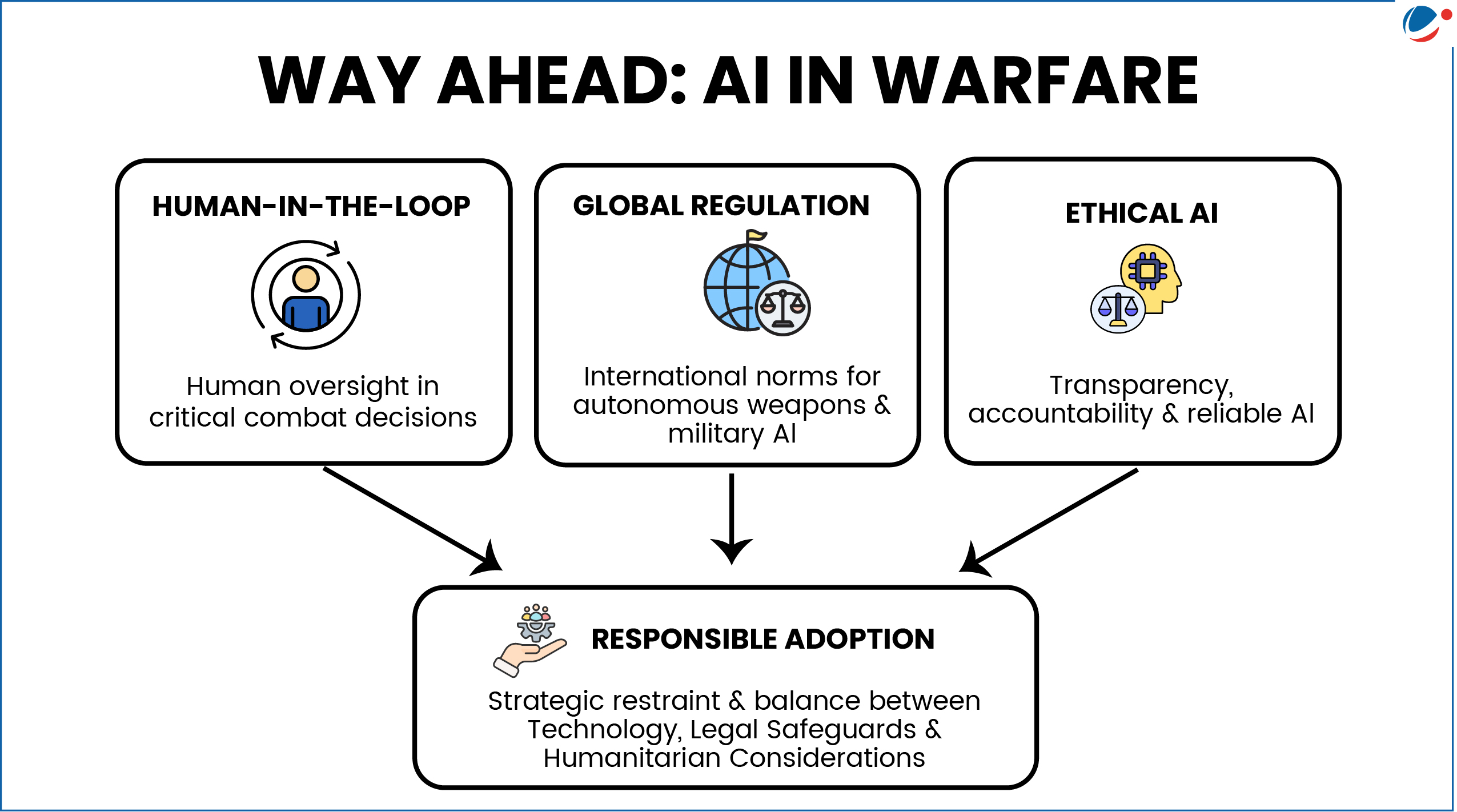
Role of AI in Modern Warfare and Defense

  • Autonomous weapons systems: AI-enabled drones and robotic systems are capable of identifying and attacking targets with minimal human intervention.
    • Precision strikes: AI-powered targeting improves accuracy and reduces operational time.
  • Intelligence, Surveillance, and Reconnaissance (ISR): AI processes large volumes of battlefield, satellites, drones, and sensors data to predict enemy movement and optimize strategy. 
    • E.g. the US military took assistance of Claude AI to attack Iran.
  • Electronic warfare and cyber operations: AI helps detect signals, disrupt enemy communications, and defend networks.
  • Logistics support: AI assists in supply chain management, predictive maintenance, and battlefield decision-making. 

Key Ethical Concerns 

  • Autonomous lethal decision-making: AI systems may make life-and-death decisions without meaningful human control, violating the Right to Life.
    • Accountability Gap: It becomes difficult to determine responsibility when AI-driven systems cause harm.
  • Misuse of Personal Data: AI-powered facial recognition and data analytics can enable large-scale monitoring of populations by governments, manipulating the public choices and violate their privacy and civil liberties.
  • AI arms race: Competition among states could accelerate the development of increasingly autonomous and lethal systems.
Watch Video News Today

Explore Related Content

Discover more articles, videos, and terms related to this topic

RELATED VIDEOS

3
Simplified | Seeing is not Believing: The DeepFake Dilemma

Simplified | Seeing is not Believing: The DeepFake Dilemma

YouTube HD
Simplified: Virtual influencers revolutionizing creator marketing

Simplified: Virtual influencers revolutionizing creator marketing

YouTube HD
Sovereign AI | Paritosh Parmar Sir

Sovereign AI | Paritosh Parmar Sir

YouTube HD

RELATED TERMS

3

Pentagon

The headquarters of the United States Department of Defense, often used as a metonym for the U.S. military establishment.

AI arms race

A competitive development of advanced artificial intelligence technologies, particularly in military applications, among nations, which could lead to the proliferation of highly autonomous and lethal weapons.

Accountability Gap

The challenge of assigning responsibility when harm is caused by AI-driven systems, as it becomes difficult to determine who is liable – the programmer, the user, or the AI itself.

Title is required. Maximum 500 characters.

Search Notes

Filter Notes

Loading your notes...
Searching your notes...
Loading more notes...
You've reached the end of your notes

No notes yet

Create your first note to get started.

No notes found

Try adjusting your search criteria or clear the search.

Saving...
Saved

Please select a subject.

Referenced Articles

linked

No references added yet
