


Despite significant legislative and judicial reforms to strengthen the arbitration ecosystem, India continues to be a less preferred destination for international arbitration.
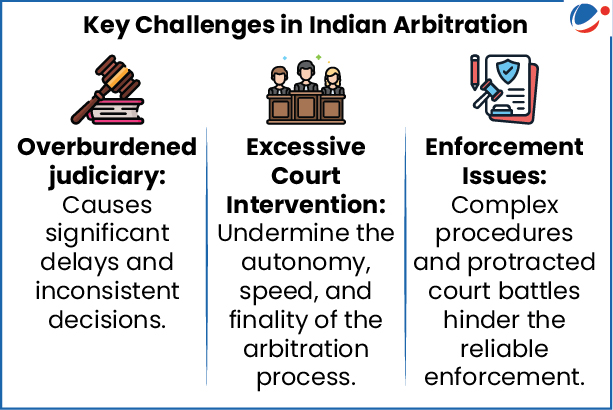
- Arbitration is a procedure in which a dispute is submitted, by agreement of the parties, to one or more arbitrators who make a binding decision on the dispute.
- Arbitration is a quasi-judicial proceeding. It is one of the mechanisms of Alternate Dispute Resolution (ADR).
Arbitration Mechanism in India
- Arbitration and Conciliation Act, 1996 governs the arbitral proceedings in India.
- It was based on UNCITRAL (United Nations Commission on International Trade Law) Model Law on International Commercial Arbitration 1985 and UNCITRAL Conciliation Rules, 1980.
- Awards are final, binding, and globally enforceable.
- Mumbai Centre for International Arbitration (MCIA) and the Delhi International Arbitration Centre (DIAC) provide institutional support.
- Key Amendments to the Act
- 2015: Set a 12-month completion timeline; minimized court interference.
- 2019: Created the Arbitration Council of India (ACI).
- 2021: Allows for an unconditional stay of the enforcement of arbitral awards in cases where the arbitration agreement, contracts, or award itself was obtained through fraud or corruption.
Recommendations for Strengthening the Arbitration Regime
- Modernize Laws: Aligning domestic legal frameworks with international standards.
- Limit Judicial Intervention: By adopting a pro-arbitration stance.
- Leverage Technology: Using digital tools like e-filing and videoconferencing.
- Boost Public Awareness: Through ICT campaigns.


