
India Emerging as a Global Business Powerhouse | Current Affairs | Vision IAS

Upgrade to Premium Today

Start Now
MENU
Home
Quick Links

High-quality MCQs and Mains Answer Writing to sharpen skills and reinforce learning every day.

Watch explainer and thematic concept-building videos under initiatives like Deep Dive, Master Classes, etc., on important UPSC topics.

A short, intensive, and exam-focused programme, insights from the Economic Survey, Union Budget, and UPSC current affairs.

ESC

In Summary

  • Union Budget 2026-27 and reforms aim to enhance India's Ease of Doing Business through digital facilitation, tax certainty, and reduced compliance.
  • Key initiatives include scaling domestic manufacturing, export resilience, fostering economic growth towards a $5 trillion economy, and ensuring long-term resilience.
  • Reforms encompass institutional changes like Start-up India, regulatory updates via Jan Vishwas Amendment Act 2023, and taxation adjustments such as GST 2.0 and MAT rate reduction.

In Summary

Union Budget 2026–27 along with various reforms aim to enhance India’s Ease of Doing Business (EoDB) with measures like digital trade facilitation, tax certainty, reduced compliance and litigation, etc.
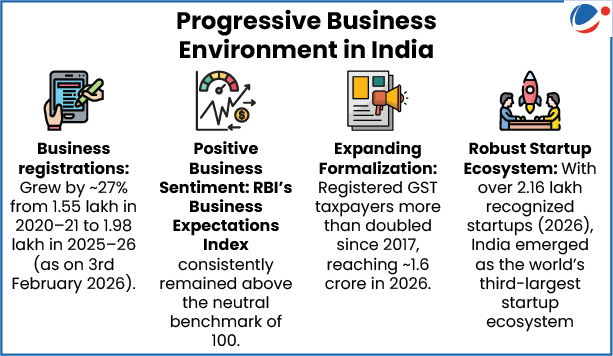
Need for Expanding Business Environment in India

  • Scaling Domestic Manufacturing: To attain import substitution aligning with vision of swadeshi and aatmanirbharta in key sectors including Electronics; Automobiles; Pharmaceuticals; Defence; etc. 
  • Export Resilience and Diversification: To navigate uncertain global trade environments, demand volatility, and supply chain disruptions. 
  • Fostering Economic Growth: Achieve the national economic target of 5 trillion dollar by 2027. 
  • Ensuring Long-term Resilience: Improving living conditions, reducing poverty, and enhancing public health and education by improved taxation.

Initiatives taken to strengthen Business Environment

  • Institutional reforms: Start-up India, Credit Guarantee Scheme, digital credit assessment models etc. for transparent, tech-enabled, investor-friendly ecosystem.
  • Regulatory Reforms: Jan Vishwas Amendment Act 2023 decriminalized various provisions and reduced liability for minor and technical offences; consolidation of labor laws into four labour codes, etc. 
  • Taxation Reforms: GST 2.0 introduced  two rate structure to improve price competitiveness and complianceUnion Budget 2026-27 proposed reducing Minimum Alternate Tax (MAT) rate from 15% to 14% and to treat it as final tax, etc.

Watch Video News Today

Explore Related Content

Discover more articles, videos, and terms related to this topic

RELATED VIDEOS

3
The Contribution of Indian Cinema to the Creative Economy

The Contribution of Indian Cinema to the Creative Economy

YouTube HD
Impact Investments

Impact Investments

YouTube HD
Universal and Meaningful Connectivity

Universal and Meaningful Connectivity

YouTube HD

RELATED TERMS

3

Minimum Alternate Tax (MAT)

A minimum tax payable by companies on their book profits when their normal income-tax liability is zero or minimal. Companies must pay the higher of their corporate tax or MAT. It is levied under the Income Tax Act, 1961, and applies to both domestic and foreign companies.

GST 2.0

Goods and Services Tax 2.0. Implies potential refinements or enhancements to the existing Goods and Services Tax regime in India, aimed at further streamlining indirect taxation.

Jan Vishwas Amendment Act 2023

An act that decriminalizes minor offenses and reduces penalties for minor and technical violations across various laws, aiming to reduce the burden on businesses and individuals and promote ease of living.

Title is required. Maximum 500 characters.

Search Notes

Filter Notes

Loading your notes...
Searching your notes...
Loading more notes...
You've reached the end of your notes

No notes yet

Create your first note to get started.

No notes found

Try adjusting your search criteria or clear the search.

Saving...
Saved

Please select a subject.

Referenced Articles

linked

No references added yet