
NPCI Rolled out Drunix, to support Blockchain and Tokenisation Ecosystems | Current Affairs | Vision IAS

Upgrade to Premium Today

Start Now
MENU
Home
Quick Links

High-quality MCQs and Mains Answer Writing to sharpen skills and reinforce learning every day.

Watch explainer and thematic concept-building videos under initiatives like Deep Dive, Master Classes, etc., on important UPSC topics.

A short, intensive, and exam-focused programme, insights from the Economic Survey, Union Budget, and UPSC current affairs.

ESC

In Summary

  • NPCI launched Drunix, an enterprise-grade distributed ledger technology for tokenization and digital asset ecosystems, re-engineered from Hyperledger Fabric.
  • Blockchain technology provides an immutable ledger for transparent information sharing, while tokenization converts real-world asset ownership into secure digital tokens.
  • NPCI, a not-for-profit entity under RBI and IBA, operates retail payment systems in India, offering products like RuPay, IMPS, AePS, and UPI.

In Summary

Drunix marks NPCI’s (National Payments Corporation of India) second major open-source contribution in blockchain and tokenisation space, following Falcon, which focused on production-grade blockchain network management and orchestration

  • Open source software/platform is source code developed and maintained through open collaboration that anyone can use, examine, alter and redistribute at no cost. 

About Drunix

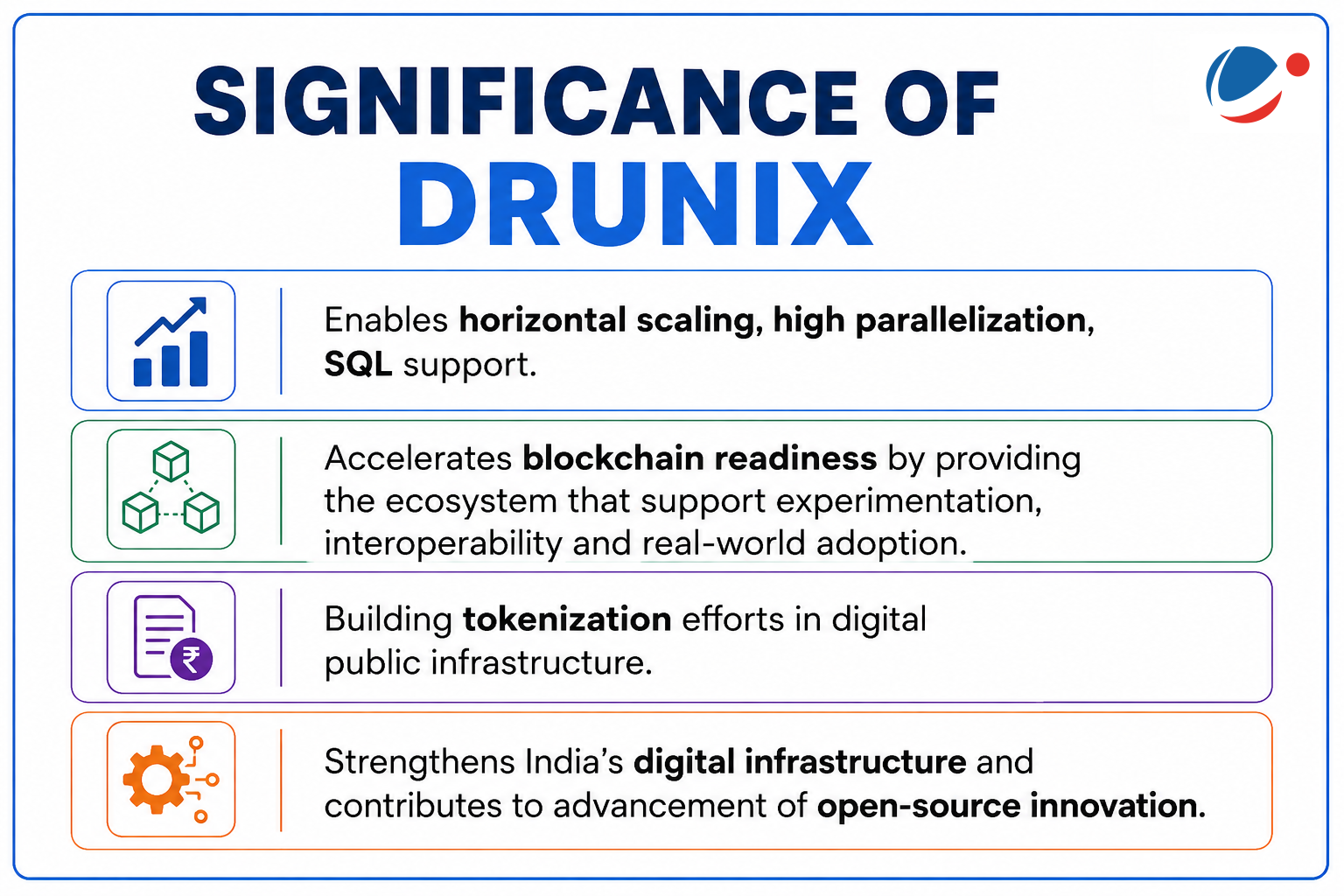
  • An enterprise-grade distributed ledger technology designed to help organizations build and scale tokenization platforms, digital asset ecosystems, and multi-organization networks. 
  • It is a custom-built private blockchain framework designed and developed by re-engineering Hyperledger Fabric. 
    • Hyperledger Fabric is an open-source enterprise blockchain framework developed under the umbrella of Linux Foundation.
About Blockchain Technology

  • Meaning: Advanced database mechanism that allows transparent information sharing within a business network. 
    • Stores data in blocks that are linked together in a chain, are chronologically consistent as one cannot delete or modify the chain without consensus from the network. 
  • Significance: Creates an unalterable or immutable ledger for tracking orders, payments, accounts; prevents unauthorised transaction entries, etc. 

About Tokenisation

  • Meaning: Process that converts ownership rights of real-world assets (like real estate, commodities, artworks, financial instruments) into digital tokens secured on blockchain networks. 
  • Significance: Democratising access to investment opportunities; new possibilities for fractional ownership, enhanced liquidity, and streamlined transaction processes. 

About NPCI

  • Umbrella organisation for operating retail payments and settlement systems in India. 
  • Initiative of: Reserve Bank of India (RBI) and Indian Banks’ Association (IBA) under Payment and Settlement Systems Act, 2007.
  • Nature:  “Not for Profit” Company under Companies Act 2013. 
  • Key   Products of NPCI: RuPay; Immediate Payment Service (IMPS); Aadhaar enabled Payment System (AePS); Unified Payments Interface (UPI); etc.  
Watch Video News Today

Explore Related Content

Discover more articles, videos, and terms related to this topic

RELATED TERMS

3

Payment and Settlement Systems Act, 2007

A legislative act that provides the legal framework for the regulation and supervision of payment systems in India. It empowers the RBI to oversee various payment mechanisms and ensure their safety and efficiency.

Hyperledger Fabric

An open-source enterprise blockchain framework developed under the umbrella of the Linux Foundation, providing a modular architecture for building and deploying blockchain-based applications.

Tokenisation

The process of converting ownership rights of real-world assets into digital tokens secured on blockchain networks, facilitating fractional ownership, enhanced liquidity, and streamlined transactions.

Title is required. Maximum 500 characters.

Search Notes

Filter Notes

Loading your notes...
Searching your notes...
Loading more notes...
You've reached the end of your notes

No notes yet

Create your first note to get started.

No notes found

Try adjusting your search criteria or clear the search.

Saving...
Saved

Please select a subject.

Referenced Articles

linked

No references added yet
