


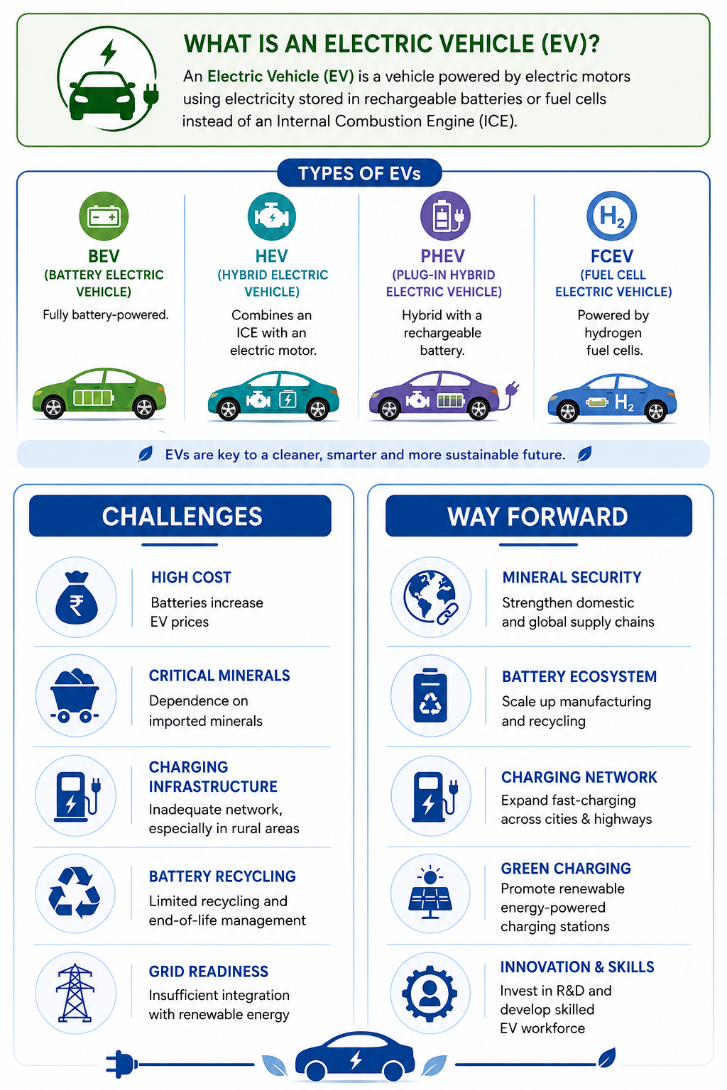
EVs boost India's energy security, climate action, economic growth, and technological competitiveness by cutting oil imports, lowering emissions, driving domestic manufacturing under Make in India, and fostering battery innovation.
Government Initiatives to Promote EVs
- Policy & Demand Promotion
- National Electric Mobility Mission Plan 2020 (NEMMP): Roadmap for EV adoption.
- FAME India Scheme: Demand incentives, charging infrastructure & manufacturing.
- PM E-DRIVE Scheme: EV incentives, charging infrastructure & e-public transport.
- Manufacturing
- PLI Scheme (Auto & Auto Components): Incentivises EV and Advanced Automotive Technologies.
- PLI Scheme for ACC Battery Storage: Develops indigenous battery manufacturing.
- Infrastructure & Innovation
- NITI Aayog India Electric Mobility Index (IEMI): Assesses State EV readiness.
- e-Amrit Portal: EV awareness and charging station information.
- Fiscal & State Support
- 5% GST on EVs.
- State EV Policies: 29 States/UTs have notified EV policies (as of December 2025) offering fiscal and non-fiscal incentives.
Key Achievements
- EV sales: Grown ~46x since 2016.
- Exports: Surged from USD 1.2 million (2020) to USD 84 million (2024).
- EV adoption surge: From 0.08% in FY15-16 to 8.26% in FY25-26.
Key Targets
- India aims for 30% of all vehicle sales to be electric by 2030, aligning with the global EV30@30 initiative.
- Establishment of 1.32 million charging stations across India by 2030.
- India’s EV market is projected to grow from USD 3.71 billion (2025) to USD 191.04 billion by 2034 (~55% CAGR), with the EV battery market growing from USD 2.71 billion to USD 15.90 billion (21.70% CAGR).




