


Bill amends MMDR Act, 1957 to restrict States’ mineral taxation powers and ensure fiscal uniformity for mineral sector.
- MMDR Act, 1957 allows central government to regulate major mineral (coal, iron ore, bauxite) while minor minerals (building stones, gravel, ordinary clay etc.) are regulated by State Government.
Key Provisions of Bill
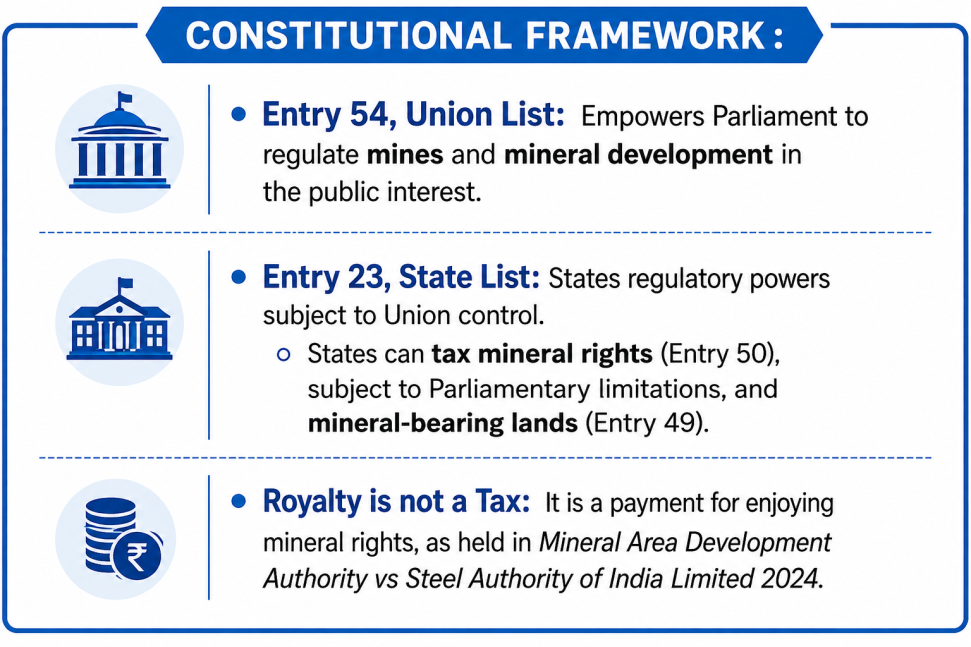
- Mineral bearing lands: Central government will be empowered to regulate mineral bearing lands i.e. any land having mineral contents in accordance with parameters prescribed by central government.
- New Section 9D: Prohibits state from imposing any tax, cess, or other such levy on mineral rights, or mineral bearing lands, whether based on mineral quantity, mineral value, royalty or otherwise, except in accordance with conditions or restrictions prescribed by Centre.
- Past Levies: Unpaid/unrecovered State levies imposed before amendment will be deemed invalid. However, amounts already deposited/recovered will not be refunded.
- Rule-Making Power (Section 13): Central Government will prescribe conditions or restrictions for imposition of tax, cess or such other levy by State Government.
Need for Amendment
- High & Uneven Tax Burden: Cascading and varying State levies increased extraction costs, hurt small and medium-scale mining operators and made some mining operations unviable.
- Business & Investor Uncertainty: Unpredictable and retrospective taxation disrupted operations, discouraged investment and weakened investor confidence.
- Inflationary Impact: Higher mineral extraction costs increased production costs and consumer prices.
- Lack of Fiscal Uniformity: Wide inter-state variations in taxes created an uneven mining landscape.



