
Saudi East-West oil pipeline shut | Current Affairs | Vision IAS

Upgrade to Premium Today

Start Now
MENU
Home
Quick Links

High-quality MCQs and Mains Answer Writing to sharpen skills and reinforce learning every day.

Watch explainer and thematic concept-building videos under initiatives like Deep Dive, Master Classes, etc., on important UPSC topics.

A short, intensive, and exam-focused programme, insights from the Economic Survey, Union Budget, and UPSC current affairs.

ESC

In Summary

  • Saudi Arabia temporarily shut its East-West oil pipeline after reported attacks from Iraq, halting 4-5% of global oil supplies.
  • The 1,200km Petroline pipeline is a crucial Hormuz-bypass route for Saudi oil exports, originating from Abqaiq and ending at Yanbu port.
  • Disruption impacts India by potentially increasing oil import costs, widening the current account deficit, and affecting inflation and the rupee's exchange rate.

In Summary

Saudi Arabia has temporarily shut its East-West oil pipeline after reported attacks from Iraq.

About East-West pipeline

  • The pipeline, also called Petroline, is an1,200km East-West pipeline in the 1980s.
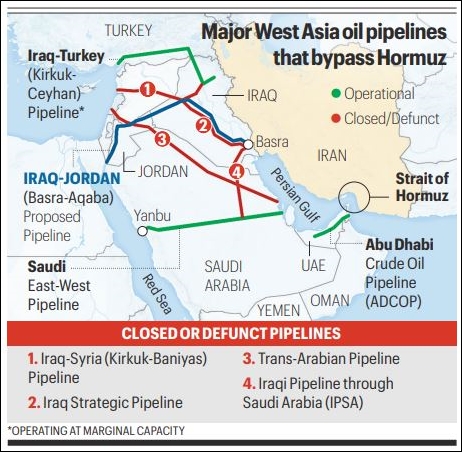
  • In bid to bypass Hormuz chokepoint, Gulf countries scramble to ramp up infraIt crosses Saudi Arabia from Abqaiq oilfield in the east to the Yanbu port on the Red Sea in the west.
    • From Yanbu, oil tankers usually sail east to Asia through the Bab el-Mandeb, while those headed west go through the Suez Canal.
  • It is an important Hormuz-bypass routes (see infographic for other bypass pipelines) for exporting Saudi Arabian crude during the Iran war.

Potential impact on India

  • Disruption of global oil supply: The closure of the pipeline has halted the flow of Saudi oil exports, which represents 4-5% of global oil supplies.
    • Saudi oil accounts for ~7-8% of India’s total oil imports over the past couple of months, a vast majority of coming from the Yanbu export facility.
  • Surging Import Costs: India imports over 88% of its crude oil needs and every $1-per-barrel increase in price increases oil import bill by up to $2 billion annually.
  • Widening Current Account deficit (CAD): Every 10% oil price increase typically widens India’s current account deficit by 0.4% of the GDP. 
  • Other economic impacts: Inflationary pressures, impact on India’s trade balance and the rupee’s exchange rate, etc.
Watch Video News Today

Explore Related Content

Discover more articles, videos, and terms related to this topic

RELATED VIDEOS

1
Role of Indian Diaspora in Making India Self-Reliant

Role of Indian Diaspora in Making India Self-Reliant

YouTube HD

RELATED TERMS

3

GDP

Gross Domestic Product. The total monetary or market value of all the finished goods and services produced within a country's borders in a specific time period.

Current Account Deficit (CAD)

A measure of a country's trade balance, calculated as the sum of the balance of trade, net income from abroad, and net current transfers. A deficit indicates that a country is importing more goods, services, and capital than it is exporting.

Hormuz-bypass routes

These are alternative oil export routes that circumvent the Strait of Hormuz, a critical chokepoint for global oil supplies. The East-West pipeline is an example of such a bypass route.

Title is required. Maximum 500 characters.

Search Notes

Filter Notes

Loading your notes...
Searching your notes...
Loading more notes...
You've reached the end of your notes

No notes yet

Create your first note to get started.

No notes found

Try adjusting your search criteria or clear the search.

Saving...
Saved

Please select a subject.

Referenced Articles

linked

No references added yet
