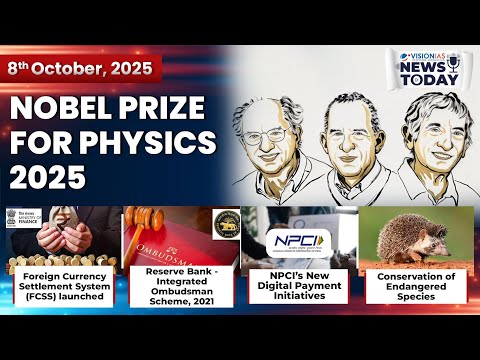
2025 Nobel Prize in Physics
The 2025 Nobel Prize in Physics has been awarded to John Clarke (U.K.), Michel H. Devoret (France), and John M. Martinis (U.S.) for their collaborative work on quantum mechanics.
Key Contributions
- Their work focused on understanding the quantum realm, particularly the phenomenon of quantum tunneling.
- They constructed an electrical circuit involving two superconductors and a Josephson junction to explore quantum phenomena.
- Their experiments demonstrated the control and simulation of electricity flow without voltage, paving the way for practical superconducting circuits.
Impact on Technology
- Their research is foundational for developing quantum computers, which utilize qubits for exponentially faster calculations compared to classical computers.
- Quantum computers pose a challenge to encryption systems reliant on slower, bit-based computations.
- Countries like India are investing heavily in quantum computing research, aiming to develop functional quantum computers by 2031.
Historical Context and Significance
- Their work in the mid-1980s was instrumental in demonstrating macroscopic quantum tunneling, a significant breakthrough in quantum physics.
- The research laid the groundwork for understanding and engineering superconducting qubits, critical for future quantum computers.
- Their achievement highlights the enduring significance and applicability of quantum mechanics in modern technology.
Acknowledgments and Awards
- John Clarke, a professor at UC Berkeley, advanced his research in superconductors and the Josephson junction.
- Michel Devoret and John Martinis joined Clarke's team, contributing to the advancement of their groundbreaking experiments.
- The Nobel Prize includes a monetary award of 11 million Swedish kroner, approximately ₹1 crore, shared equally among the three laureates.