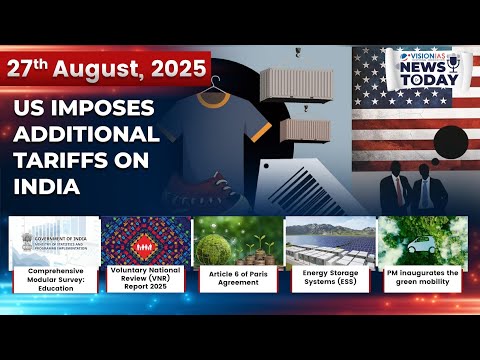
India-US Bilateral Trade Deal
India and the United States (US) have not yet concluded a bilateral trade deal, despite both countries signing agreements with other partners in recent years. Here are the reasons and complexities involved in the negotiations:
Trade Agreements with Other Partners
- In the past four years, India has signed trade agreements with Mauritius, the United Arab Emirates, Australia, New Zealand, Oman, the European Free Trade Association bloc, the United Kingdom (UK), and members of the Indo-Pacific Economic Framework (IPEF), which also includes the US.
- The US has concluded quick trade deals with Japan, the European Union (EU), the UK, South Korea, Thailand, Vietnam, and Malaysia in the last six months.
Reasons for Delayed India-US Trade Deal
- Security Dependence:
- Countries rapidly concluding deals with the US depend heavily on Washington for their security.
- India does not rely on the US for security, changing the negotiation dynamics.
- Broad Scope of Negotiations:
- US-India talks extend beyond trade to strategic and policy areas significant to Washington.
US as a Security Provider
- Countries like Japan, South Korea, UK, and EU members rely on US military support, shaping their trade negotiations.
- In Southeast Asia, countries like the Philippines and Thailand are bound by treaties or embedded in the US security framework.
- India maintains strategic autonomy, differing from countries dependent on US security.
- China, similar to India, does not depend on the US for security and holds strategic leverage in critical minerals.
Indo-US Trade Talks: Beyond Trade
- Negotiations began in February 2025 but remain stuck due to demands that extend into domestic policy changes.
- US demands include:
- Increased purchase of American oil and defense equipment by India.
- Relaxation of data and digital rules, and distancing from BRICS partners, especially Russia and China.
- Unrestricted cross-border data flows and changes in digital services taxation.
- Entry of US companies like Starlink into the Indian market.
- The US imposed a 25% tariff on Indian exports in response to oil purchases from Russia, but not on China or the EU.
India's Concessions and Challenges
- India has increased its oil imports from the US by 80%, adjusted nuclear liability frameworks, and allowed Starlink operations.
- India has shown flexibility in trade access, willing to eliminate tariffs on 95% of US industrial exports.
- Ongoing issues include US demands for access to dairy and genetically-modified crops, sensitive in India.
Next Steps and Strategic Decisions
- Negotiations have reached a standstill, awaiting a decision from President Trump.
- India should avoid further concessions without an agreement, with a clear decision needed on Russian oil imports.
- Export decline to the US by 20.7% over six months highlights the cost of strategic ambiguity.
- A potential complete halt to Russian oil could lead US demands to shift focus to other sectors like agriculture and digital trade.
Ultimately, a trade deal should be fair and reciprocal without compromising India's strategic independence or policy space.