Abhyaas
Know Where You Stand in UPSC Prelims: How Abhyaas Benchmarks Your Preparation















There comes a point in UPSC preparation when the anxiety is no longer about the syllabus. The subjects are known, the sources are familiar, and the routine of reading, revising, and testing begins to acquire a certain order. Yet, beneath this apparent control lies a more important and more difficult question: Where do I actually stand?
This question is central to the Preliminary Examination. In an exam defined by intense competition, preparation cannot be understood merely as completion of books or repetition of notes. It must be understood in relation to the standard of the examination and the level of the competition. A candidate may feel prepared in isolation and still remain uncertain in a comparative setting. That uncertainty is not accidental; it emerges from the very nature of UPSC Prelims.
The Preliminary Examination is not simply a test of memory or information. It is a filtering stage that distinguishes between broad familiarity with the syllabus and exam-ready command over it. This is why many aspirants discover that the real challenge is not only to study more, but to measure preparation more intelligently.
Why UPSC Prelims Demands Benchmarking, Not Just Preparation
The common instinct in preparation is to focus on content acquisition. Aspirants complete standard books, revise current affairs, attempt topic-wise questions, and often evaluate their growth through raw scores. However, Prelims success depends on something more layered than score accumulation.
- Relative Competition: UPSC Prelims is fundamentally comparative. A score becomes meaningful only when understood against the broader performance of serious aspirants. In such an exam, preparedness is not absolute; it is relative.
- Variable Difficulty: The paper rarely rewards mechanical preparation. Questions may combine static concepts, current relevance, and option-based traps in ways that make even familiar areas uncertain. This means that readiness must be judged not only by what one knows, but by how one responds under evolving difficulty.
- Decision Quality: Prelims is as much a test of judgment as of knowledge. Whether to attempt, eliminate, or skip is often decisive. Two candidates with similar knowledge levels may perform very differently because their decision-making differs.
- Cutoff Sensitivity: Small differences in performance often produce large differences in outcome. Missing the cutoff is not always a reflection of weak preparation; sometimes it is the result of inadequate benchmarking, poor calibration, or weak exam temperament.
For these reasons, serious preparation needs a mechanism that reveals competitive standing with greater clarity.
Why Self-Assessment Often Creates a False Sense of Readiness
Many aspirants do test themselves regularly. Yet self-testing, unless anchored in a broader competitive framework, can produce distorted conclusions.
- Scores Without Context: A mock score may appear encouraging, but without comparison it does not reveal whether that level is sufficient for a competitive exam.
- Inconsistent Testing Conditions: Home-based attempts, casual timing, and uneven seriousness in test environments can make performance look stronger than it may actually be under formal conditions.
- Selective Confidence: Aspirants often interpret strong performances as proof of readiness while discounting erratic performances as exceptions. This creates emotional comfort but weak analytical clarity.
- Uneven Performance Patterns: A candidate may be strong in content but weak in time management; accurate in easy papers but unstable in difficult ones; comfortable in GS but uncertain in CSAT. Such patterns are not always visible through isolated self-evaluation.
In effect, self-assessment is necessary but insufficient. What aspirants require is a more objective and comparative understanding of their position.
The Academic Value of Benchmarking in UPSC Preparation
Benchmarking introduces discipline into preparation by converting vague confidence into measurable clarity. It helps aspirants understand not merely whether they are improving, but whether their improvement is competitive.
- Competitive Positioning: Benchmarking reveals where an aspirant stands among other serious candidates rather than in an isolated personal cycle of tests.
- Strategic Calibration: It helps determine whether one’s attempt strategy, accuracy level, and risk-taking behaviour are aligned with exam demands.
- Focused Prioritisation: Once comparative gaps become visible, preparation can be directed towards specific weaknesses instead of broad, unfocused revision.
- Performance Tracking Over Time: Repeated benchmarking across multiple tests helps aspirants observe whether improvement is stable, temporary, or uneven.
Thus, benchmarking is not merely evaluative; it is diagnostic and strategic.
Abhyaas as a National Benchmarking Platform
It is in this context that the All India Abhyaas Prelims (GS +CSAT) Mock Test Series 2026 becomes significant. Conducted by VisionIAS as a nationwide UPSC Prelims simulation, Abhyaas is designed to provide aspirants with a structured environment in which preparation can be measured more realistically.
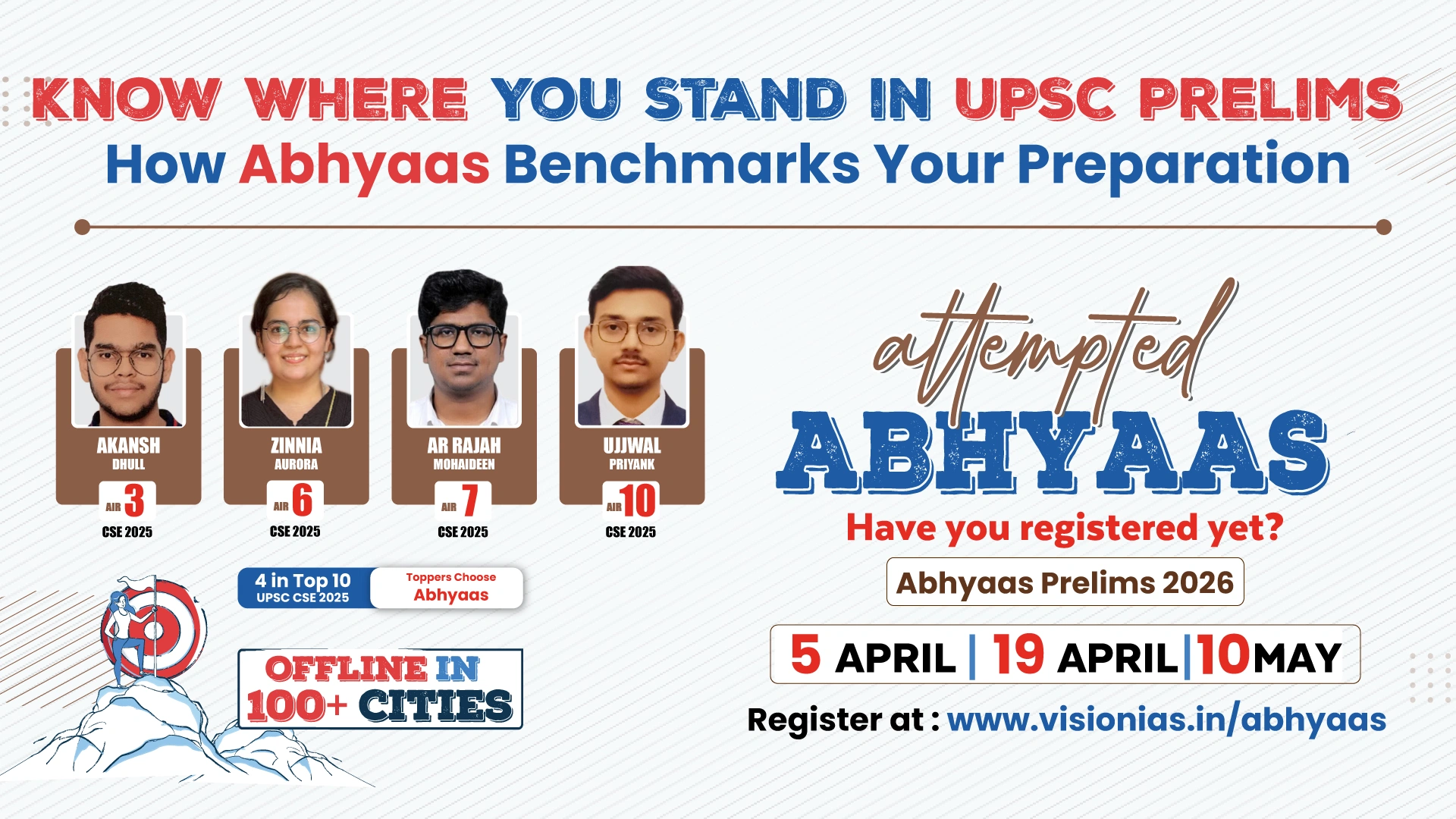
It is conducted in 100+ cities and follows an offline OMR-based format, with full-length General Studies and CSAT papers closely aligned to the actual examination setting. For the 2026 cycle, the All India Abhyaas tests are scheduled on 5 April, 19 April, and 10 May 2026.
The significance of Abhyaas lies not only in simulation, but in standardisation. A common testing environment, large-scale participation, and comparative evaluation together create a more reliable picture of one’s standing.
Register: Abhyaas Prelims 2026

In this broader context, if one reflects on the preparation journeys of several UPSC toppers across recent years who have engaged with structured prelims simulations such as Abhyaas, a consistent pattern becomes visible.
UPSC Toppers like Shubham Kumar (AIR 1, CSE 2020), Ankita Agarwal (AIR 1, CSE 2021), Ishita Kishore (AIR 1, CSE 2022), Aditya Srivastava (AIR 1, CSE 2023), Shakti Dubey (AIR 1, CSE 2024), and Akansh Dhull (AIR 3, CSE 2025) reflect an approach where preparation goes beyond content coverage to include deliberate performance refinement. Their journeys underline the importance of testing, evaluation, and benchmarking as integral components of serious prelims preparation.
How Abhyaas Benchmarks Preparation
- All India Ranking and Comparative Standing: One of the strongest academic uses of Abhyaas is that it places a candidate’s performance within a national cohort. This transforms a test score into a more meaningful indicator of competitiveness.
- UPSC-Aligned Testing Environment: Because the tests are conducted in an offline OMR mode and include both GS and CSAT, the candidate is able to experience the rhythm, seriousness, and constraint structure of the real exam more closely.
- Performance Analysis: VisionIAS presents Abhyaas as a platform for detailed performance review, allowing aspirants to identify not only weak subjects but also patterns in approach, accuracy, and test behaviour.
- Live Test Discussion: A benchmark becomes valuable only when it leads to correction. Post-test discussions support that process by helping aspirants understand not merely the correct answer, but the logic, prioritisation, and approach behind it.
- Mentoring Support: The inclusion of mentoring support makes the benchmarking exercise more actionable. Comparative performance, when interpreted correctly, can guide more focused revision and strategic adjustment.
From Confidence to Clarity
The real value of benchmarking lies in the shift it produces in the aspirant’s mindset. Preparation begins to move away from vague reassurance and towards informed clarity. One no longer asks only, Have I studied enough? Instead, the questions become sharper: Am I competitive enough? Is my strategy stable enough? Are my weak areas manageable before the actual exam?
This shift is academically important because it makes preparation more evidence-based. It reduces guesswork, disciplines revision, and creates a more honest understanding of readiness.
Conclusion
In UPSC Prelims, the difference between effort and outcome is often determined by how accurately preparation is measured before the actual examination. Without benchmarking, preparation may remain sincere but directionless. With benchmarking, it becomes sharper, more grounded, and more responsive to the demands of the exam.
Abhyaas, in this sense, functions not merely as a mock test series but as a benchmarking framework. It offers aspirants a way to understand their standing, refine their strategy, and move closer to exam readiness with greater realism.
Watch VisionIAS Faculties Tips on Abhyaas Prelims 2026