Current Affairs
11th Quad Foreign Ministers’ Meeting: Key Outcomes for the Indo-Pacific
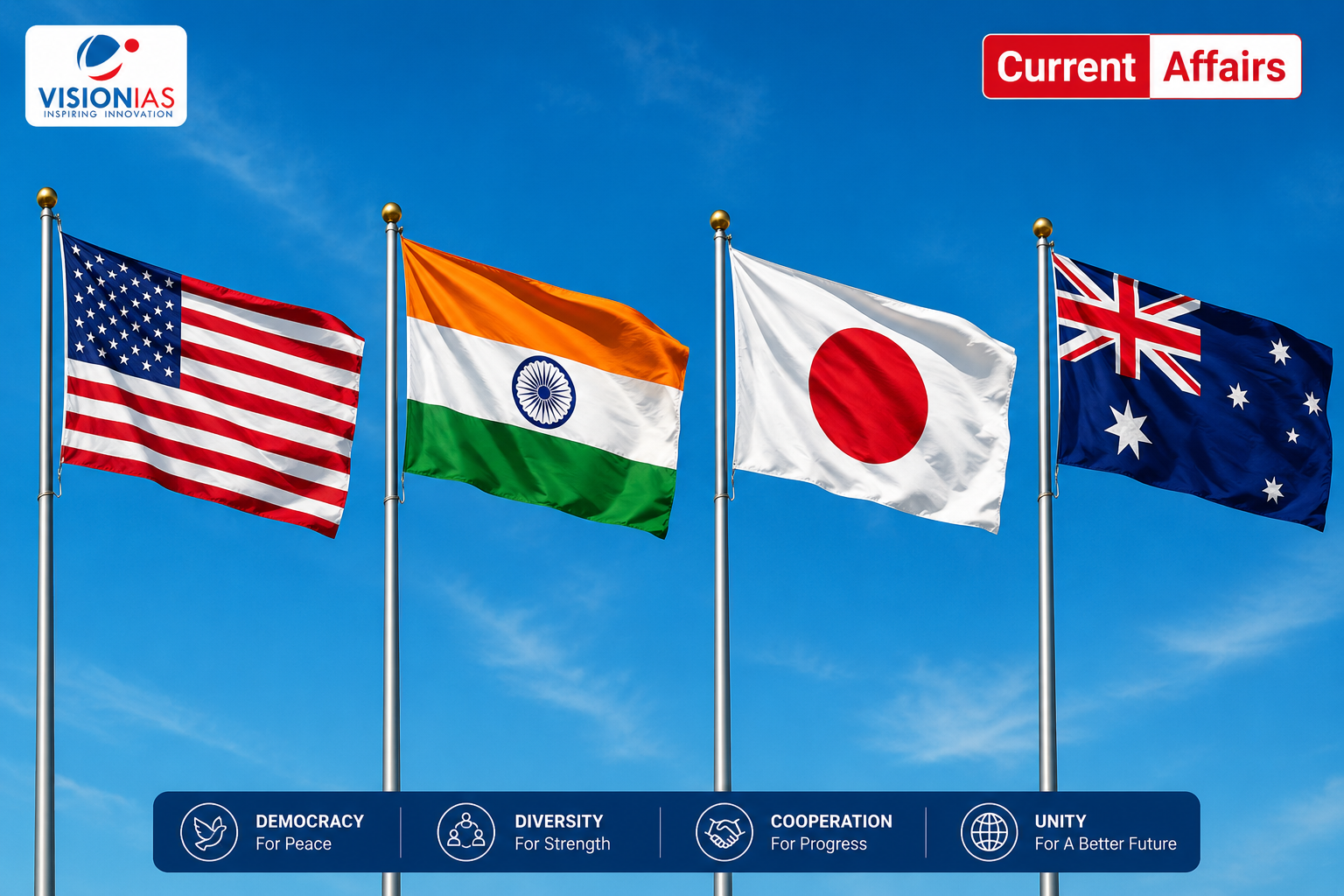















The 11th Foreign Ministers’ Meeting of the Quadrilateral Security Dialogue (Quad) was held in May 2026 with participation from India, the United States, Japan and Australia.
New Delhi hosted the 11th Quad Foreign Ministers’ Meeting on 26 May 2026. The meeting brought together the Foreign Ministers of India, Australia, and Japan, alongside the United States Secretary of State. The Quadrilateral Security Dialogue (Quad) collectively represents 24% of the world’s population, 35% of global GDP, and 18% of global trade.
Ministers reviewed cooperation across maritime surveillance, critical minerals, energy security, next-generation communications, and humanitarian preparedness. Several initiatives were announced, reinforcing the Quad’s role in shaping a free, open, and rules-based Indo-Pacific.
What Is the Quadrilateral Security Dialogue (Quad)?
The Quadrilateral Security Dialogue, known as the Quad, is an informal strategic grouping comprising India, the United States, Japan, and Australia. Its origins trace back to the 2004 Indian Ocean Tsunami, when the four countries coordinated humanitarian relief.
Key milestones in the Quad’s evolution:
- 2007: Formally proposed as a strategic dialogue by then-Japanese PM Shinzo Abe, but went dormant shortly after.
- 2017: Revived amid concerns about challenges to the rules-based order and increasing assertiveness in the Indo-Pacific.
- 2026: The Quad has evolved into one of the most consequential multilateral groupings in the Indo-Pacific, covering maritime security, clean energy, critical minerals, and agricultural technology.
Key Outcomes of the 11th Quad Foreign Ministers’ Meeting
The 11th Quad Foreign Ministers’ Meeting produced outcomes grouped across four pillars: maritime and transnational security; economic prosperity and energy security; critical and emerging technology; and humanitarian assistance and emergency response.
1. Maritime and Transnational Security
Ensuring freedom of navigation and open sea lanes remains central to the Quad’s maritime agenda. At the 11th meeting, ministers announced steps to upgrade maritime domain awareness across the Indo-Pacific, with an initial focus on the Indian Ocean Region. The Indo-Pacific Maritime Surveillance Collaboration (IPMSC) was launched as the first initiative to pool each member’s surveillance capabilities, enhance real-time information sharing, and strengthen maritime domain awareness across the region.
Building on this, Quad countries are developing a Common Operating Picture (COP) under the Indo-Pacific Partnership for Maritime Domain Awareness (IPMDA) framework, enabling near real-time visibility of maritime activity. India will also host the next edition of the Quad-at-Sea Ship Observer Mission, aimed at strengthening interoperability among Quad navies and coast guards to address unlawful maritime activities.
On counter-terrorism, India hosted two Quad Workshops in September 2025, covering:
- Countering the use of Unmanned Aerial Vehicles (UAVs) and drones for terrorist purposes.
- Preventing terrorist exploitation of new and emerging technologies.
A Quad Counterterrorism Tabletop Exercise focused on state-sponsored terrorism and uncrewed aerial vehicles is scheduled in Australia in June 2026. Ministers also reaffirmed adherence to UNCLOS (United Nations Convention on the Law of the Sea), underlining navigational rights and overflight freedoms in the Strait of Hormuz, the Red Sea, and the East and South China Seas.
2. Economic Prosperity, Energy Security, and Critical Minerals
The announcements on critical minerals and supply chain security stood out at the 11th Quad Foreign Ministers’ Meeting. China currently holds 49% of the world’s rare earth reserves, produces 69% of rare earth minerals, and controls 90% of their refining. In this context, the Quad’s response operates at two levels.
At the multilateral level, the Quad Critical Minerals Initiative Framework was announced to coordinate economic policy and investment across mining, processing, and recycling, with a target of mobilising up to $20 billion to reduce dependence on concentrated supply sources. Bilaterally, India and the United States signed the Framework on Securing of Supply in the Mining and Processing of Critical Minerals and Rare Earths, building on the U.S.-led Pax Silica and FORGE initiatives to cover financing, recycling, and supply diversification.
Other economic initiatives announced at the meeting include:
- Quad Initiative on Indo-Pacific Energy Security: Aimed at strengthening regional energy resilience through cooperation in technology, policy, market analysis, and emergency response.
- Ports of the Future Partnership: The Quad announced cooperation with the Government of Fiji to advance port infrastructure, supporting key Indo-Pacific trade corridors.
- Undersea Cable Connectivity: The Quad committed to connecting all Pacific Island Forum countries via undersea cables by 2026, with combined energy technology assistance across the Indo-Pacific exceeding $25 million.
3. Critical and Emerging Technology
The technology agenda at the Quad Foreign Ministers’ Meeting reflected a recognition that the Indo-Pacific’s digital future depends on standards, supply chains, and innovation. Quad partners announced collaboration on Next-Gen Communication Standards, with a focus on shaping global 6G standards and promoting Open RAN (Radio Access Networks) frameworks, where trusted suppliers are central to digital sovereignty.
Additional technology initiatives announced at the meeting:
- Open RAN Progress in Palau: Trusted suppliers were selected in February 2026, strengthening Palau’s access to secure 4G and 5G connectivity and contributing to digital supply chain resilience.
- Digital Identity Standards Workshop: Quad countries agreed to create a technical translation guide to enhance cross-border interoperability of digital identity frameworks.
- AI-ENGAGE (Agriculture): Over $6 million was announced for six international research projects under the Advancing Innovations for Empowering NextGen Agriculture initiative, delivering AI, robotics, and sensing tools to improve crop yields, pest management, and food security.
4. Humanitarian Assistance and Emergency Response
The Quad has consistently treated security and human welfare as linked priorities. At the 11th meeting, partners committed over $50 million toward training health professionals across the Indo-Pacific to respond to public health emergencies, including disease outbreaks.
On disaster response, a tabletop exercise (TTX) and Strategic Working Group meeting held in Honolulu in 2025 enhanced the Quad’s collective capabilities. These exercises coordinate responses covering search and rescue and logistics, so that when disaster strikes in the Indo-Pacific, the Quad can respond without delay.
Significance of the Quad for India
India’s hosting of the 11th Quad Foreign Ministers’ Meeting in New Delhi reflected its growing role in the grouping. The outcomes carry weight for India across four areas:
- Strategic Balancing: The Quad, including the annual Malabar Exercises, gives India a platform to project maritime power and counterbalance Chinese assertiveness in the Indian Ocean Region without the obligations of a formal alliance.
- Critical Minerals Security: The India-US critical minerals framework supports India’s clean energy and manufacturing goals in EVs, batteries, semiconductors, and solar energy, by reducing dependence on Chinese supply chains for rare earths and critical minerals.
- Technology Leadership: India’s participation in 6G standards development and digital identity frameworks positions it as a rule-setter in the next phase of global digital infrastructure.
- Economic Connectivity: Investments in port infrastructure, undersea cables, and energy technology align with India’s Act East Policy and its ambitions as a regional trade hub.
Conclusion
The 11th Quad Foreign Ministers’ Meeting in New Delhi was more than a diplomatic gathering. It demonstrated that the Quadrilateral Security Dialogue has matured into a results-oriented partnership. From launching a maritime surveillance initiative to mobilising $20 billion for critical minerals supply chains, the Quad is translating shared values into outcomes for the Indo-Pacific.
For India, the moment carries weight on multiple fronts. As host, as a signatory of the new India-US critical minerals framework, and as an active voice on 6G standards and UNCLOS, India is helping shape the Quad’s direction. The June 2026 counterterrorism exercise in Australia will further test the grouping’s ability to move from dialogue to action.
Master Digital Age Governance & Technology Trends with VisionIAS Comprehensive Current Affairs →
11th Quad Foreign Ministers’ Meeting FAQs
1: Which countries are members of the Quad?
Ans. India, the United States, Japan, and Australia.
2: What maritime initiative was launched at the 11th Quad Foreign Ministers’ Meeting?
Ans. The Indo-Pacific Maritime Surveillance Collaboration (IPMSC) was launched to pool surveillance capabilities and enhance real-time information sharing across the region.
3: How much funding was announced for the Quad Critical Minerals Initiative?
Ans. Up to $20 billion.
4: What percentage of rare earth refining does China currently control?
Ans. 90%.
5: What technology standards are Quad nations collaborating on?
Ans. Global 6G standards and Open RAN frameworks.