Essay
VisionIAS VAM 2026 Essay: A Thought-Building Toolkit for UPSC Mains



The UPSC Civil Services Mains Essay Paper is unlike any other paper in the examination. General Studies tests what an aspirant knows; the Essay Paper tests how an aspirant thinks. It evaluates clarity of thought, depth of understanding, originality, balance, coherence, expression, and the ability to connect ideas across disciplines.
In General Studies, the right answer often depends on accuracy, coverage and relevant facts. In Essay, there is no single fixed answer. The real challenge is to interpret the topic correctly, identify its deeper theme, build a coherent argument, examine multiple perspectives, and present a mature, balanced and forward-looking view.
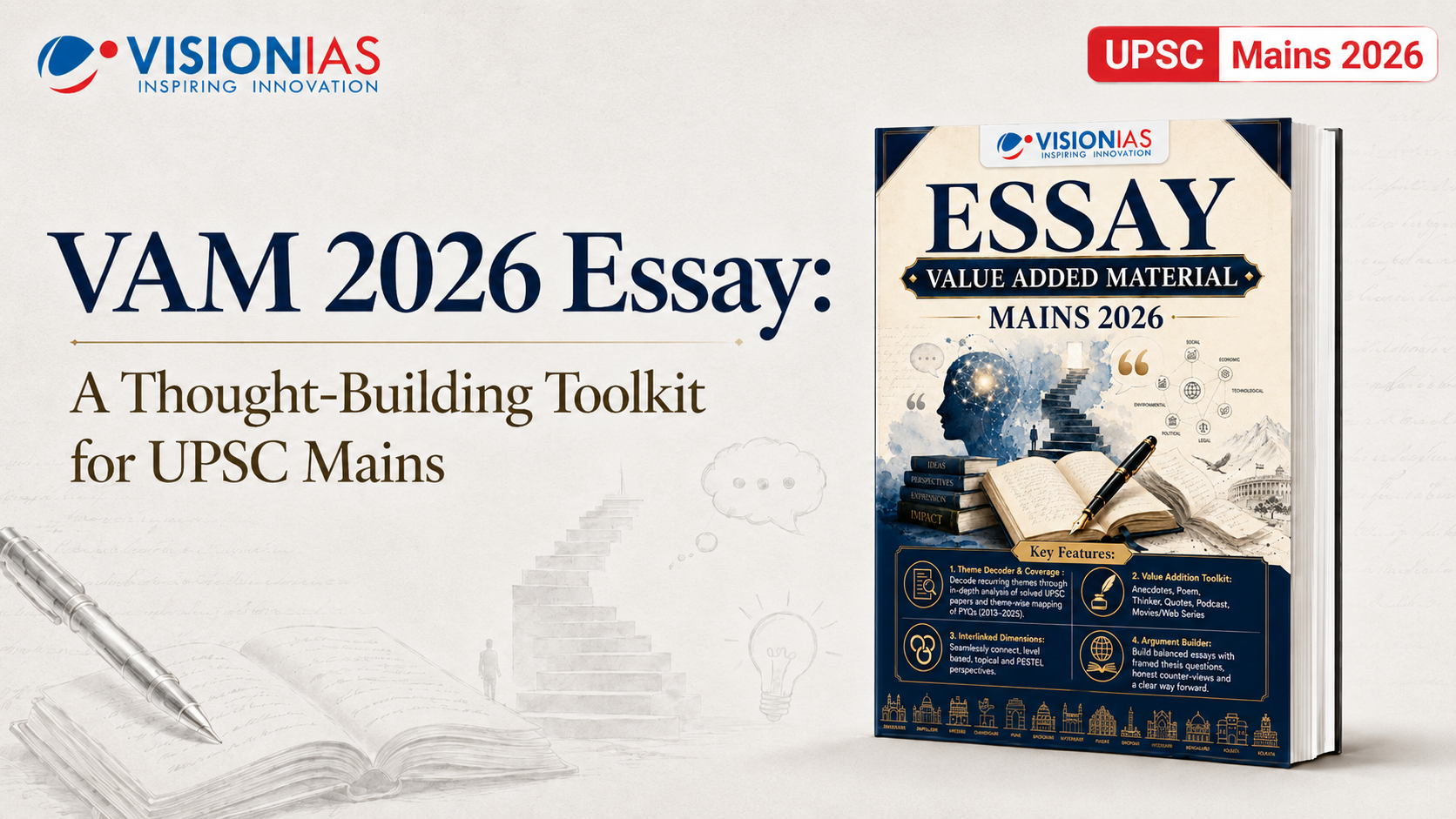
This is where VisionIAS Value Added Material (VAM) Essay 2026 becomes a strategic resource for UPSC Mains aspirants. It is not a collection of ready-made essays. It is a toolkit that helps aspirants learn how to think, structure and write better essays.
[Download VisionIAS Essay VAM 2026 PDF]
Why the UPSC Essay Paper Requires a Different Approach
The Essay Paper carries 250 marks, with aspirants required to write two essays of around 1000–1200 words each. This makes it one of the most decisive papers in Mains. However, many aspirants approach it either like a General Studies answer or like a literary composition. Both approaches can limit marks.
A good UPSC essay requires:
- Correct interpretation of the topic
- Identification of the central tension or paradox
- Multidimensional analysis
- Philosophical and practical depth
- Coherent flow from introduction to conclusion
- Balanced thesis and anti-thesis
- Relevant examples, anecdotes, thinkers, quotes and data
- Simple, mature and error-free language
- A hopeful and meaningful conclusion
The Essay Paper gives freedom to move across disciplines such as philosophy, ethics, sociology, history, economics, science, literature, governance and environment. A strong essay rarely remains confined to one subject. It draws insights from multiple fields and connects them into one coherent argument.
What Makes VisionIAS Essay VAM 2026 Useful?
1. It Helps Aspirants Think in Themes, Not Just Topics
UPSC essay topics are rarely narrow. Even when they appear simple, they are usually built around a deeper philosophical question, social tension, paradox or ethical challenge.
For example, a topic like “Digital economy: great equaliser or great divider?” is not merely about technology. It is about access, inequality, opportunity, power, inclusion, justice and governance.
Similarly, philosophical topics on truth, change, happiness, wisdom, freedom or identity require aspirants to go beyond surface meanings and engage with the deeper idea.
VisionIAS Essay VAM 2026 helps aspirants identify the broader theme beneath the topic and develop arguments accordingly.
2. It Uses the Building Block Method
The VAM encourages aspirants to treat every quote, anecdote, thinker, book, movie, statistic, poem and contemporary example as a building block. The aim is not to memorise material mechanically, but to understand where each example fits and how it can be adapted to different essay topics.
For instance:
- A story on the Ship of Theseus can be used for essays on change, identity and continuity.
- Aristotle can be used for happiness, virtue, ethics and purpose.
- Gandhi can be used for truth, means and ends, non-violence, simplicity and moral leadership.
- Artificial Intelligence can be used for essays on technology, ethics, creativity, inequality and human future.
- Climate change can be used for essays on sustainability, responsibility, development and intergenerational justice.
This approach helps aspirants build flexible content that can be used creatively across multiple topics.
3. It Provides a Clear Essay Architecture
One of the strongest features of the VAM is its structured essay architecture. Each theme is developed through a common framework:
- Essence of the theme
- Previous Year Questions
- Anecdotes and opening hooks
- Thesis
- Anti-thesis
- Penultimate or way forward
- Conclusion
- Value addition box
This helps aspirants understand how an essay can be unpacked, structured and developed into a coherent argument.
This framework is especially useful because it prevents the essay from becoming a random collection of points. It gives direction and ensures that the essay moves logically from interpretation to analysis, balance and conclusion.
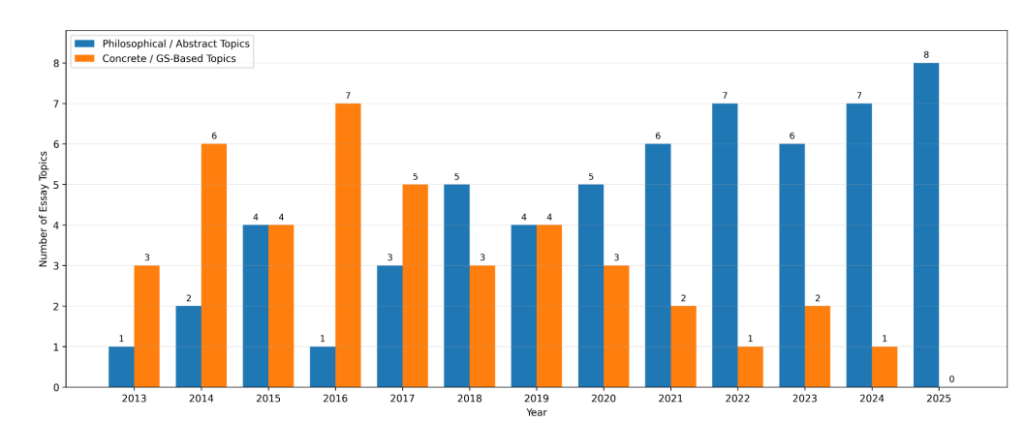
Evolution of UPSC Essay Paper: Why This VAM Matters Now
The UPSC Essay Paper has gradually shifted from conventional General Studies-oriented topics towards deeper philosophical, ethical and multidimensional themes. Knowledge remains important, but it is no longer enough. The paper increasingly rewards:
- Conceptual clarity
- Critical thinking
- Ability to connect abstract ideas with real-world realities
- Balanced reasoning
- Intellectual maturity
- Authentic expression
Philosophical topics such as change, identity, truth, wisdom, happiness, freedom, justice, values and faith have gained strong relevance. At the same time, topical themes like governance, technology, environment, economy, international relations and social change continue to remain important.
Major Theme Clusters Covered in VisionIAS Essay VAM 2026
The VAM is divided into three major sections.
Section 1: Fundamentals of Essay Writing
This section covers the basics of essay writing, including:
- What is an essay?
- What is a philosophical essay?
- Exam hall management
- Topic selection
- Brainstorming
- Essay structure
- Introduction
- Body development
- Conclusion
- Argument building
- Coherence, presentation and language
This section is useful for aspirants who know content but struggle to convert ideas into a complete essay.
Section 2: Philosophical Themes and Their Applications
This section covers major philosophical themes that frequently appear in the UPSC Essay Paper. These include:
- Change, Permanence and Identity
- Reality, Perception and Truth
- Action, Risk and Potential
- Happiness, Good Life and Well-Being
- Simplicity, Purpose and the Journey
- Knowledge and Wisdom
- Humanity and Values
- Power and Responsibility
- Justice and Charity
- Choice, Wrong and Right
- Religion, Belief and Faith
- Education, Creative Thinking and Innovation
These themes help aspirants develop depth, reflection and philosophical maturity in essays.
Section 3: Topical Themes and Contemporary Issues
This section covers important contemporary themes across governance, economy, society, technology, environment and international relations.
Key areas include:
- Democracy, Governance and Information
- Economic Growth, Development and Inequality
- International Relations, Geopolitics and Security
- Science, Technology and the Future
- Environment, Ecology and Sustainability
- Contemporary Social Dynamics
This section helps aspirants connect current issues with broader ideas, making essays balanced and relevant.
How VAM Essay 2026 Improves Essay Writing
1. It Helps Decode the Topic
The first challenge in essay writing is not writing; it is understanding. Every essay topic contains a central tension. Aspirants must identify it before beginning the essay.
For example:
- “You cannot step twice in the same river” reflects change as the only constant.
- “Culture is what we are; civilisation is what we have” reflects the tension between inner identity and external development.
- “The process of self-discovery has now been technologically outsourced” reflects the tension between human identity and algorithmic influence.
- “The fulfilment of the ‘new woman’ in India is a myth” reflects the tension between apparent progress and deeper structural continuity.
VAM Essay 2026 trains aspirants to identify such tensions before building arguments.
2. It Teaches Thesis, Anti-Thesis and Synthesis
A mature essay does not argue only one side. It presents a thesis, examines counter-arguments, and then arrives at a balanced synthesis.
For instance, in an essay on change and permanence:
Thesis: Change is essential for adaptation, growth and progress.
Anti-thesis: Without continuity and values, change may become chaos.
Synthesis: True progress lies in changing forms while preserving core principles.
This movement from thesis to anti-thesis to synthesis gives the essay intellectual maturity.
3. It Provides Ready-to-Adapt Opening Hooks
A strong introduction immediately creates interest and sets the direction of the essay. The VAM provides multiple types of introductions, such as:
- Personality-based introduction
- Quotation-based introduction
- Report/fact/index-based introduction
- Anecdote-based introduction
- Narrative introduction
- Book or movie-based introduction
For example, the Ship of Theseus can be used to begin essays on identity, continuity and change. A quote can introduce essays on truth, justice, freedom or power. A fact can ground essays on inequality, technology or environment.
4. It Helps Build the Body with Coherence
The body of an essay carries the main argument. It should not be a list of disconnected points. Each paragraph should flow logically from the previous one and contribute to the central thesis.
A strong essay body should include:
- Clear paragraphing
- Smooth transitions
- Multiple dimensions
- Examples and evidence
- Counter-arguments
- Balanced analysis
- Progressive movement of thought
The VAM emphasises coherence, logical flow and connectors so that the essay reads like one continuous argument, not as scattered notes.
5. It Encourages Multidimensional Thinking
A UPSC essay should explore the topic through multiple dimensions. Depending on the topic, aspirants can use:
- Individual dimension
- Social dimension
- Political dimension
- Economic dimension
- Ethical dimension
- Historical dimension
- Technological dimension
- Environmental dimension
- Global dimension
- Constitutional dimension
For example, an essay on technology should not only discuss innovation. It should examine access, inequality, privacy, democracy, employment, ethics, education, governance and the future of humanity.
6. It Guides Effective Conclusions
A conclusion should not simply repeat the essay. It should provide closure, balance and direction. VAM Essay 2026 discusses different types of conclusions, such as:
- Philosophical conclusion
- Cyclic conclusion
- Quotation-based conclusion
- Poem-based conclusion
- Book-based conclusion
- Personality-based conclusion
A powerful conclusion rises from the specific topic to a broader human truth and ends on a hopeful, forward-looking note.
Red Flags: What Aspirants Should Avoid
The VAM also highlights common mistakes that reduce marks in the Essay Paper. Aspirants should avoid:
- Misinterpreting the core theme
- Taking metaphorical topics literally
- Writing the essay like a GS answer
- Dumping facts, reports and data without flow
- Writing from only one angle
- Ignoring counter-arguments
- Using long, unbroken paragraphs
- Forcing irrelevant anecdotes
- Using heavy jargon
- Spending too much time on the first essay
- Rushing the conclusion
- Skipping final revision
These reminders are especially useful during final practice and exam hall execution.
How to Use VisionIAS Essay VAM 2026 Effectively
Step 1: Understand the Toolkit First
Begin with Section 1. Understand the fundamentals of essay writing, the difference between GS and Essay, the four-step method, and the role of thesis, anti-thesis and synthesis.
Step 2: Build Theme-Wise Notes
For each philosophical theme, prepare a short note containing:
- Essence of the theme
- 2–3 opening hooks
- 4–5 dimensions
- 2 thinkers or quotes
- 4 examples
- 1 counter-argument
- 1 possible conclusion
Step 3: Prepare an Example Bank
Create a flexible bank of:
- Anecdotes
- Quotes
- Thinkers
- Books and movies
- Historical examples
- Constitutional examples
- Contemporary issues
- Reports and data
Do not memorise them blindly. Learn where and how they can be used.
Step 4: Practise Topic Decoding
Before writing an essay, spend time decoding the topic. Ask:
- What is the central idea?
- What is the tension or paradox?
- Is it philosophical, social, ethical, technological or governance-oriented?
- What are possible dimensions?
- What is the counter-view?
- What should be the final balanced position?
Step 5: Practise Introductions and Conclusions Separately
Many aspirants lose marks because their introductions are vague and conclusions are rushed. Practise 10–15 introductions and conclusions separately using different styles.
Step 6: Write Full-Length Essays
Use the VAM for weekly essay practice. After writing, evaluate:
- Did the essay remain on theme?
- Was the flow coherent?
- Were examples relevant?
- Was the language simple and mature?
- Was the conclusion meaningful?
- Did the essay show original thinking?
Step 7: Manage Time in the Exam Hall
The Essay Paper requires two equally strong essays. Aspirants should avoid over-investing time in the first essay and weakening the second one. Keep time for brainstorming, writing and final revision.
Last-Mile Benefits of VisionIAS Essay VAM 2026
During the final phase before Mains, aspirants need a resource that helps them think clearly and write with confidence. VAM Essay 2026 provides:
- A structured essay-writing framework
- Philosophical and topical theme coverage
- PYQ-linked thematic preparation
- Opening hooks and anecdotes
- Thesis and anti-thesis development
- Value addition through quotes, thinkers, books, movies and examples
- Guidance on introduction, body and conclusion
- Red flags to avoid common mistakes
- Practical tools for essay planning and execution
It helps aspirants move from content collection to thought formation, and from random writing to structured expression.
[Download VisionIAS Essay VAM 2026 PDF]
Final Word
The UPSC Essay Paper rewards neither memorised content nor ornamental language alone. It rewards clarity, balance, depth, coherence and originality. A good essay shows that the aspirant can think beyond facts, connect ideas, understand contradictions and arrive at a mature view.
VisionIAS Essay VAM 2026 is designed to support this journey. It helps aspirants understand themes, build arguments, enrich essays with examples, and write with structure and confidence.
Use it not as a book of ready-made essays, but as a thinking toolkit. Read the themes, practise the architecture, build your own examples, and develop your own voice.
When knowledge meets reflection, and structure meets originality, essay writing becomes powerful. Let VisionIAS Essay VAM 2026 be your strategic companion for UPSC Mains Essay Paper.
FAQs on VisionIAS Essay VAM 2026
1. What is VisionIAS Essay VAM 2026?
VisionIAS Essay Value Added Material 2026 is a strategic toolkit for UPSC Mains Essay Paper. It helps aspirants understand essay themes, build arguments, use value additions and write coherent, balanced and multidimensional essays.
2. Is this a collection of ready-made essays?
No. It is not meant for memorising ready-made essays. It provides frameworks, themes, examples, hooks, quotes, thinkers and argument structures that aspirants can adapt creatively.
3. How does this VAM help in philosophical essays?
It explains major philosophical themes such as change, truth, happiness, wisdom, justice, identity, faith, values and responsibility. It helps aspirants decode abstract topics and connect them with real-life examples.
4. Does it cover contemporary topics also?
Yes. It covers topical themes such as governance, economy, inequality, science and technology, environment, international relations, security and social dynamics.
5. What is the best way to use VisionIAS Essay VAM 2026?
Start with the fundamentals, then revise theme-wise content, prepare opening hooks and examples, practise thesis-antithesis-synthesis, and write full-length essays regularly under time limits.