Geography
VisionIAS VAM 2026 Geography Optional Paper-I : A Complete Revision Resource for UPSC Mains








Geography has long remained one of the most popular optional subjects in the UPSC Civil Services Examination. It is analytical, interdisciplinary, diagram-friendly, and closely linked with contemporary issues such as climate change, urbanisation, migration, regional development, environmental degradation, resource management and geopolitics.
Yet, for many aspirants, Geography Optional can also feel overwhelming. The syllabus is vast, concepts are layered, theories need clarity, diagrams must be practised, and answers must combine geographical understanding with current examples.
As Mains approaches, aspirants often face questions such as: What should be revised first? Which themes are more important? How can theories, models, diagrams and case studies be used effectively in answers?
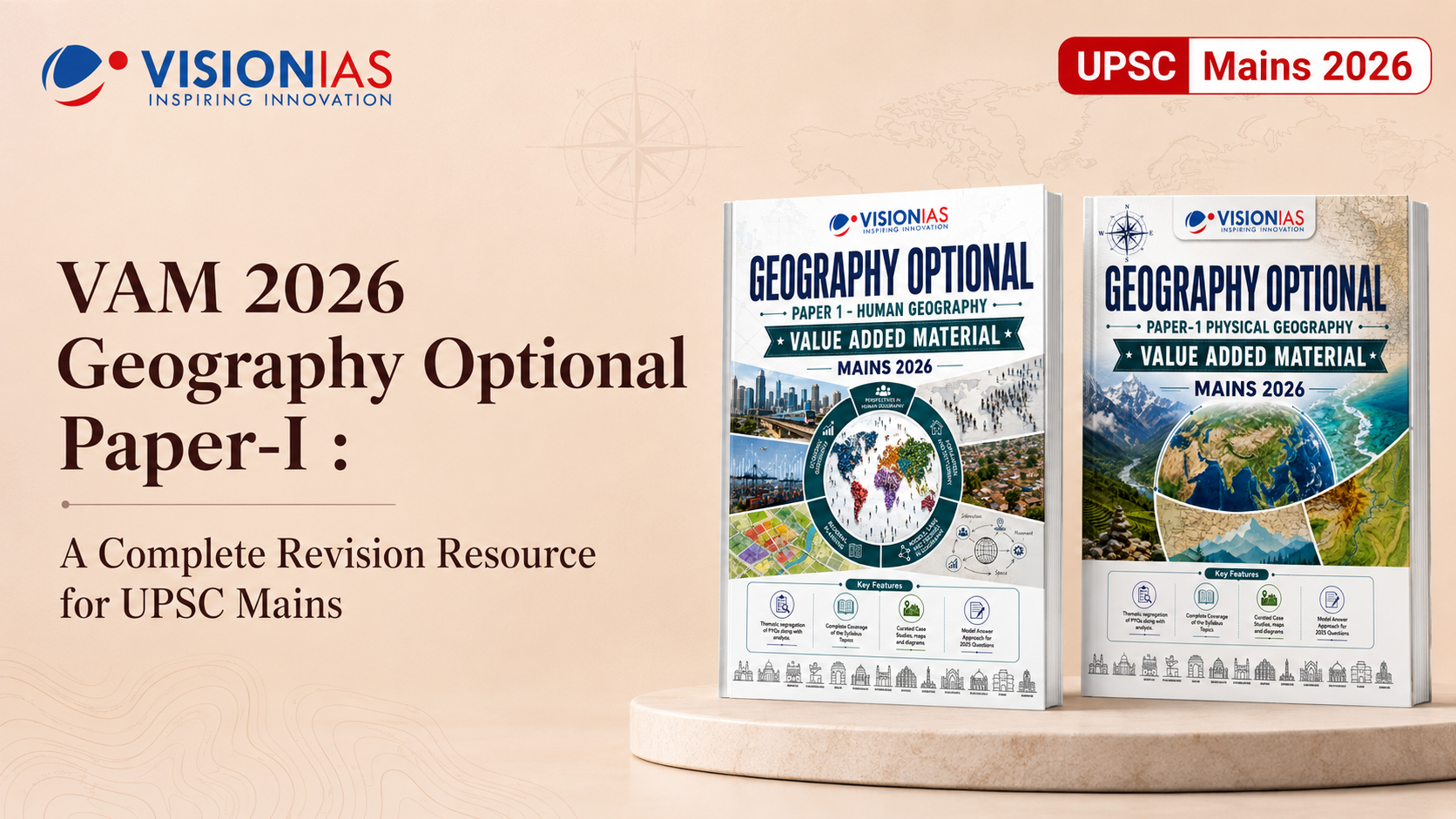
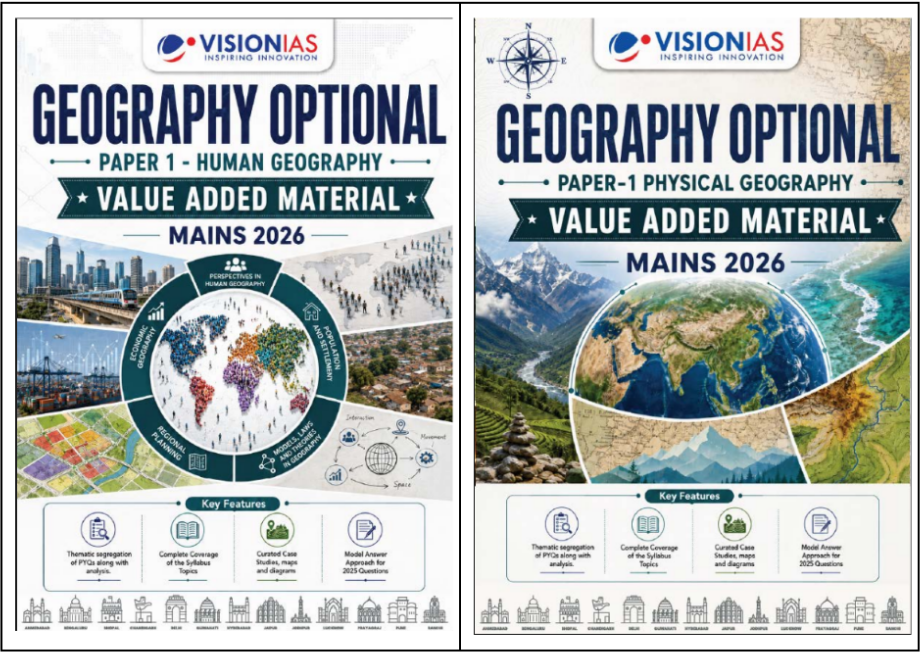
This is where VisionIAS Value Added Material (VAM) Geography Optional 2026 becomes highly useful. Covering both Physical Geography and Human Geography, the VAM is designed to help aspirants revise the syllabus in a structured, exam-oriented and answer-enrichment manner.
It is not just a compilation of notes. It is a focused resource that brings together syllabus coverage, PYQ analysis, case studies, maps, diagrams, contemporary examples and model answer approaches to help aspirants write more analytical and impactful answers.
Why Geography Optional Needs a Structured Revision Strategy
Geography Optional is not a subject that can be prepared through isolated facts. It requires the ability to understand processes, explain patterns, apply theories, draw diagrams and connect local realities with global frameworks.
A good Geography Optional answer usually requires:
- Conceptual clarity
- Syllabus mapping
- PYQ-based prioritisation
- Geographical terminology
- Relevant diagrams and maps
- Models and theories
- Case studies and examples
- Interlinking of physical and human dimensions
- Contemporary relevance
- Structured and analytical presentation
For example, a question on plate tectonics may require understanding of crustal evolution, geosynclines, mountain building, earthquakes and volcanic processes. Similarly, a question on urbanisation may demand linkage with migration, urban morphology, primate city, rank-size rule, rural-urban fringe, satellite towns and sustainable city planning.
Therefore, Geography Optional preparation must move beyond reading. It must become answer-oriented, diagram-supported and conceptually integrated.
[Download VisionIAS Geography Optional Physical Geography VAM 2026 PDF]
[Download VisionIAS Geography Optional Human Geography VAM 2026 PDF]
What Makes VisionIAS Geography Optional VAM 2026 Useful?
1. Complete Coverage of Physical and Human Geography
The VAM brings together the two major pillars of Geography Optional preparation: Physical Geography and Human Geography.
The Physical Geography VAM covers:
- Geomorphology
- Climatology
- Oceanography
- Biogeography
- Environmental Geography
The Human Geography VAM covers:
- Perspectives in Human Geography
- Economic Geography
- Population and Settlement Geography
- Regional Planning
- Models, Theories and Laws in Human Geography
Together, these sections help aspirants revise the conceptual, theoretical, applied and contemporary dimensions of Geography Optional.
2. PYQ-Based Preparation from 2010–2025
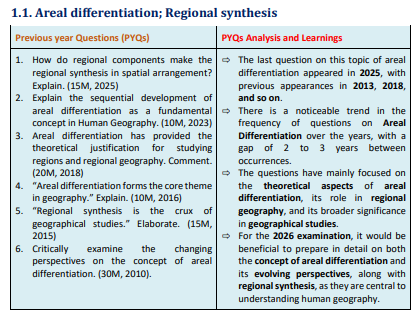
One of the strongest features of the VAM is the in-depth analysis of Previous Year Questions from 2010 to 2025. Questions are arranged according to syllabus sections, with analysis of recurring themes and key takeaways.
This helps aspirants identify:
- Frequently asked topics
- Emerging themes
- Conceptual areas requiring deeper preparation
- Units that demand diagram-based answers
- Topics where models and theories are repeatedly useful
- Areas where contemporary examples can improve answer quality
For example, in Physical Geography, questions from Geomorphology often test conceptual clarity on landform development, geomorphic processes, structure-process-stage, tectonic processes and applied geomorphology. In Human Geography, questions often test theoretical understanding, demographic changes, development models, settlement patterns, regional planning and models such as Von Thunen, Weber, Christaller, Losch and Rostow.
3. Marks Distribution and Unit-Wise Prioritisation
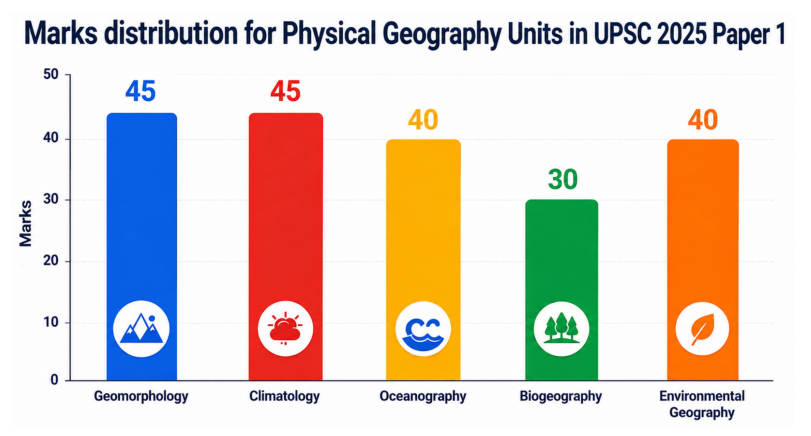
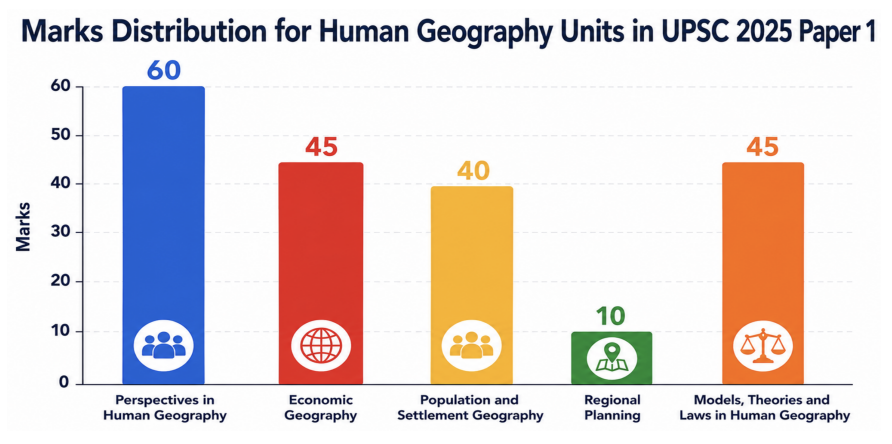
The VAM includes marks-distribution visuals for Physical and Human Geography units. These are useful for prioritising revision in the final phase.
For Physical Geography, the major units include Geomorphology, Climatology, Oceanography, Biogeography and Environmental Geography.
For Human Geography, the major units include Perspectives in Human Geography, Economic Geography, Population and Settlement Geography, Regional Planning and Models, Theories and Laws in Human Geography.
Such unit-wise clarity helps aspirants avoid random revision and focus on areas that require stronger conceptual preparation.
4. Case Studies, Maps and Diagrams for Answer Enrichment
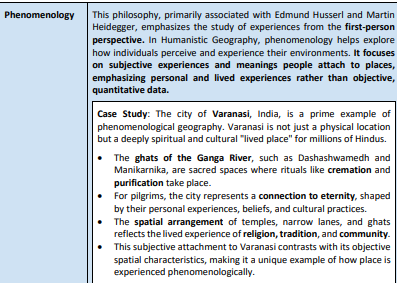
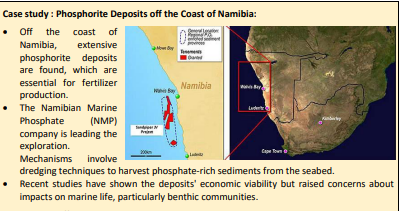
Geography answers are incomplete without spatial clarity and visual presentation. The VAM includes curated case studies, maps and diagrams that help aspirants present answers in a more geographical manner.
These value additions can be used for:
- Introductions
- Explanatory diagrams
- Flowcharts
- Comparative analysis
- Case-study based arguments
- Applied geography questions
- Conclusion and way forward
For instance, a question on geomorphic processes can be enriched with examples such as the Himalayas, Grand Canyon, Mississippi Valley or Peninsular India. A question on population and settlement can be strengthened with demographic trends, migration examples, urban morphology and sustainable city models.
How Physical Geography VAM Strengthens Preparation
Physical Geography forms the conceptual foundation of Geography Optional. It helps aspirants understand Earth systems, landforms, atmospheric processes, oceans, ecosystems and environmental change.
1. Geomorphology
This section covers geomorphic processes, landform development, endogenetic and exogenetic forces, Earth’s interior, geomagnetism, geosynclines, continental drift, isostasy, plate tectonics, mountain building, volcanicity, earthquakes, tsunamis, geomorphic cycles, denudation chronology, slope development and applied geomorphology.
This unit is important because it tests both conceptual clarity and process-based explanation.
Aspirants can use this section to prepare answer-ready explanations on:
- Structure-process-stage relationship
- Uniformitarianism
- Complexity of geomorphic evolution
- Plate tectonics and mountain building
- Earthquakes and volcanoes
- Applied geomorphology in resource exploration and environmental management
2. Climatology
Climatology covers temperature and pressure belts, heat budget, atmospheric stability and instability, atmospheric circulation, winds, monsoon, jet streams, precipitation, air masses, fronts, tropical and temperate cyclones, climatic classifications, hydrology, climate change, applied climatology and urban climates.
This unit is highly relevant because it connects theory with current issues such as extreme weather, climate change, urban heat islands, monsoon variability and atmospheric circulation changes.
3. Oceanography
Oceanography includes ocean bottom topography, temperature, salinity, ocean deposits, waves, currents, tides, marine resources, coral reefs, sea-level changes, Law of the Sea and marine pollution.
This section can be used to answer questions on ocean circulation, coral bleaching, marine resources, coastal vulnerability, sea-level rise, maritime boundaries and ocean governance.
4. Biogeography
Biogeography covers soil science, soil profile, classification and distribution of soils, soil erosion, degradation and conservation, world distribution of plants and animals, wildlife, gene pool centres, deforestation, social forestry and agroforestry.
This unit helps aspirants connect geography with ecology, biodiversity, soil conservation, land use and environmental sustainability.
5. Environmental Geography
Environmental Geography covers principles of ecology, human ecological adaptations, human influence on ecology and environment, ecological changes, biodiversity, ecosystem management, sustainable development, environmental hazards, degradation, conservation, environmental policy, education and legislation.
This section is especially useful for questions linking geography with climate change, environmental governance, sustainability and human-environment interaction.
How Human Geography VAM Strengthens Preparation
Human Geography forms the analytical and application-oriented core of Geography Optional. It helps aspirants understand the spatial dimensions of population, economy, culture, settlement, planning and development.
1. Perspectives in Human Geography
This unit covers areal differentiation, regional synthesis, dichotomy and dualism, environmentalism, quantitative revolution, locational analysis, radical, behavioural, human and welfare approaches, languages, religions, secularisation, cultural regions and Human Development Index.
The VAM also provides a table of geographers, their significant works and famous phrases, helping aspirants use scholars more effectively in answers.
Aspirants can use this section to enrich answers with thinkers such as Humboldt, Ritter, Ratzel, Vidal de la Blache, Mackinder, Huntington, Semple and others.
2. Economic Geography
Economic Geography covers economic development and growth, world economic development, measurement and problems, Limits to Growth, resource distribution and management, energy crisis, agriculture, food security, famine, industrial location, world industries and global trade patterns.
This unit helps aspirants write answers on resource geography, development disparities, agricultural systems, industrial patterns, trade networks and global economic restructuring.
3. Population and Settlement Geography
This section covers population growth and distribution, demographic attributes, migration, population theories, population problems, policies, quality of life, social capital, rural settlements, urban settlements, urban morphology, primate city, rank-size rule, functional classification of towns, rural-urban fringe, satellite towns, urbanisation problems and sustainable development of cities.
This is one of the most application-oriented areas of Human Geography. It helps aspirants connect theories with contemporary issues such as ageing, migration, urban sprawl, informal settlements, smart cities, sustainability and social well-being.
4. Regional Planning
Regional Planning covers concept of region, formal and functional regions, methods of regionalisation, growth centres, growth poles, regional imbalances, approaches and policies for regional development, environmental concerns and sustainable development in regional planning.
This unit is useful for questions on planning regions, backward regions, regional disparity, development policy, environmental constraints and spatial planning.
5. Models, Theories and Laws in Human Geography
This section covers system analysis, Malthusian, Marxian and demographic transition models, Central Place Theory of Christaller and Losch, Perroux and Boudeville theories, Von Thunen’s agricultural location model, Weber’s industrial location model, Rostow’s stages of growth, Heartland and Rimland theories, and laws of international boundaries and frontiers.
This unit is crucial because Geography Optional often rewards theoretical clarity when used appropriately.
How VAM Helps in Geography Optional Answer Writing
1. From Content to Application
Many aspirants know the content but struggle to apply it in answers. The VAM helps bridge this gap by combining theory, PYQ analysis, examples and model answer approaches.
For example, a question on landform development should not only explain processes, but also use examples, diagrams and relevant geomorphological principles. Similarly, a question on urbanisation should not merely define urban growth, but examine causes, patterns, consequences, theories and remedies.
2. Use of Geographical Terminology
Optional answers must show subject-specific understanding. Terms such as areal differentiation, regional synthesis, chorology, locational analysis, isostasy, geomorphic cycle, atmospheric stability, ocean salinity, demographic transition, primate city, growth pole and central place hierarchy make answers more precise.
The VAM helps aspirants use such terminology in a structured and relevant manner.
3. Diagram-Based Enrichment
Geography answers become stronger when supported by simple, clear and well-labelled diagrams. The VAM provides diagrams and maps that can be adapted in answers.
Aspirants should prepare a personal diagram bank from the VAM for:
- Plate tectonics
- Geomorphic cycles
- Cyclones
- Monsoon mechanism
- Ocean currents
- Soil profile
- Settlement hierarchy
- Central Place Theory
- Von Thunen model
- Weber’s industrial location model
- Growth pole model
4. Use of Case Studies
Case studies improve the applied dimension of answers. Instead of writing only theory, aspirants should add examples from India and the world.
For instance:
- Himalayas for tectonics and mountain building
- Grand Canyon for youthful landforms
- Peninsular India for multiple erosion cycles
- Urban heat islands for applied climatology
- Coral reefs for oceanography and climate change
- Migration trends for population geography
- Smart city and satellite town examples for settlement geography
- Regional disparity examples for planning
5. Model Answer Approaches for 2025 Questions
The VAM includes structured approaches for questions asked in the 2025 examination. This helps aspirants understand not just what content is relevant, but how to frame answers.
A good answer approach should include:
- Direct introduction
- Conceptual explanation
- Diagram or map where relevant
- Examples or case studies
- Analytical discussion
- Balanced conclusion
How to Use Geography Optional VAM 2026 Effectively
Step 1: Begin with Unit-Wise Syllabus Mapping
Start by reading the table of contents and mapping each topic with the UPSC syllabus. This will help avoid scattered revision.
Step 2: Read PYQ Analysis Before Each Unit
Before revising any topic, first go through the PYQs and analysis. This will help you understand the type of questions UPSC asks.
Step 3: Create a Diagram Bank
Prepare 20–30 high-utility diagrams from both Physical and Human Geography. Practise drawing them quickly.
Step 4: Prepare Scholar and Model Sheets
For Human Geography, prepare a compact list of geographers, theories and models. For Physical Geography, prepare key concepts and thinkers such as Davis, Penck, King and Thornbury wherever relevant.
Step 5: Build Case Study Notes
Prepare small case-study notes for geomorphology, climatology, oceanography, urbanisation, migration, regional planning and environmental geography.
Step 6: Use Contemporary Examples
Add updated examples from climate change, urbanisation, migration, resource crisis, regional disparities and environmental governance.
Step 7: Practise Answer Structuring
For every answer, follow a broad structure:
- Define or introduce the concept
- Explain core process/theory
- Add diagram or map
- Support with examples
- Analyse limitations or contemporary relevance
- Conclude with a balanced geographical perspective
Last-Mile Benefits of VisionIAS Geography Optional VAM 2026
During the final phase before Mains, aspirants need material that is compact, structured and answer-oriented. The VAM helps by providing:
- Complete syllabus coverage
- PYQ analysis from 2010–2025
- Unit-wise revision structure
- Marks-distribution insights
- Curated case studies
- Maps and diagrams
- Models and theories
- Contemporary examples
- Model answer approaches for 2025 questions
- Better clarity on what to write and how to write
It helps aspirants move from bulky preparation to focused revision, and from content collection to answer execution.
[Download VisionIAS Geography Optional Physical Geography VAM 2026 PDF]
[Download VisionIAS Geography Optional Human Geography VAM 2026 PDF]
Final Word
Geography Optional can become a high-scoring subject when preparation is conceptual, structured and application-oriented. Aspirants must understand processes, theories and models, but they must also learn how to present them through diagrams, examples and analytical explanations.
VisionIAS Geography Optional VAM 2026 is designed to support this approach. It helps aspirants revise Physical and Human Geography systematically, use PYQs intelligently, enrich answers with case studies and diagrams, and develop strong model-based understanding.
Use it as a revision and answer-enrichment resource. Map the syllabus, study the PYQ trends, practise diagrams, revise models, use case studies and write answers regularly.
When geographical concepts meet clear structure, visual presentation and contemporary relevance, answer quality improves. Let VisionIAS Geography Optional VAM 2026 be your focused companion for UPSC Mains Geography Optional preparation.
FAQs on VisionIAS Geography Optional VAM 2026
1. What is VisionIAS Geography Optional VAM 2026?
VisionIAS Geography Optional VAM 2026 is an exam-oriented value-added resource for UPSC Mains Geography Optional. It covers Physical Geography and Human Geography through syllabus-wise content, PYQ analysis, diagrams, case studies and model answer approaches.
2. How does this VAM help in Geography Optional answer writing?
It helps aspirants write better answers by providing conceptual clarity, PYQ-based insights, geographical terminology, diagrams, maps, case studies, theories and structured model answer approaches.
3. What are the major areas covered in Physical Geography VAM?
It covers Geomorphology, Climatology, Oceanography, Biogeography and Environmental Geography.
4. What are the major areas covered in Human Geography VAM?
It covers Perspectives in Human Geography, Economic Geography, Population and Settlement Geography, Regional Planning, and Models, Theories and Laws in Human Geography.
5. What is the best way to use Geography Optional VAM 2026?
Start with syllabus mapping, then revise PYQ analysis, prepare diagrams and model sheets, mark case studies, and practise answer writing using the model answer approaches provided in the VAM.