General Studies 3
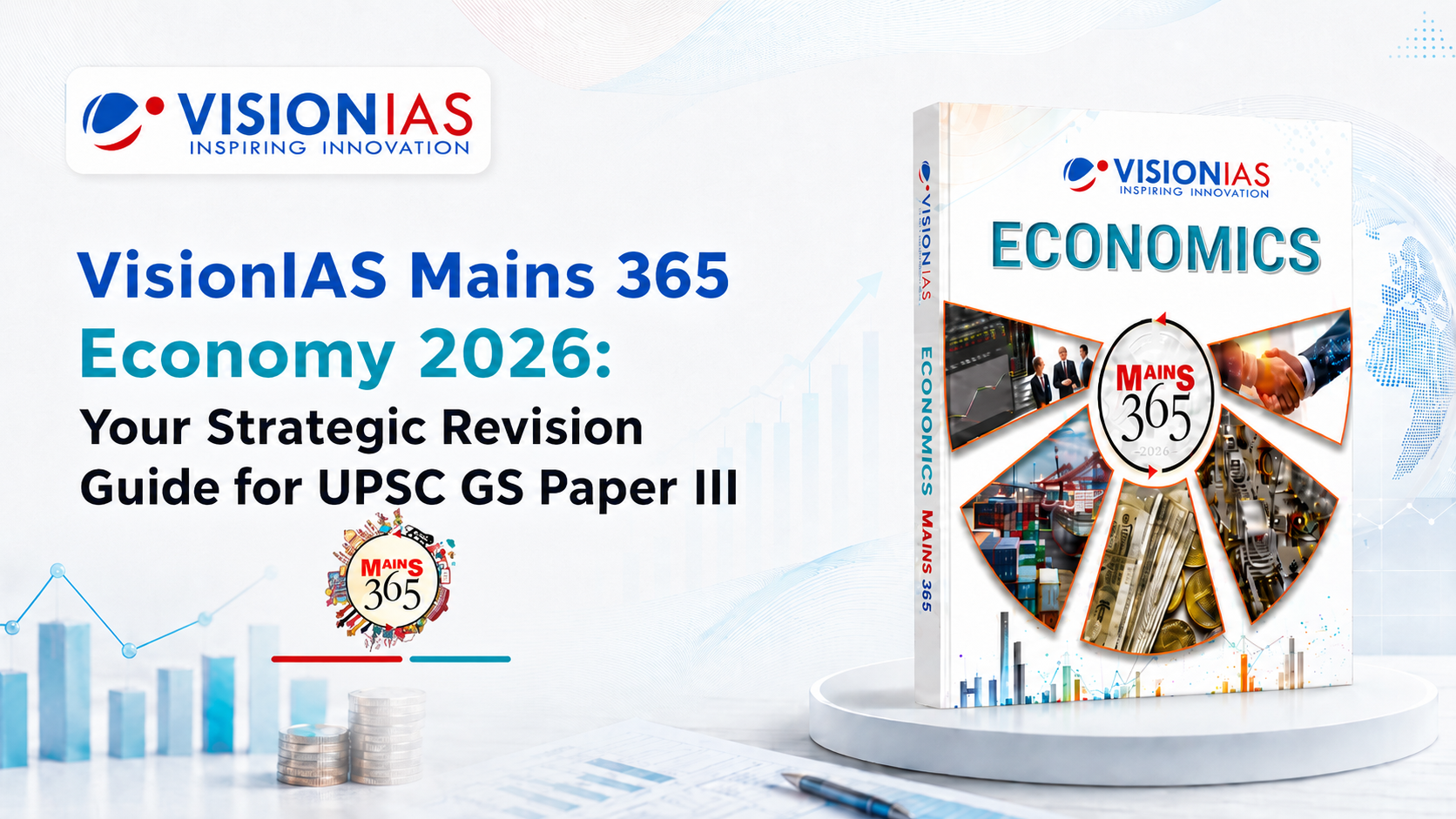
Mains 365 Economy 2026 : Your Strategic Revision Guide for UPSC Mains GS Paper III










The UPSC Civil Services Mains Examination is a test of clarity, precision, analytical depth, and the ability to use current developments in a structured manner. This becomes especially important in GS3, where the Economy section often requires aspirants to connect concepts, policies, data, schemes, reports, and contemporary developments within a limited word count.
Many aspirants read extensively for Economy. They follow newspapers, Budget announcements, Economic Survey, government schemes, RBI updates, policy documents, and reports.
Yet, during answer writing, they often struggle with a common problem: how to convert scattered information into a coherent, analytical, and examiner-friendly answer.
This is where VisionIAS Mains 365 Economy 2026 becomes a focused and reliable revision companion. Covering important developments from the past one year, the document is designed to help aspirants revise Economy in a structured, syllabus-aligned, and answer-oriented manner.
Also Read, Reflections from VisionIAS current affairs in UPSC Mains 2025 GS Paper-3
Rather than functioning as a mere compilation of current affairs, Mains 365 Economy helps aspirants build conceptual clarity, retain relevant facts, and use them effectively in UPSC-style answers.

Why Economy in GS Paper III Requires a Different Approach
Economy is one of the most dynamic areas of the UPSC Mains syllabus. Unlike purely static topics, Economy questions often demand an integrated understanding of multiple dimensions.
A good GS-III Economy answer usually requires:
- Conceptual clarity on basic economic terms and processes
- Awareness of recent policy developments and government initiatives
- Use of relevant data, reports, indices, and examples
- Understanding of implementation challenges
- A balanced and practical way forward
- Ability to connect micro-level issues with macroeconomic goals
For instance, a question on inflation may require linkage with CPI revision, monetary policy, consumption patterns, household expenditure, supply-side constraints, and welfare impact. Similarly, a question on manufacturing may require discussion on global value chains, labour-intensive sectors, technology-intensive industries, supply-chain resilience, R&D, MSMEs, and employment generation.
This is why GS-III Economy preparation cannot remain limited to reading. It must move towards structured revision and answer applications.
Common Challenges Aspirants Face in Economy Preparation
- Fragmented Sources: Aspirants often refer to multiple sources such as newspapers, Budget documents, Economic Survey, government portals, RBI updates, policy reports, and coaching notes. While each source has value, excessive dependence on scattered sources can create confusion about what to revise and what to leave.
- Static-Dynamic Disconnect: Many aspirants understand basic concepts such as inflation, fiscal deficit, financial inclusion, FDI, or agricultural marketing. However, they struggle to connect these concepts with current developments. UPSC expects aspirants to move beyond definitions and apply concepts to contemporary governance and policy challenges.
- Data Fatigue: There is no shortage of data in Economy. The challenge is not only to remember facts, but to know where and how to use them. Irrelevant or excessive data can make answers mechanical, while well-placed facts can make answers credible and analytical.
- Weak Answer Structuring: Even when content is available, many answers remain average because they lack a proper structure. A strong answer needs a crisp introduction, logically arranged body, issue-specific analysis, and a practical conclusion or way forward.
- Lack of Administrative Perspective: UPSC rewards answers that reflect policy understanding and problem-solving ability. Economy answers should not read like academic essays alone; they should show awareness of implementation, governance, inclusion, sustainability, and institutional reforms.
Mains 365 Economy is designed to address these gaps through syllabus-wise organization, value-added content, infographics, data points, keywords, and practice-oriented frameworks.
What Makes VisionIAS Mains 365 Economy 2026 Useful for UPSC Mains?
1. GS Paper III-Aligned Structure
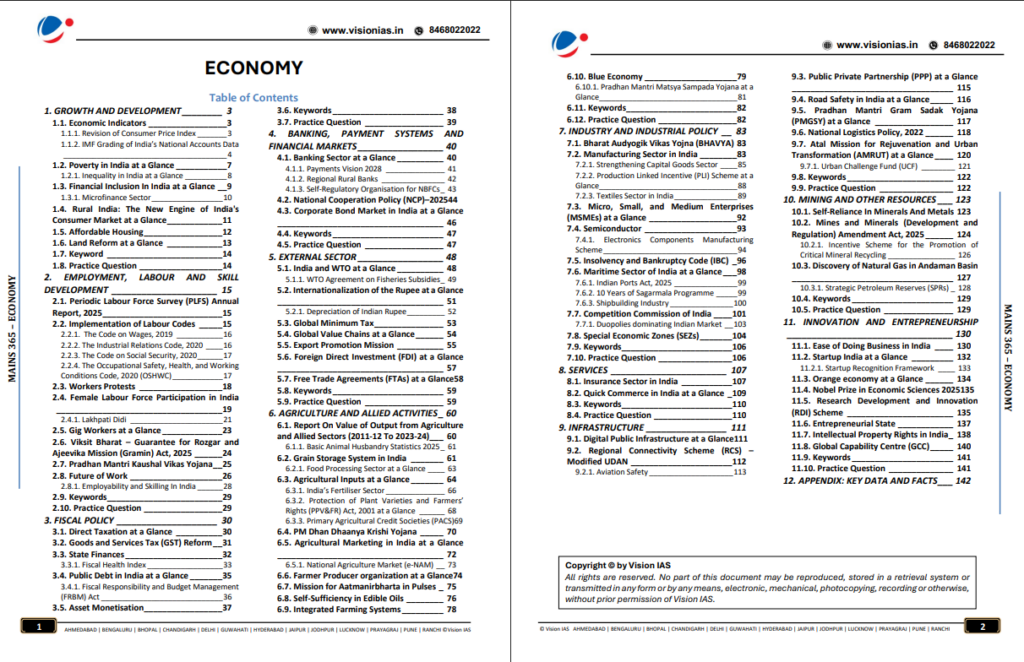
The document is organized around key areas of the GS-III Economy syllabus, making revision systematic and targeted. It covers major themes such as:
- Growth and Development
- Employment, Labour and Skill Development
- Fiscal Policy
- Banking, Payment Systems and Financial Markets
- External Sector
- Agriculture and Allied Activities
- Industry and Industrial Policy
- Services
- Infrastructure
- Mining and Other Resources
- Innovation and Entrepreneurship
- Key Data and Facts
This structure allows aspirants to revise Economy topic-wise rather than randomly. It also helps in mapping current developments directly with syllabus areas.
2. Static + Current Affairs Integration
UPSC Mains questions increasingly test whether aspirants can connect foundational concepts with current issues. Mains 365 Economy helps bridge this gap.
For example, the document connects:
- CPI revision with inflation measurement and monetary policy
- IMF grading of India’s national accounts data with statistical reforms
- Labour Codes with employment formalization and worker protection
- WTO fisheries subsidies with Indian fishermen and trade negotiations
- Internationalization of the rupee with external sector strategy
- Manufacturing strategy with global value chains and strategic autonomy
- Digital Public Infrastructure with inclusive growth and service delivery
- Startup India and RDI with innovation-led development
This integration helps aspirants write answers that are current, analytical, and relevant to UPSC’s evolving expectations.
3. Ready-to-Use Data, Keywords and Examples
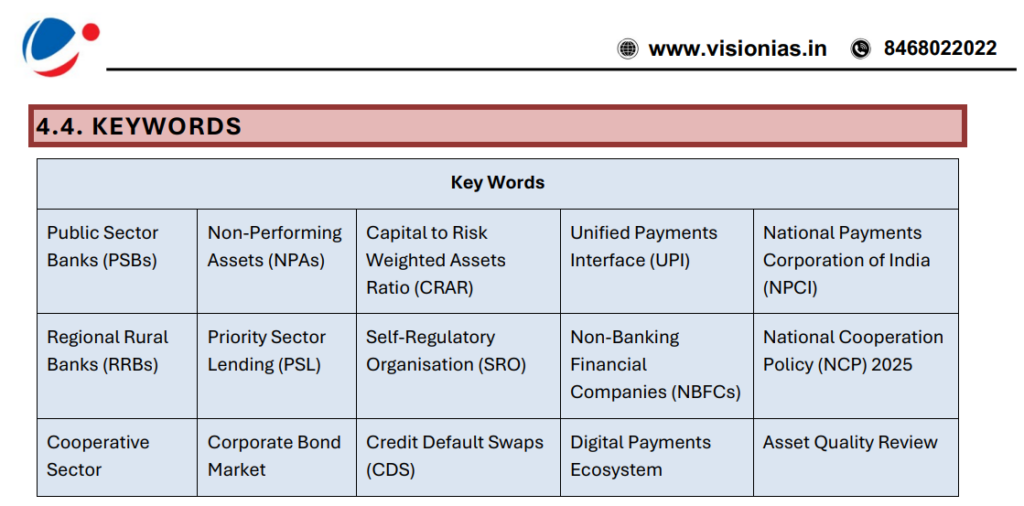
In Economy answers, relevant data can improve quality significantly. However, data must be used selectively. Mains 365 Economy provides important facts, keywords, schemes, and examples in a concise format so that aspirants can recall and apply them easily.
Such value additions are useful for:
- Introductions
- Subheadings
- Body arguments
- Diagrams and flowcharts
- Way forward
- Conclusions
For example, keywords such as “financial inclusion”, “double deflation”, “global value chains”, “asset monetisation”, “digital public infrastructure”, “entrepreneurial state”, and “critical minerals” can make answers more precise and conceptually rich.
4. Infographics for Quick Revision
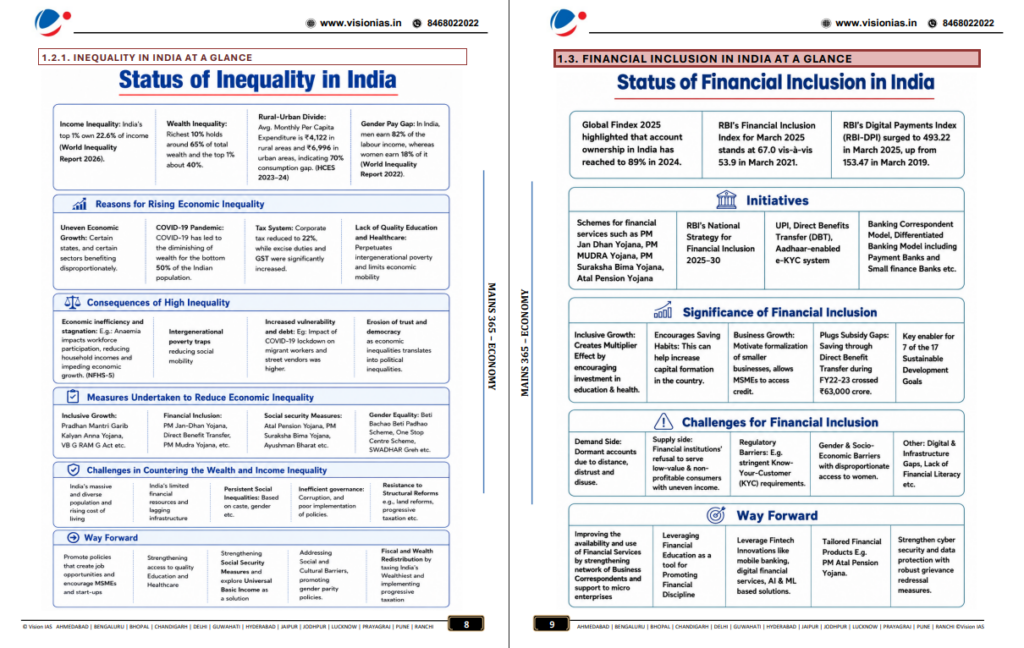
Mains 365 Economy includes infographics and at-a-glance presentations that help aspirants revise complex issues quickly. These are particularly useful during the final phase before Mains, when aspirants need high-retention formats instead of lengthy notes.
Infographics can also help in answer writing. Aspirants can convert them into:
- Flowcharts
- Cause-effect diagrams
- Stakeholder maps
- Issue-solution frameworks
- Policy implementation models
How Mains 365 Economy Enhances Answer Writing
A good Economy answer must not only present information but also show structure, relevance, and policy understanding. Mains 365 Economy helps aspirants convert content into answer-ready points.
Let us understand this through an example.
Example Question
“Union Budget 2026–27’s two-track manufacturing strategy seeks to combine technological self-reliance with labour-intensive growth. Discuss how this strategy can help India move from strategic autonomy to strategic indispensability in global value chains. Also examine the key constraints that may hinder India’s manufacturing transformation.”
This is the kind of question where a generic answer on manufacturing will not be sufficient. It requires the aspirant to understand the larger shift in India’s manufacturing policy, link it with global value chains, and examine structural bottlenecks.
Mains 365 Economy helps an aspirant frame such an answer in the following way:
Introduction
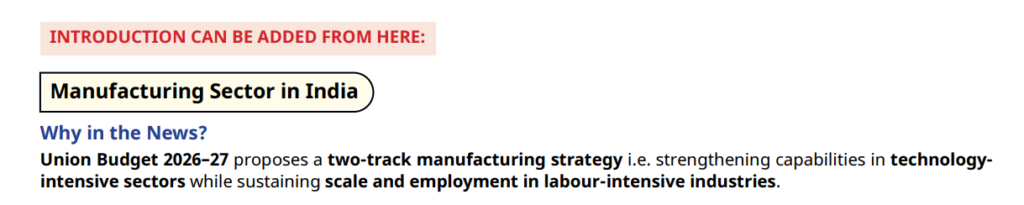
The answer can begin with the idea that Union Budget 2026–27 proposes a two-track manufacturing strategy: strengthening technology-intensive sectors while sustaining scale and employment in labour-intensive industries.
This gives the answer immediate relevance and connects it with a contemporary policy development.
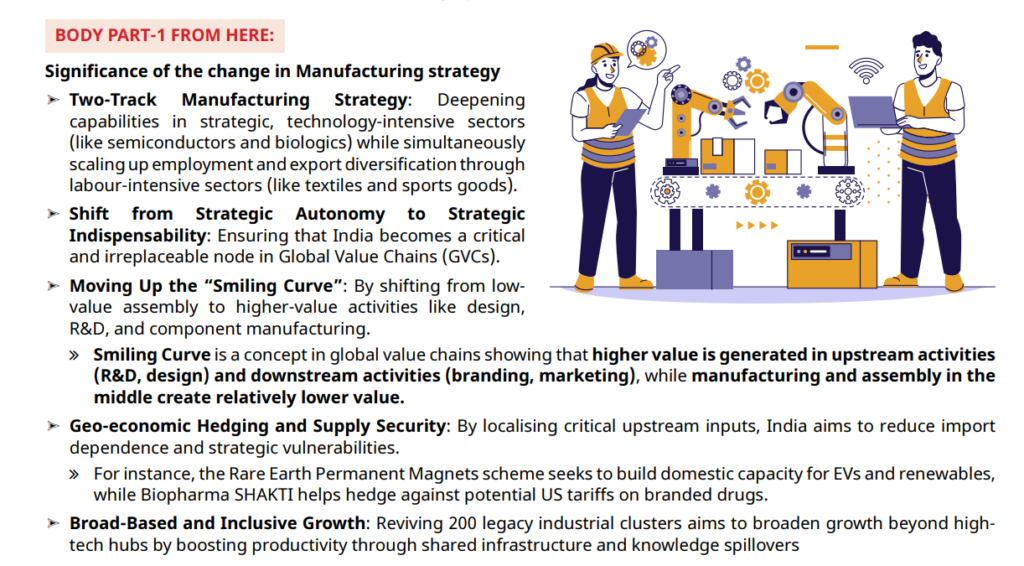
Body Part 1: Significance of the Two-Track Manufacturing Strategy
The answer can then explain how the strategy helps India move towards a stronger position in global value chains.
Relevant points may include:
- Deepening capabilities in strategic and technology-intensive sectors such as semiconductors, biologics, and advanced manufacturing
- Scaling up employment and export diversification through labour-intensive sectors such as textiles and sports goods
- Moving from strategic autonomy to strategic indispensability by becoming a critical node in global value chains
- Moving up the “smiling curve” through design, R&D, branding, and component manufacturing
- Reducing import dependence through localization of critical inputs
- Promoting broad-based and inclusive growth through industrial clusters
Body Part 2: Challenges in India’s Manufacturing Transformation
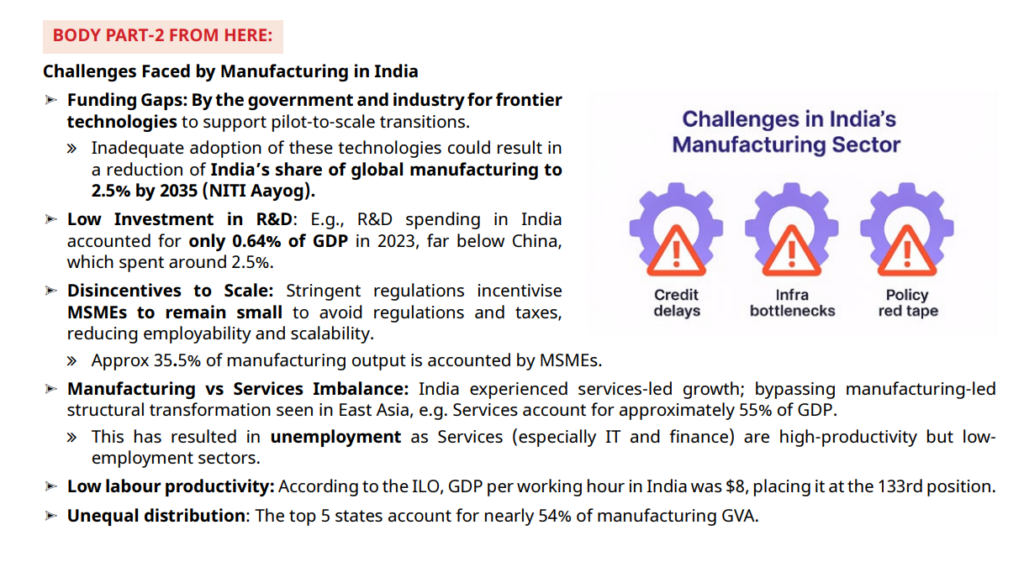
The answer should then examine constraints in a balanced way. These may include:
- Funding gaps for frontier technologies
- Low investment in R&D
- Disincentives for MSMEs to scale up
- Manufacturing-services imbalance
- Low labour productivity
- Regional concentration of manufacturing capacity
- Infrastructure and policy bottlenecks
This makes the answer analytical rather than one-sided.
Conclusion
A strong conclusion may highlight that India’s manufacturing transformation requires simultaneous pursuit of import substitution, supply-chain resilience, and global indispensability. It should also emphasize execution, institutional coordination, and alignment between policy intent and implementation.
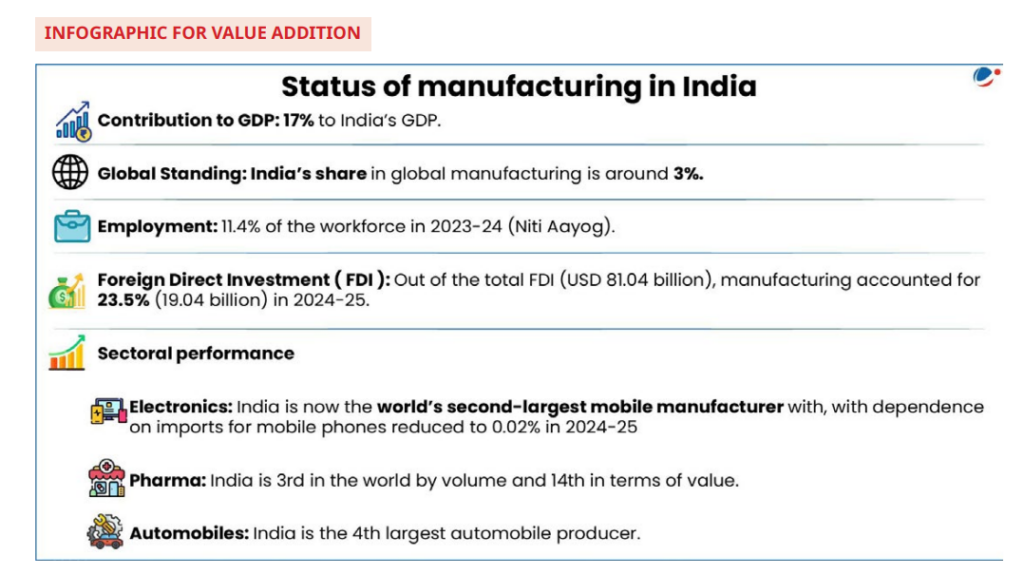
Value Addition
Aspirants can enrich the same answer by adding a relevant infographic or data box on the status of manufacturing in India.
This is the real advantage of Mains 365 Economy: it does not simply provide content; it shows how content can be converted into an answer.
What Makes Mains 365 Economy Exam-Ready?
1. Context-Analysis-Way Forward Format
Many topics are presented in a way that helps aspirants understand the issue, analyze its significance, identify challenges, and write a practical way forward. This format closely matches the structure required in UPSC Mains answers.
2. Syllabus-Wise Coverage
The document helps aspirants revise according to GS-III themes. This makes it easier to map topics with previous year questions and possible upcoming questions.
3. Value-Added Facts and Examples
Relevant facts, reports, schemes, and examples help aspirants make answers more authoritative and specific.
4. Better Retention Through Visuals
Infographics, tables, and compact presentation formats help aspirants retain important points during the last phase of revision.
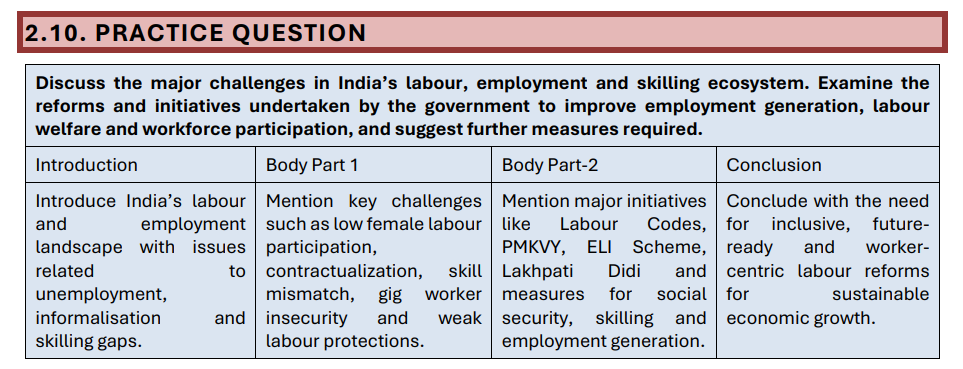
5. Practice Questions
Practice questions at the end of sections help aspirants test whether they can convert the given content into structured answers.
How to Use Mains 365 Economy 2026 Effectively
Step 1: Map the Document with the GS-III Syllabus
Do not read the document randomly. First, identify where each chapter fits within the GS-III syllabus. This will help you revise with a clear sense of purpose.
Step 2: Mark High-Utility Data and Keywords
Highlight data, reports, schemes, and keywords that can be used across multiple answers. Avoid memorizing every figure. Focus on versatile value additions.
Step 3: Convert Topics into Answer Frameworks
For every important issue, prepare a basic framework:
- Introduction
- Causes / significance
- Challenges
- Government initiatives
- Way forward
- Conclusion
This will help you reproduce answers quickly in the examination hall.
Step 4: Use Infographics for Revision and Diagrams
During revision, focus on infographics and tables. Try converting them into simple diagrams or flowcharts that can be used in answers.
Step 5: Practice with PYQs and Test Series
Mains 365 is most effective when used with answer writing practice. Pick previous year questions or test series questions and use Mains 365 points to enrich your answers.
Step 6: Revise in Multiple Rounds
In the first reading, understand the topic. In the second reading, mark key points. In the final revision, focus only on data, keywords, examples, and answer frameworks.
Last-Mile Benefits in the Examination Hall
The final days before Mains are not meant for reading new and bulky material. They are meant for smart revision, consolidation, and confidence-building.
Mains 365 Economy helps aspirants in the exam hall by enabling:
- Faster recall of relevant facts
- Better answer structuring
- Use of precise keywords
- Integration of current affairs with static concepts
- Balanced analysis of policy issues
- Practical and administrative way forwards
- Improved confidence in complex Economy questions
When others are still thinking about what to write, a well-prepared aspirant can begin structuring the answer with clarity.
Why Mains 365 Economy Should Be Part of Your Final Revision Strategy
Economy is deeply connected with several dimensions of governance and development. Questions may involve poverty, inequality, fiscal policy, employment, agriculture, external trade, industrial policy, infrastructure, digital economy, innovation, or inclusive growth. Therefore, preparation must be both broad and precise.
VisionIAS Mains 365 Economy 2026 helps aspirants bring together:
- Current affairs
- Conceptual clarity
- Data and facts
- Policy analysis
- Answer writing structure
- Quick revision tools
It allows aspirants to move from scattered preparation to organized revision, and from information accumulation to answer execution.
[Download Mains 365 Economy 2026 PDF]
Final Word
The Economy section of GS Paper III can become scoring when preparation is structured, data is used intelligently, and answers reflect both analytical clarity and administrative perspective.
Mains 365 Economy 2026 is designed to support aspirants in this journey. It helps simplify complex developments, organize important themes, and provide answer-ready content for UPSC Mains.
Use it not merely as a reading document, but as an answer-enrichment tool. Integrate it with your notes, revise it in multiple rounds, practice with PYQs, and use its frameworks to write crisp, balanced, and policy-oriented answers.
When content meets clarity, structure, and context, answer quality improves. Let Mains 365 Economy be your strategic companion for GS Paper III revision.
FAQs on VisionIAS Mains 365 Economy 2026
1. What is VisionIAS Mains 365 Economy 2026?
VisionIAS Mains 365 Economy 2026 is a curated and exam-oriented revision document for UPSC CSE Mains GS Paper III. It covers important Economy-related developments from the past one year and presents them in a structured, syllabus-aligned manner.
2. How does Mains 365 Economy help in answer writing?
It helps aspirants integrate static concepts with current developments, relevant data, policy examples, infographics, and way-forward points. This makes answers more analytical, current, and examiner-friendly.
3. Is Mains 365 Economy useful for last-minute revision?
Yes. The document is designed for focused revision. Its topic-wise structure, infographics, keywords, data points, and practice questions make it useful during the final phase before Mains.
4. Can Mains 365 Economy replace newspapers or basic books?
Mains 365 Economy should be used as a revision and answer-enrichment tool. Aspirants should use it along with their basic conceptual understanding, class notes, PYQs, and answer writing practice.
5. What is the best way to use Mains 365 Economy?
Use it in three stages: first, understand the issues; second, mark important data, keywords, and examples; third, apply the content in PYQs and test series answers. During final revision, focus on infographics, value-added points, and answer frameworks.