


Why in the news?
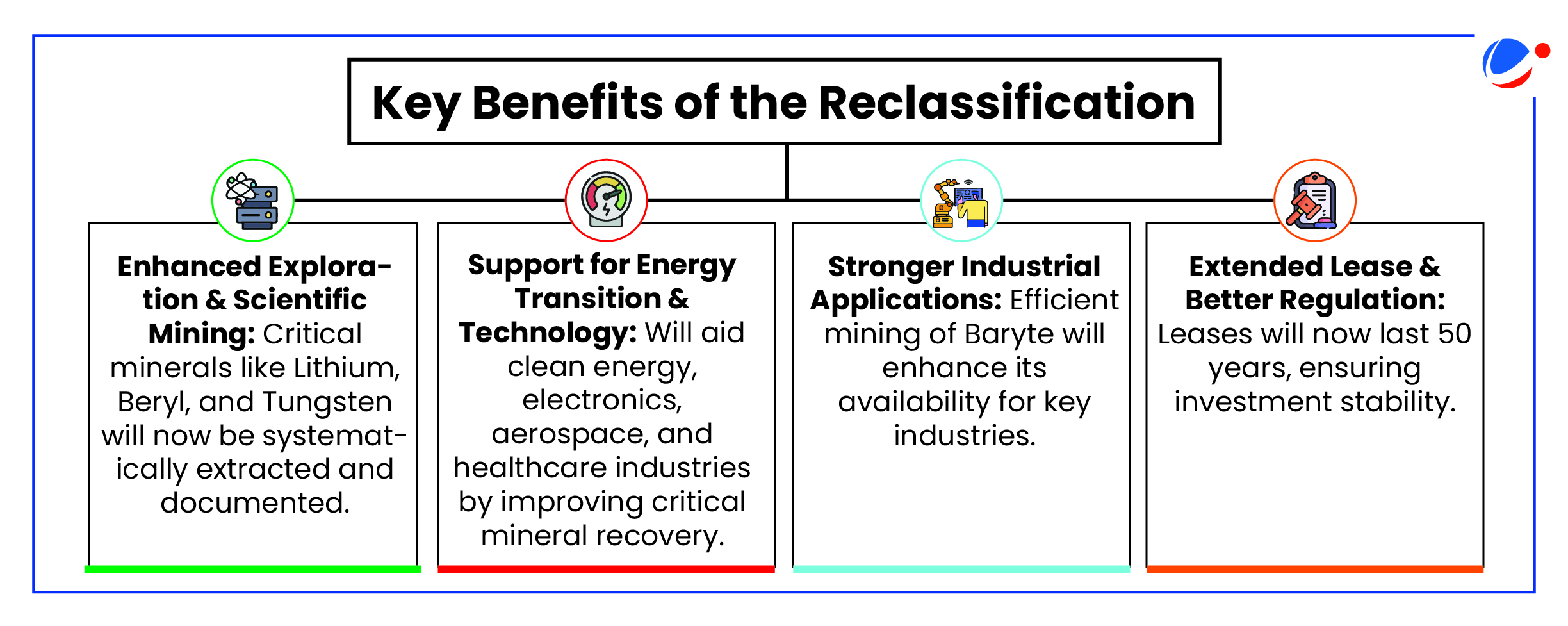
The Ministry of Mines has reclassified Barytes, Felspar, Mica, and Quartz from minor minerals to major minerals.
More on the news
- This move follows the recent approval of the National Critical Mineral Mission by the Union Cabinet.
- Reclassification is based on recommendations from an Inter-Ministerial Committee led by Dr. V. K. Saraswat.
Reason for Reclassification
- The decision to shift these minerals to the major minerals category is based on their association with critical minerals and their importance in various high-tech industries.
- Critical minerals are those minerals that are essential for economic development and national security (Ministry of Mines).
- Quartz, Felspar, and Mica in Pegmatite Rocks
- These minerals are found in pegmatite rocks, which also contain essential critical minerals like Beryl, Lithium, Niobium, Tantalum, Molybdenum, Tin, Titanium, and Tungsten.
- Earlier, when these minerals were leased as minor minerals, leaseholders did not report or extract the critical minerals present.
- Baryte and its Industrial Significance
- Baryte often occurs in concretions and vein fillings in limestone and dolostone, alongside ores of Antimony, Cobalt, Copper, Lead, Manganese, and Silver.
- It has extensive industrial applications in oil and gas drilling, electronics, TV screens, rubber, glass, ceramics, paint, radiation shielding, and medical applications.
About Major and Minor Minerals
- A mineral is a natural substance of organic or inorganic origin with definite chemical and physical properties, forming the building blocks of rocks and ores.
- Under the Mines and Minerals (Development and Regulation) (MMDR) Act, 1957, minerals are broadly classified in two categories, i.e. major minerals and minor minerals.
- Minor minerals means building stones, gravel, ordinary clay, ordinary sand other than sand used for prescribed purposes and any other mineral which the Central Government may declare to be a minor mineral.
- Major minerals include all minerals other than minor minerals. E.g. Coal, Iron, Zinc, Limestone etc.
- Framework for Governance:
- Legal Framework for Mineral Regulation: The MMDR Act, 1957 is the primary law governing the mining sector, except for petroleum and natural gas.
- The GoI has framed additional rules for mineral management:
- Mineral Concession (MC) Rules, 1960: Regulates permits, licenses, and leases for all minerals except Atomic and Minor Minerals.
- Mineral Conservation and Development (MCD) Rules, 1988: Ensures conservation and systematic development of minerals.
- Role of State Governments in Mineral Regulation:
- Section 15 of MMDR Act, 1957: Gives State Governments the power to make rules for minor minerals.
- Section 23C of MMDR Act, 1957: Empowers State Governments to prevent illegal mining, transportation, and storage of minerals.
- Section 9 (b) of the MMDR Act as amended in 2015: Mandates the State Government to establish District Mineral Foundation Trust in every district affected by the mining operation.
