
Why in the News?
President of India has given her assent to the Public Examinations (Prevention of Unfair Means) Amendment Bill, 2026 which was passed by the Parliament in Monsoon session.
Need of the examinations reform in India
- To curb increasing paper leak incidents: 148 cases have been documented since 2015, averaging 12 per year such as NEET-UG 2026, MPSC Drug Inspector examination, 2026, UP Police Constable Recruitment Exam (2024) etc.
- Preservation of Public Trust and Social Mobility: Competitive examinations cut across caste, religion, language, and regional divides as the primary pathway for upward social and economic mobility.
- High-Stakes Pressure: Multi-crore incentives around medical and professional seats, combined with a winner-take-all single-day examination model, create immense psychological and financial pressure that fuels demand for short-cuts.
- Insider Vulnerabilities: Traditional security heavily focuses on protecting printed question papers during transit. However, major vulnerabilities exist during question setting, moderation, translation, and digitization.
- Commercialization and Coaching Monopoly: Chronic underfunding of public schools (with public education spending lingering at 2.9–3.5% of GDP) and widespread "black teaching" force students to rely on expensive private coaching.
- Unlimited Attempts: For high-stakes exams like NEET, the absence of an upper age limit or attempt restrictions creates a massive pool of long-term repeaters dependent on coaching networks.
- Administrative challenges: Such as high vacancies, for example; 39 sanctioned positions in the NTA, only 23 officers are currently in position and on deputation to the NTA a vacancy of 41%. NTA also lacks statutory backing.
- Expedite Justice Delivery: No conviction in the last two years following the passage of the Public Examinations (Prevention of Unfair Means) Act, 2024 due to lack of time bound investigation and trials mechanism.
Key provisions of the Act
- Enforcement: Act comes into force from 31st July, 2026.
- Enhanced Penalties and Fines: Amendment will enhance penalties mentioned in Public Examinations (Prevention of Unfair Means) Act, 2024. (Refer the table)
- Two-Month Investigation Cap: Mandates that investigation into offences under the Act must be completed within two months from the date the information or reference is recorded.
- Special Task Force (STF): Empowers the Central Government to constitute a dedicated Special Task Force to investigate offences under the Act, alongside Central Investigating Agencies.
- Designation of Special Courts: Requires every State Government and Union Territory Administration, in consultation with the Chief Justice of the relevant High Court, to designate Session Courts as Special Fast Track Courts.
- Two-Judge High Court Bench: Appeals against judgments, sentences, bail orders, or rulings of Special Fast Track Courts lie before a Division Bench of two High Court Judges. (Disposal of appeals, within three months)
- 30-Day Filing Limit: Appeals must be preferred within 30 days, with a maximum upper limit of 90 days including condonation of delays.
- Broader Definition of Malpractice: Covers the entire spectrum of unfair means, including question paper/answer key leaks, OMR and computer system tampering.
- Property Seizure: Provides for the seizure of properties belonging to convicted offenders.
- Trials must proceed on a day-to-day basis and be completed within three months from date of filing the chargesheet.
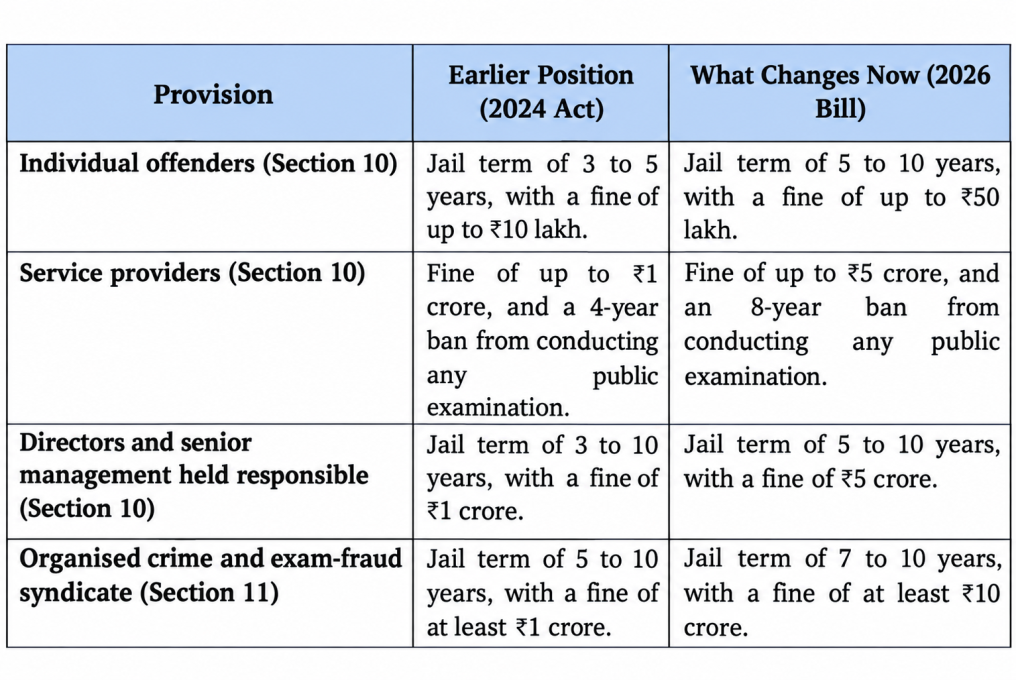
Some of the apprehensions about the New Act
- Lack of Prior Convictions: The original 2024 Act has yielded no convictions over the past two years, raising doubts about whether merely increasing statutory penalties will improve actual enforcement.
- Unenforceable Investigation Deadlines: The Act mandates completing investigations within two months. However, unlike other statutes (e.g., The Lokpal and Lokayuktas Act, 2013), Act provides no mechanism or requirement for written explanation if the timeline is missed.
- Severe Court Congestion: The creation of Special Fast Track Courts (FTSCs) may face existing systemic backlogs. For instance, similar POCSO fast-track courts had over 2.45 lakh pending cases by 2025, with average trial times stretching up to 1,717 days in certain states such as Delhi.
- Contradiction with Supreme Court Precedents: It requires trials to conclude within three months of filing the chargesheet.
- Bar on Appeals Beyond 90 Days: High Courts (such as Bombay and Delhi) have previously ruled that absolute statutory bars on appeals infringe upon fundamental rights under Article 21.
- Severity of Penalties: Stricter penal provisions (5 to 10 years imprisonment) raise concerns about career destruction of students without adequate differentiation between minor infractions and organized crime syndicates.
- NCRB data shows that under similar statutory 60-day limits, over 40% of cases remained pending investigation beyond six months such as POCSO cases.
- However, a landmark 2002 Supreme Court ruling (P. Ramachandra Rao v. State of Karnataka) held that it is neither permissible nor judicially advisable to draw rigid outer time limits for criminal trials.
Other initiatives taken by government
|
Way forward
Parliamentary Standing Committee on Education, Women, Children, Youth and Sports recommendations:
- Address Source-Stage & Insider Vulnerabilities: Prioritize antecedent verification and conflict-of-interest scrutiny for question setters, moderators, and translators.
- Rotation and Quarantine of Experts: Avoid repeated engagement of the same experts across consecutive years.
- Establish a Dedicated Cadre: Transition NTA away from reliance on short-term deputations by recruiting permanent, specialized staff in psychometrics, cybersecurity, examination security, and digital logistics.
- Two-Stage Examination Model: Feasibility study on splitting large exams like NEET-UG into a common preliminary test and course-specific mains (e.g., separating MBBS/BDS from Nursing) to reduce candidate overcrowding.
- Public Integrity Framework & Equity Audits: Publish a comprehensive White Paper on past exam breaches, institute a Public Examination Integrity Framework (PEIF).
- Regulation of Coaching Centers: Establish a national regulatory framework for private coaching academies to ensure fee transparency, safety, and mental health support for students.
- Implementation of Radhakrishnan Committee Recommendations: Such as phased transition to CBT mode.
Conclusion
Comprehensive legal reforms and technological innovation will restore institutional integrity, safeguarding public trust and securing a transparent, merit-based future for India's youth through the transformed examination system.