


Why in the News?
Supreme Court strongly disapproved of the rising misuse of public interest litigation (PIL).
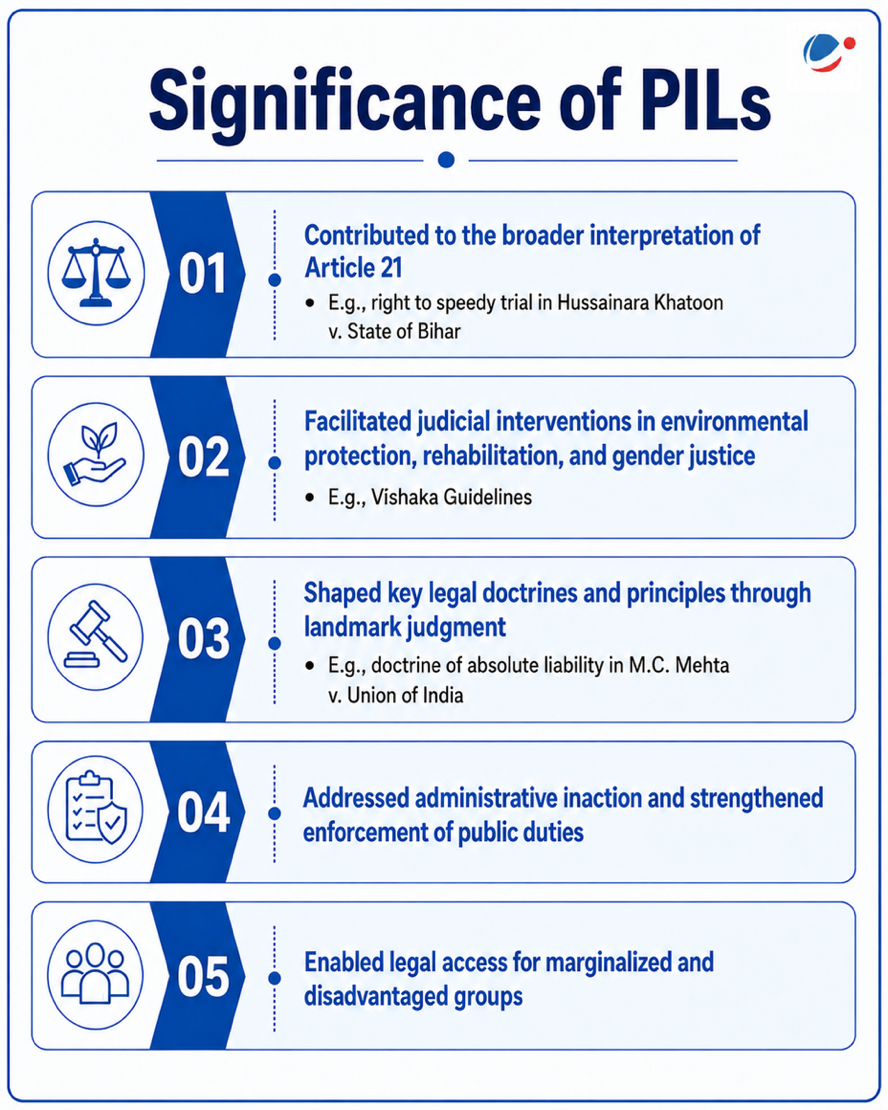
About Public Interest Litigation (PIL)
- PIL means a legal action initiated in a court of law for the enforcement of public interest or general interest in which the public or class of the community have some interest by which their legal rights or liabilities are affected.
- Locus standi (the legal right of a person to file a suit): If a wrong is done to a person or a group who cannot approach the court themselves due to poverty, disability, or helplessness, any public-spirited individual or social action group can file a petition on their behalf.
- Background:
- The PIL for the first time originated in USA in the 1960s.
- In India the term 'PIL' was first used by Justice V.K. Krishna Iyer and Justice P.N. Bhagwati in a judgement.
- Two categories of PIL
- Representative Social Action (seeking redress for a determinate, disadvantaged class).
- Citizen Social Action (asserting diffuse, collective rights affecting the broader public).
- PIL vs conventional litigation: The petitioner in the PIL may be a third party, which is not personally involved in the dispute, while in the conventional petition the petitioner is one of the two parties involved in the dispute.
Reason for rising PIL in India
- Judicial Activism: Courts actively expanded the scope of fundamental rights under Articles 21, 32, and 226, making PIL a powerful tool for protecting rights and ensuring government accountability.
- Simplified Access to Justice: Courts introduced epistolary jurisdiction, allowing letters and postcards to be treated as writ petitions, making PIL more accessible to the public.
- Democratization of access to justice: This is done by relaxing the traditional rule of locus standi which allowed only the specific person who suffered a direct legal wrong could file a petition in court.
- Progressive social legislations: Laws relating to bonded labour, minimum wages, land ceiling and environmental protection enabled courts to protect the rights of the poor.
- Removing Socio-Economic Barriers: PIL bypassed costly, lengthy, and complex traditional litigation procedures, providing a direct and low-cost route to highest courts.
Concerns related to misuse of PIL
- Public Interest Litigation Vs Private Interest Litigation: When people or companies file PILs to resolve personal grievances or business issues under the pretence of public interest.
- E.g. In Chhetriya Pardushan Mukti Sangharsh Samiti v. State of U.P. (1990) case, SC held that Samiti has not come with clean intention and hence PIL cannot be entertained.
- Increased Judicial Backlog: Supreme Court is burden with more than 3500 PILs adding to the already considerable backlog of pending cases in Indian courts.
- Ambush PILs:Such PILs are deliberately filed with the aim of securing dismissal and obstructing legitimate litigants from accessing the Court.
- Judicial Overreach: Through PIL, courts sometimes end up framing policies or taking on a continuing administrative role to monitor implementations, which blurs the lines of the separation of powers.
- Dissociation of Rights and Relief: E.g., due to a lack of resources to implement massive programs (like low-income housing), courts may merely "declare rights" without actually granting the tangible relief sought by the petitioner.
- Political motives: Rather than being filed out of true public interest, many PILs are filed for political reasons.
- PILs are used by political parties and individuals to target opponents, postpone government initiatives, or generate publicity.
Important Judicial pronouncements related to PILs
|
Way forward to preserve the purity and sanctity of PILs
- In State of Uttarakhand v. Balwant Singh Chaufal (2010), the Supreme Court issued following directions: -
- Verification: Courts must prima facie verify the credentials of the petitioner and the correctness of the petition's contents before entertaining a PIL.
- Rule Formulation: Instead of judges individually devising procedures, each High Court should formulate specific rules to encourage genuine, bona fide PILs and effectively discourage those filed with oblique motives.
- Assessing Public Interest: The court should ensure that the petition which involves larger public interest, gravity and urgency must be given priority over other petitions.
- Imposing Penalties: Courts should discourage "busybodies" who file frivolous petitions for extraneous or ulterior motives by imposing exemplary costs.
- Prioritization: Petitions that involve larger public interest, gravity, and urgency must be given priority over other petitions.
- Others suggestions:
- Community Involvement: Discussing the legal issues thoroughly with the affected people to explicitly identify which fundamental rights have been infringed.
- Exhausting Alternatives: Preparing a "status paper" to share with interested groups and issuing notices to the relevant authorities demanding action before resorting to court litigation, unless the matter is too urgent to wait.
- Strong Documentation: Petitions must specify the exact relief desired and be solidly backed by evidence, including documents, newspaper clippings, photographs, investigation reports, and affidavits.
Conclusion
Public Interest Litigation (PIL) continue to be a valid use of judicial authority, guaranteeing that everyone can obtain justice. PILs can continue to be extremely important in creating a society that is more just and equal if they are used and reformed carefully. Its most significant contribution has been to increase government accountability for the poor's human rights.


