
India Dispatches Humanitarian Aid to Myanmar Under 'Operation Brahma' After 7.7 Magnitude Earthquake | Current Affairs | Vision IAS
MENU
Home

Periodically curated articles and updates on national and international developments relevant for UPSC Civil Services Examination.

Quick Links

High-quality MCQs and Mains Answer Writing to sharpen skills and reinforce learning every day.

Watch explainer and thematic concept-building videos under initiatives like Deep Dive, Master Classes, etc., on important UPSC topics.

ESC

The earthquake, with a depth of 10 km, was the strongest in two years. The shallow depth had intensified shockwaves, as they travelled from focus (Earthquake's origin point beneath surface) to surface.

  • The quake’s epicentre (Ground surface directly above the focus) was located ~17 km from Mandalay (Myanmar).
What caused the Earthquake?

  • Strike-Slip Fault: The Myanmar earthquake occurred due to "strike-slip faulting" (Sagaing fault) between the Indian and Eurasian plates.
  • About the Sagaing Fault
    • Location: Runs from north to south through Myanmar, and marks the boundary between Indian and Eurasian plates.
    • Feature: It’s one of the longest and most activestrike-slip faults globally, spanning 1,500 km
    • Tectonic Movement: Indian plate is moving northward compared to Eurasian plate, causing stress along fault.

About Fault

  • Definition: Faults are fractures in the Earth's crust where rocks move relative to each other, caused by tectonic stress.
    • The movement along these fault planes releases accumulated strain, leading to earthquakes.

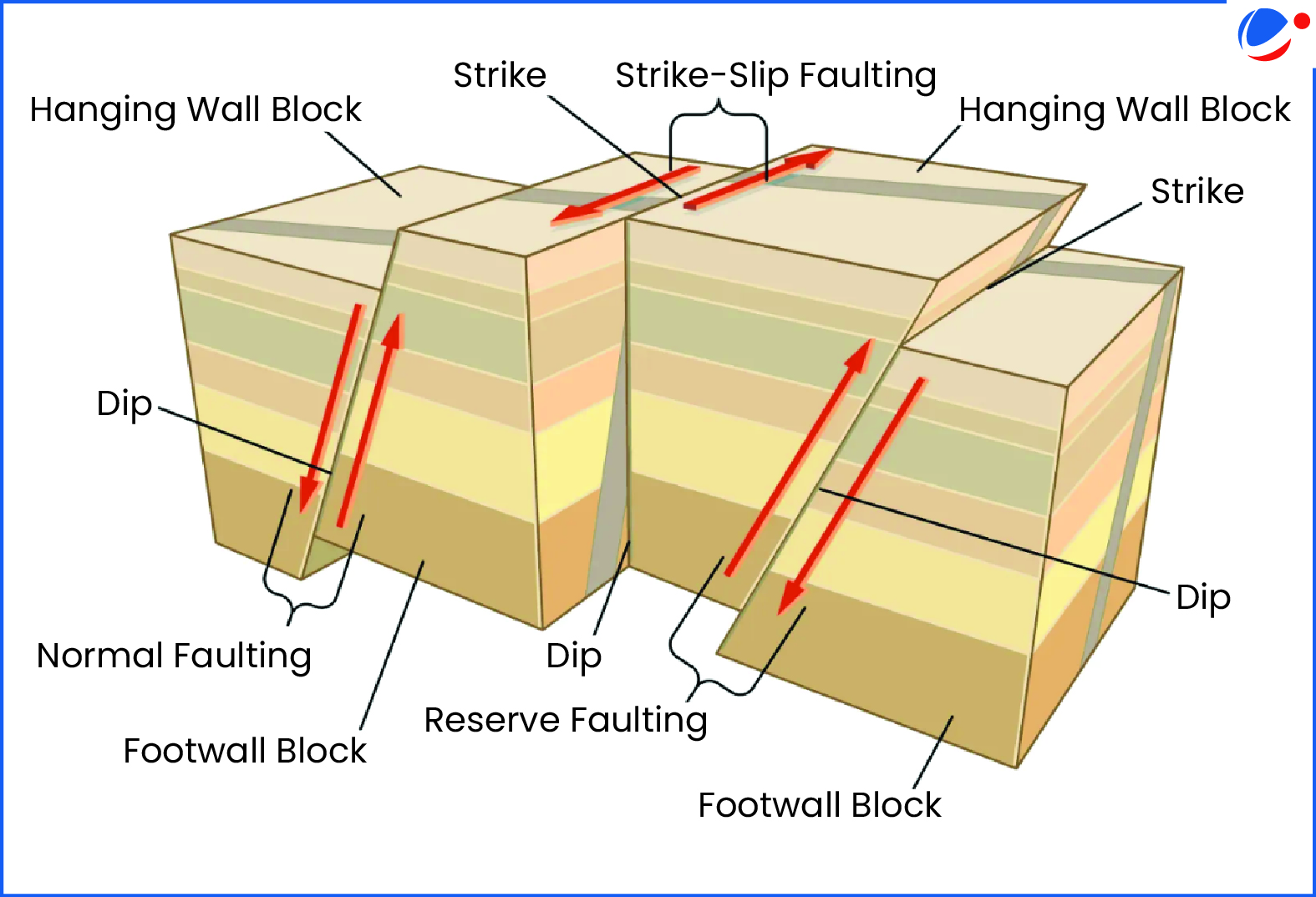
The primary types of faults are (See image):

  • Normal Fault: The hanging wall moves downward relative to the footwall, common at divergent boundaries. E.g., East African Rift Valley and the Basin
  • Reverse Fault: The hanging wall moves upward, occurring at convergent boundaries due to compression. E.g., the Rocky Mountains and the Himalayan Mountains.
  • Strike-Slip Fault: Horizontal movement, minimal vertical displacement. E.g., Anatolia Fault, Turkey.
  • Transform Fault: A type of strike-slip fault, forming boundaries between tectonic plates. E.g., San Andreas Fault, California.
Watch Video News Today

Explore Related Content

Discover more articles, videos, and terms related to this topic

Title is required. Maximum 500 characters.

Search Notes

Filter Notes

Loading your notes...
Searching your notes...
Loading more notes...
You've reached the end of your notes

No notes yet

Create your first note to get started.

No notes found

Try adjusting your search criteria or clear the search.

Saving...
Saved

Please select a subject.

Referenced Articles

linked

No references added yet

Subscribe for Premium Features