


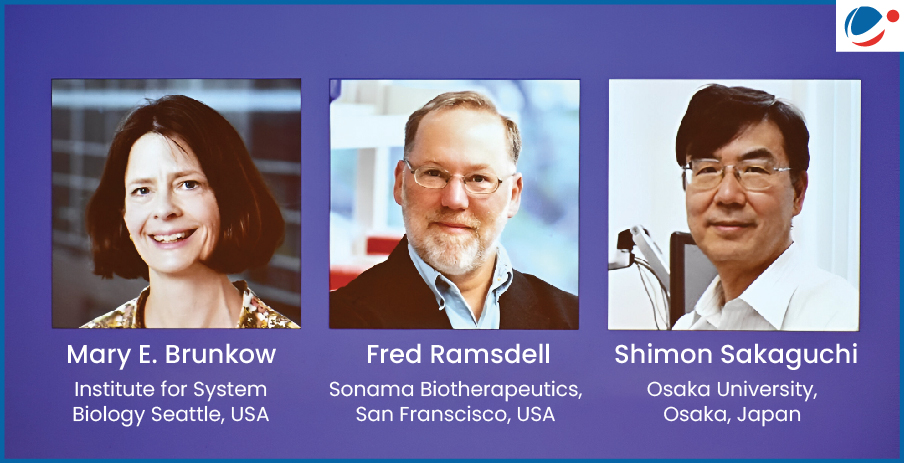
The Nobel Prize in Physiology or Medicine was awarded to Mary E. Brunkow, Fred Ramsdell (USA) and Shimon Sakaguchi (Japan) for their discoveries on peripheral immune tolerance.
Key Highlights of the Research
- Focus Area:
- The research centers on the peripheral immune system, which includes immune components outside the central nervous system (brain and spinal cord).
- Understanding this system is essential for to understand on how immune systems work in determining what should be attacked or protected.
- Discovery of Regulatory T (Treg) Cells:
- T-cells are immune cells that defend the body from pathogens, with different T-cells performing specialized functions identified by surface proteins.
- In 1995, Shimon Sakaguchi discovered a new class called regulatory T-cells, which calm the immune system and prevent it from attacking the host, a mechanism known as peripheral tolerance.
- FOXP3 Gene and Autoimmunity:
- Brunkow and Ramsdell advanced the field by studying scurfy mice, which develop severe autoimmune disease.
- In 2001, they identified the FOXP3 gene as responsible for autoimmunity in these mice and in the human disorder IPEX.
- This discovery enabled Sakaguchi to demonstrate that the FOXP3 gene controls the development of regulatory T-cells.
Significance
- Cancer therapies: Tumors can recruit T-cells to evade immunity thus; immunotherapies aim to inhibit T-cell activity to improve treatment effectiveness.
- Autoimmune & transplant care: Trials aim to enhance Treg formation to treat autoimmune diseases or prevent organ rejection.


