
NITI Aayog Releases Report on ‘Internationalization of Higher Education in India’ | Current Affairs | Vision IAS
MENU
Home

Periodically curated articles and updates on national and international developments relevant for UPSC Civil Services Examination.

Quick Links

High-quality MCQs and Mains Answer Writing to sharpen skills and reinforce learning every day.

Watch explainer and thematic concept-building videos under initiatives like Deep Dive, Master Classes, etc., on important UPSC topics.

ESC

In Summary

India aims to globalize its higher education by increasing international student and faculty ratios, expanding campuses, enhancing global rankings, and implementing policy reforms. Key initiatives include funding, regulation, and branding strategies.

In Summary

A central pillar of the National Education Policy (NEP) 2020, internationalization focuses on transforming India’s domestic higher education ecosystem into a globally integrated system via 

  • Enhanced international students and faculty ratio in Indian Higher Education Institutions (HEIs),
  • Presence of local campuses of top global institutions in India,
  • Expansion of Indian HEIs outside India, etc.

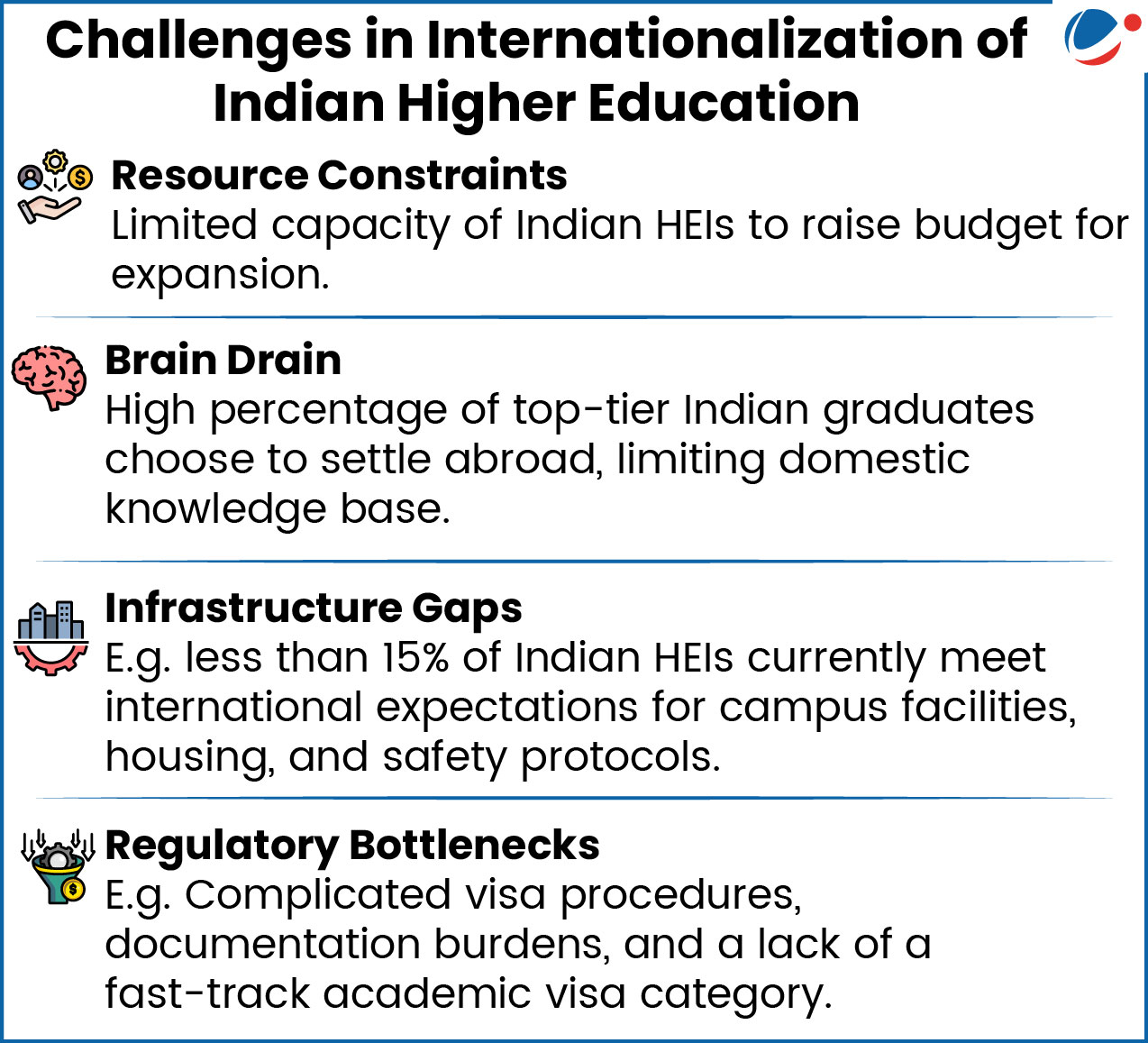
Why India needs internationalization of its higher education?

  • Outward remittances: increased by over 2,000% in a decade, reaching nearly USD 3.4 billion in 2023–24 (~ 53% of India's Union higher education budget).
  • Democratization of Quality: 97% of Indian student in domestic institutions can avail high-quality, world-class education that aligns with global standards.
  • Global Readiness: By embedding international benchmarks, faculty exchanges, and global curricula into Indian campuses, the country can prepare its massive workforce to be "world-ready" and competitive in the global talent pool.
  • Other: Countering brain drain, harnessing the diaspora, improving the global rankings (e.g. higher international student and faculty ratios), soft power projection (e.g. offshore campuses like IIT Delhi in Abu Dhabi), etc.

Policy Recommendations by NITI Aayog

  • Governance: Establish an Inter-Ministerial Task Force and designate Country Centres of Excellence (CoEs) in 54 Central Universities to serve as nodal points for specific nations.
  • Regulation: Revise the NIRF criteria to include internationalization metrics and simplify the visa documents.
  • Finance: Launch the Bharat Vidya Kosh (a $10 billion sovereign research fund) and the Vishwa Bandhu flagship scholarship to attract global researchers and master's students.
  • Branding & Outreach: Develop the Bharat ki AAN (Alumni Ambassador Network) to engage successful Indian-origin alumni as global brand ambassadors and revamp the "Study in India" portal into a one-stop digital solution.
  • Curriculum & Culture: Integrate Indian Knowledge Systems (IKS) with global academic standards and mandate industry-relevant internships and reflective writing modules in degree programmes.
Watch Video News Today

Explore Related Content

Discover more articles, videos, and terms related to this topic

RELATED VIDEOS

3
News Today (Jul 04, 2024)

News Today (Jul 04, 2024)

YouTube HD
Simplified | The Hidden Casualty: Education in the Climate Change Narrative

Simplified | The Hidden Casualty: Education in the Climate Change Narrative

YouTube HD
News Today (Nov 08, 2024)

News Today (Nov 08, 2024)

YouTube HD
Title is required. Maximum 500 characters.

Search Notes

Filter Notes

Loading your notes...
Searching your notes...
Loading more notes...
You've reached the end of your notes

No notes yet

Create your first note to get started.

No notes found

Try adjusting your search criteria or clear the search.

Saving...
Saved

Please select a subject.

Referenced Articles

linked

No references added yet

Subscribe for Premium Features
