


BoT highlighted slowing exports due to the steep US tariffs of 50 %.
Board of Trade
- About: It is apex advisory body on policy measures related to the Foreign Trade Policy aimed at strengthening India’s trade ecosystem.
- Chairman: Minister for Commerce & Industry.
- Members: Comprise ministers in charge of trade and commerce in state governments and union territories, export promotion councils, industry associations etc.
- It was reconstituted in 2019 through the merger of the Council for Trade Development and Promotion with the BoT.
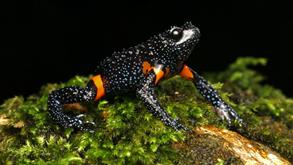
According to a recent study, a group of seven galaxy frogs vanished from the Western Ghats due to rise in photo tourism.
About Galaxy frog
- Location: The only known species of its genus (Melanobatrachus indicus), it is endemic to the Western Ghats of south-western Ghats.
- It is mostly found in high-altitude evergreen forest and shola forest.
- Characteristics:
- It is a rare frog with a slender, elongated body of uniform width.
- This species is terrestrial and associated with leaf-litter, rocks and another ground cover of moist evergreen tropical forests.
- IUCN status: Vulnerable
Researchers found high levels of antibiotic-resistant staphylococci in both the indoor and outdoor environment in parts of Delhi.
About Staphylococcus
- They are gram positive cocci (spherical-shaped bacterium) that occur in groups in clusters.
- It was first observed in humans by Von Recklinghausen.
- They showed tolerance to penicillin and resistances to all clinical useful antibiotics like erythromycin, tetracycline, aminoglycosides
- Types: Staphylococcus aureus and Staphylococcus epidermidis.
National Biodiversity Authority disbursed ₹45 lakh to red sanders farmers from Andhra Pradesh under Access and Benefit Sharing.
About Red Sanders
- It is an Indian endemic tree species, with a restricted geographic range in the Eastern Ghats specifically to the forest in the state of Andhra Pradesh.
- IUCN: Endangered
About Access and Benefit Sharing (ABS)
- A framework under the Convention on Biological Diversity (1992) and Nagoya Protocol (2010) for fair benefit sharing from genetic resources and traditional knowledge.
- In India: governed by the Biological Diversity Act, 2002 and 2025 Access and Benefit Sharing (ABS) Regulations.
Government releases draft guidelines for Battery Pack Aadhaar System.
About Battery Pack Aadhaar System
- It is an indigenous digital identification and data storage system developed to ensure end-to-end traceability of batteries throughout their entire lifecycle.
- It includes a unique identification number for each battery pack, capturing and storing vital information from extraction to final disposal.
- Battery categories that are required to maintain a Battery Pack Aadhaar as an electronic record include Electric Vehicle Batteries and Industrial Batteries with capacity greater than 2kWh.
- Significance: Enabling second-life usage, regulatory compliance, and efficient recycling.
India and Pakistan exchanged lists of nuclear installations under ‘Agreement on Prohibition of Attacks against Nuclear Installations and Facilities’ (or India-Pakistan Non-attack Agreement).
About the India-Pakistan Non-attack Agreement
- Signed: 31st December 1988, and entered into force on January 27, 1991.
- It requires both nations to exchange information on January 1st each year regarding the location of their nuclear installations.
- Aim: Refrains both sides from directly or indirectly causing the destruction of, or damage to, any nuclear installation or facility in the other country.
- Significance: Considered a key measure for reducing nuclear risk between India and Pakistan.
Prime Minister chaired 50th meeting of Pro-Active Governance and Timely Implementation (PRAGATI).
- The system has accelerated the implementation of mega projects and key welfare schemes.
About PRAGATI
- Launched: In 2015.
- Overview: It is a three-tier system (Prime Minister’s Office (PMO), Union Government Secretaries, and Chief Secretaries of the States)
- Objectives:
- Programme Implementation (coordination between agencies)
- Project Monitoring (technology-based platform)
- Grievance Redressal (CPGRAMS).
India has moved to 8th position (in 2025) from 123rd (in 2014) in contributions to the World Health Organization’s pharmacovigilance database under the WHO Programme for International Drug Monitoring (WHO PIDM).
- The improvement in rankings has been attributed to the Pharmacovigilance Programme of India (PvPI).
- Launched in 2010, PvPI is Government of India's flagship drug safety monitoring programme, which analyses drug-related adverse events and sends recommendations to CDSCO for taking appropriate regulatory actions.
About WHO Programme for International Drug Monitoring (WHO PIDM)
- Established: in 1968
- Aim: to put medicines and vaccine safety at the heart of global healthcare.
- VigiBase: WHO global database of adverse event reports for medicines and vaccines.


