
India becomes world's largest rice producer, surpasses China: Agriculture Minister | Current Affairs | Vision IAS
MENU
Home

Periodically curated articles and updates on national and international developments relevant for UPSC Civil Services Examination.

Quick Links

High-quality MCQs and Mains Answer Writing to sharpen skills and reinforce learning every day.

Watch explainer and thematic concept-building videos under initiatives like Deep Dive, Master Classes, etc., on important UPSC topics.

ESC

In Summary

  • India is the world's largest rice exporter (20.1 MT in 2024-25), with major destinations including Saudi Arabia and Iran.
  • Uttar Pradesh, Telangana, and West Bengal are top rice-producing states in India, contributing significantly to national output.
  • Rice, a staple crop, thrives in warm, humid conditions with abundant rainfall and can grow in various soil types.

In Summary

Union Agriculture Minister also released 184 new high-yielding seed varieties for 25 crops.

Status of Rice Production and export:
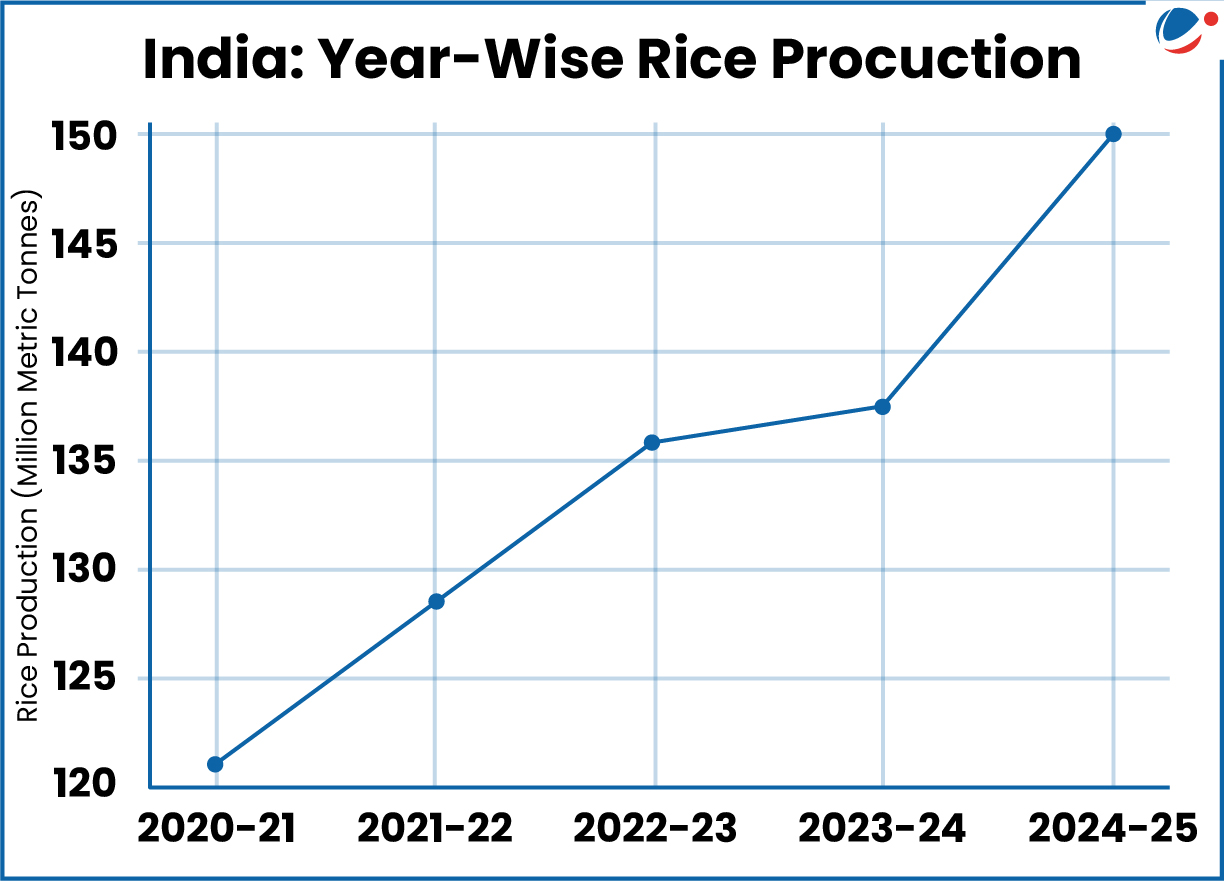
  • Major producers of rice: India (150 MT),China, Indonesia, Bangladesh, Japan, Sri Lanka and Egypt.
  • State wise Production in India (2024-25): Uttar Pradesh (13.8%), Telangana (11.6%), West Bengal (10.6%), Punjab (9.5%), Chhatisgarh (7%) etc.
  • Export: India is the world's largest rice exporter (exporting 20.1 million metric tonnes of rice in 2024–25).
  • Major export destinations of India's Rice: Saudi Arabia, Iran, Iraq, Benin, United Arab Emirates etc.

About Rice Crop

  • Type: Major food crop of the world and staple diet of the tropical and sub-tropical regions. 
  • Growth Conditions:
    • Rice is grown under varying conditions in India from 8°N to 30°N latitude and from sea level to about 2,500 metre altitude.
    • Grown in variety of soils including silts, loams and gravels and can tolerate acidic as well as alkaline soils.
    • Abundant rainfall (100-150cm), high humidity and high temperature (30°C during day and 20°C at night).
      • Paddy is a semi-aquatic plant that requires standing water (averaging 10–15 cm) for three-quarters of its growing season. 
      • It grows best in impermeable subsoil with a pH between 5.5 and 6.5.
  • Cropping Seasons in India: Rice is grown in three distinct seasons based on the region:
    • Aman (Winter rice): Sown in June–July and harvested in November–December.
    • Aus (Autumn rice): Sown in May–June and harvested in September–October.
    • Boro (Summer rice): Cultivated between November and May, often in areas that remain moist during winter.

Watch Video News Today

Explore Related Content

Discover more articles, videos, and terms related to this topic

RELATED VIDEOS

3
The Contribution of Indian Cinema to the Creative Economy

The Contribution of Indian Cinema to the Creative Economy

YouTube HD
Impact Investments

Impact Investments

YouTube HD
Universal and Meaningful Connectivity

Universal and Meaningful Connectivity

YouTube HD

RELATED TERMS

3

Staple diet

A food that is eaten regularly and in such quantities as to constitute the dominant part of the diet for a given population, playing a crucial role in food security and cultural identity.

Aman, Aus, Boro

These are distinct cropping seasons for rice cultivation in India, named based on their sowing and harvesting periods. Understanding these seasons is important for agricultural planning, policy, and regional crop production analysis.

Cropping Seasons

Distinct periods of the year characterized by specific agricultural activities, particularly sowing and harvesting of particular crops. In India, rice is grown in three main seasons: Aman (Winter), Aus (Autumn), and Boro (Summer), each adapted to varying rainfall and temperature patterns.

Title is required. Maximum 500 characters.

Search Notes

Filter Notes

Loading your notes...
Searching your notes...
Loading more notes...
You've reached the end of your notes

No notes yet

Create your first note to get started.

No notes found

Try adjusting your search criteria or clear the search.

Saving...
Saved

Please select a subject.

Referenced Articles

linked

No references added yet