
WEF announced five new ‘Fourth Industrial Revolution (IR 4.0) Centres’ globally | Current Affairs | Vision IAS
MENU
Home
Quick Links

High-quality MCQs and Mains Answer Writing to sharpen skills and reinforce learning every day.

Watch explainer and thematic concept-building videos under initiatives like Deep Dive, Master Classes, etc., on important UPSC topics.

ESC

In Summary

  • The Fourth Industrial Revolution (IR 4.0) involves convergence of digital, physical, and biological technologies like AI and IoT.
  • IR 4.0 offers economic growth, inclusive development, environmental sustainability, and emphasizes human capital and lifelong learning.
  • Challenges include technology gap, workforce disruption, security risks, and environmental effects from increased connectivity and resource use.

In Summary

One of the Centre will be built in in Andhra Pradesh, India as well. 

  • It will be 3rd such centre in India after Mumbai and Telangana.
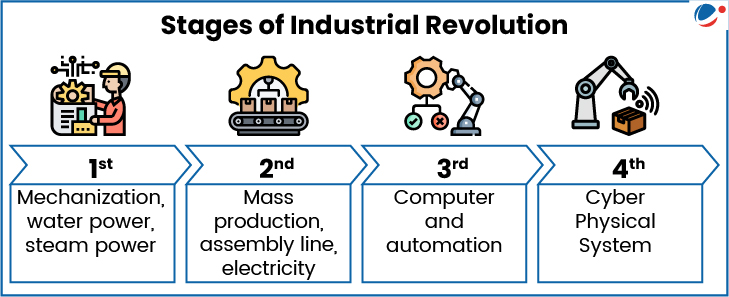
What is the Fourth Industrial Revolution?

  • The term was coined by Klaus Schwab, founder of the World Economic Forum (WEF) in 2016. 
  • IR 4.0 describes the current era in which digital, physical and biological technologies converge such as AI, robotics, the Internet of Things (IoT), quantum computing, etc.
  • Unlike earlier revolutions, IR 4.0 is blurring boundaries between physical, digital and biological systems. 

Significance of Fourth Industrial Revolution

  • Economic growth: Enhances productivity and improves supply chain resilience through automation, data analytics and smart manufacturing.
  • Inclusive development potential: Offers developing countries like India an opportunity to leapfrog legacy technologies and expand digital access.
  • Environmental sustainability: Supports low-carbon and resource-efficient growth through smart grids, precision agriculture and circular economy practices. 
    • For example, "Lighthouse" factories have demonstrated significant reductions in CO2 emissions and water usage through predictive analytics and IoT.
  • Human capital centrality: Shifts the focus from physical labour to skills, innovation, and lifelong learning.

Challenges and Risks

  • The Technology Gap: There is a risk of widening inequality between developed and developing nations. 
    • E.g. Ten "frontrunner" economies account for 91% of global patent applications in advanced digital production technologies. 
  • Workforce Disruption: The demand for manual skills in repeatable tasks is expected to decline by nearly 30%, while demand for technological skills (e.g., coding) will rise by over 50%.
  • Security and Cyber Resilience: As industrial sites become more connected, they become vulnerable to cyberattacks, espionage, and disruption of critical infrastructure.
  • Environmental Effects: The increased use of sensors, data centers, and connected devices consumes energy and scarce resources.
Watch Video News Today

Explore Related Content

Discover more articles, videos, and terms related to this topic

RELATED TERMS

3

Technology Gap

The disparity in technological access, adoption, and development between different countries or regions, potentially leading to widening inequalities.

Circular Economy

An economic model focused on minimizing waste and maximizing resource utilization through reuse, repair, and recycling. Training in circular economy principles is a new focus under PMKVY 4.0.

Lighthouse factories

Advanced manufacturing facilities that utilize Industry 4.0 technologies to achieve significant improvements in productivity, efficiency, and sustainability, often demonstrated by reduced emissions and resource usage.

Title is required. Maximum 500 characters.

Search Notes

Filter Notes

Loading your notes...
Searching your notes...
Loading more notes...
You've reached the end of your notes

No notes yet

Create your first note to get started.

No notes found

Try adjusting your search criteria or clear the search.

Saving...
Saved

Please select a subject.

Referenced Articles

linked

No references added yet