


A new digital platform, Atlas of Climate Adaptation in Indian Agriculture (ACASA-India) has been launched to help farmers plan for climate challenges.
- It has been developed by ICAR-led National Agricultural Research and Extension System (NARES) in collaboration with Borlaug Institute for South Asia (BISA) –CIMMYT to support location-specific, data-driven adaptation planning for climate resilient agriculture.
- Insights from ACASA-India would help government agencies determine future investment requirements for climate risk mitigation and scaling opportunities.
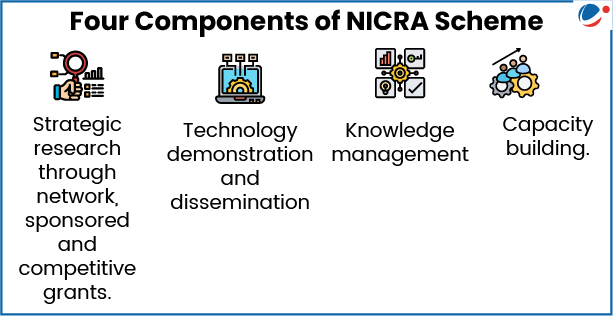
About National Innovations in Climate Resilient Agriculture (NICRA):
- Launched by: Indian Council of Agricultural Research (ICAR) in 2011
- Objective:
- To enhance resilience of Indian agriculture to climate change and vulnerability
- To validate and demonstrate climate resilient technologies on farmer’s fields.
What is Climate Resilient Agriculture (CRA)?
- It refers to adopting adaptation and mitigation practices in agriculture to enhance system’s ability to withstand climate shocks and recover quickly.
Need for CRA
- Preventing Yield loss: Climate change can reduce yields by 4.5 to 9.0% resulting in around 1.5% GDP loss per year.
- Protecting Livelihoods: Around 57% of rural households depend on farming for income.
- Rainfed Area Vulnerability: 51% of India’s net sown area is rainfed, producing ~40% of food, making it highly sensitive to climate variability.
- Food security: India faces increased issues of undernourishment, child malnutrition, micronutrient deficiency etc.


