Laser Interferometer Gravitational Wave Observatory (LIGO-India) | Current Affairs | Vision IAS

Upgrade to Premium Today

Start Now
MENU
Home
Quick Links

High-quality MCQs and Mains Answer Writing to sharpen skills and reinforce learning every day.

Watch explainer and thematic concept-building videos under initiatives like Deep Dive, Master Classes, etc., on important UPSC topics.

A short, intensive, and exam-focused programme, insights from the Economic Survey, Union Budget, and UPSC current affairs.

ESC

In Summary

  • L&T secured a deal from India's DAE to construct a LIGO observatory in Hingoli, Maharashtra.
  • LIGO, an interferometer-based observatory, detects gravitational waves, which are ripples in space-time predicted by Einstein.
  • LIGO India, approved in 2016, is a collaborative project involving DAE, DST, and the US NSF, enhancing India's astrophysical research and technological capabilities.

In Summary

Larsen & Toubro (L&T) has won the deal from India’s Department of Atomic Energy (DAE) to build a LIGO at Aundha in Hingoli district, Maharashtra

About LIGO 

  • Objective: It is interferometer based observatory, designed to detect Gravitational Waves.
    • Gravitational waves are 'ripples' in space-time caused by some of the most violent and energetic processes (like neutron stars or black holes colliding or orbiting each other) in the Universe. 
      • These cosmic ripples would then travel at the speed of light, carrying with them information about their origins, as well as clues to the nature of gravity itself. 
      • Albert Einstein predicted the existence of gravitational waves in 1916 in his general theory of relativity. 
  • Principle: LIGO exploits the physical properties of light and of space itself to detect and understand the origins of gravitational waves.
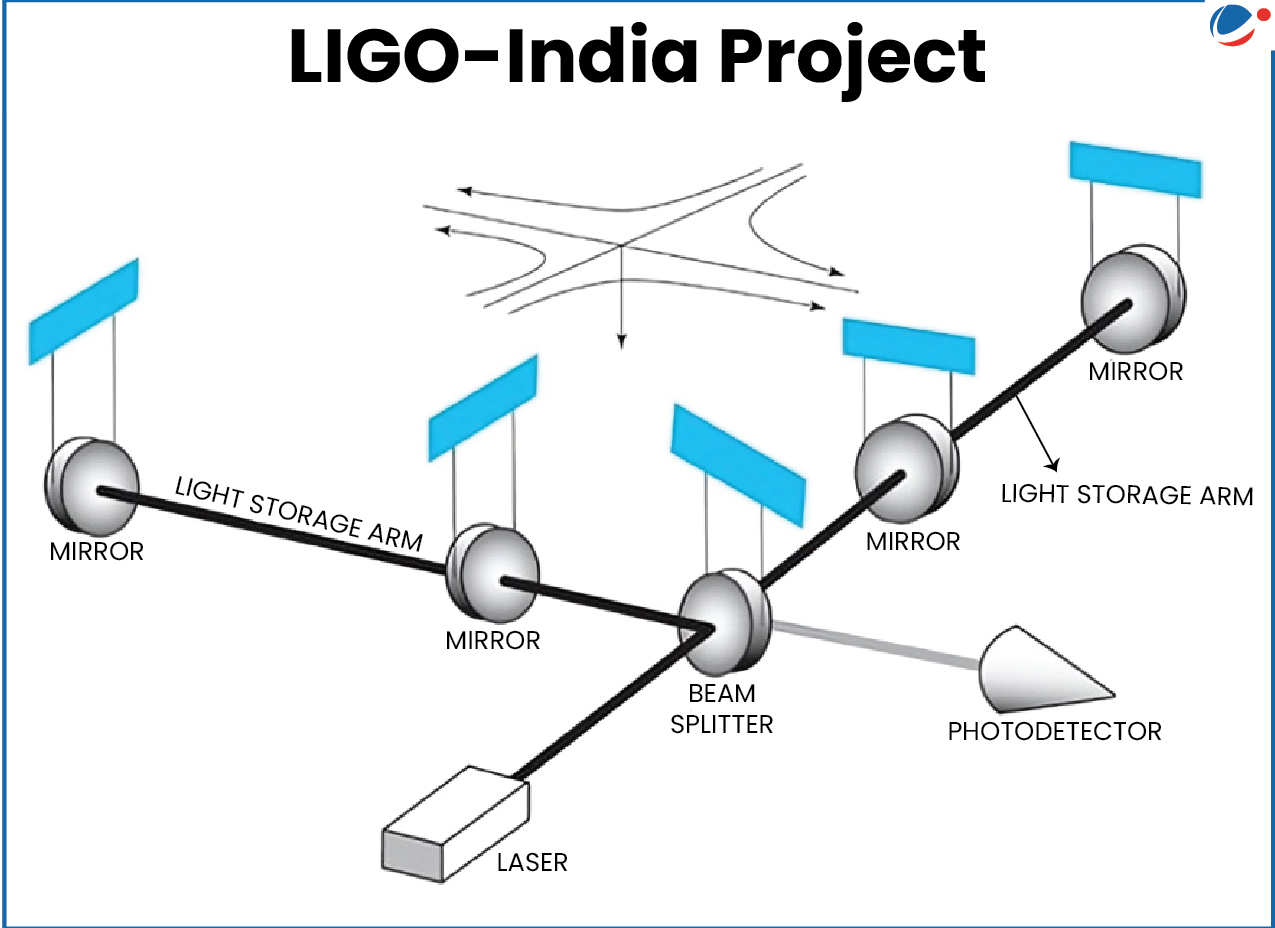
    • LIGO detects gravitational waves by using laser interferometry to measure miniscule changes in space caused by passing waves. 
    • It uses twin 4-km-long L-shaped vacuum tunnels to split a laser beamreflect it off mirrors, and recombine them, creating an interference pattern that reveals stretching or compressing of space.

LIGO India

  • About: Approved by the Government of India in 2016, it is part of the worldwide network of Gravitational Wave Observatory to further enhance the knowledge about gravitational waves, first detected at LIGO-USA in 2015.
  • Development: By the Department of Atomic Energy (DAE) and the Department of Science and Technology (DST) in collaboration with the National Science Foundation (NSF), USA, under a Memorandum of Understanding.
    • Institutes from India: Institute of Plasma Research (IPR) Gandhinagar, Inter University Centre for Astronomy and Astrophysics (IUCAA), Pune and Raja Ramanna Centre for Advanced Technology (RRCAT), Indore.
  • Other Global Gravitational Wave Observatory: LIGO (USA), VIRGO (Italy), KAGRA (Japan) etc.
  • Significance for India: development of Astrophysical Research Leadership; Technological Advancement; Industrial Collaboration; International Prestige & Diplomacy, etc.
Watch Video News Today

Explore Related Content

Discover more articles, videos, and terms related to this topic

RELATED TERMS

3

Astrophysical Research

A branch of astronomy and physics that deals with the physical nature of celestial objects and phenomena, rather than their positions or motions in space. LIGO India aims to enhance India's leadership in this field.

National Science Foundation (NSF)

An independent agency of the United States government dedicated to promoting the progress of science; to advance the national health, prosperity, and welfare; and to secure the national defense.

Department of Science and Technology (DST)

A nodal agency of the Government of India responsible for formulating and implementing policies and programmes related to science and technology.

Title is required. Maximum 500 characters.

Search Notes

Filter Notes

Loading your notes...
Searching your notes...
Loading more notes...
You've reached the end of your notes

No notes yet

Create your first note to get started.

No notes found

Try adjusting your search criteria or clear the search.

Saving...
Saved

Please select a subject.

Referenced Articles

linked

No references added yet