


In Kisan Mahapanchayat v. Union of India and Ors, the policy of importing yellow dal without any duty was challenged.
•The policy potentially lowered domestic prices and discouraged local farmers from growing pulses.
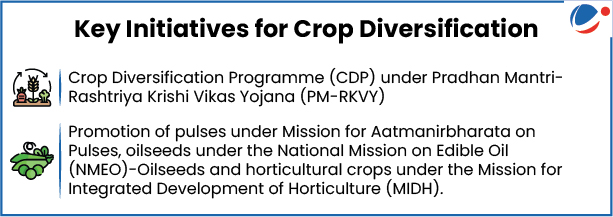
Key Initiatives for Crop Diversification
•Crop Diversification Programme (CDP) under Pradhan Mantri- Rashtriya Krishi Vikas Yojana (PM-RKVY)
•Promotion of pulses under Mission for Aatmanirbharata on Pulses, oilseeds under the National Mission on Edible Oil (NMEO)-Oilseeds and horticultural crops under the Mission for Integrated Development of Horticulture (MIDH).
What is Crop diversification?
It refers to the addition of new crops or cropping systems to agricultural production on a particular farm based on the different returns from value- added crops with complementary marketing opportunities.
Need for Crop Diversification
• Dominance of Wheat and Paddy: Policies and practices have resulted in surplus production of wheat and paddy, impacting production of pulses and oilseeds and increasing import dependence.
• Environmental Sustainability: The paddy-wheat cycle, especially in North India, has led to depletion of groundwater and soil degradation.
• Nutritional security: Crop diversification can ensure increased consumption of pulses in a balanced diet.
• Soil Health: Pulses are nitrogen-fixing crops which improve soil fertility, reducing the need for chemical fertilizers.
Challenges
• Absence of an incentivized MSP: This results in Pulses being sold in open market at prices below the MSP, making pulses farming unattractive for farmers.
• Mismatch in MSP and Import policies, affecting financial viability of crop diversification.
• Others: Lack of infrastructure, lack of farm resources and awareness, lack of capital and risk taking ability, climatic factors, lack of technical knowledge etc.
Key Suggestions of SC• Governance Reforms: o Strengthen inter-ministerial coordination to address gaps in agricultural policy. o Evolve a coordinated long-term policy for stability and predictability for pulses and oilseed farmers. • MSP and Price Support: o MSP for pulses must be high enough to cover the specific risks and expenditures incurred by small-scale farmers, in line with the Swaminathan Committee. o Ensuring a guaranteed platform for farmers to sell pulses at least at MSP to encourage crop diversification. o Multi-stakeholder discussions, including ground-level experts on key issues like absence of an incentivised MSP for pulses. • Import Policy: Aligning Import Duty Structure with the Domestic MSP to ensure that imports do not disincentivize local production. |




