
Biogas, Emerging as an Alternative amidst Rising Cooking Fuel Crunch | Current Affairs | Vision IAS

Upgrade to Premium Today

Start Now
MENU
Home
Quick Links

High-quality MCQs and Mains Answer Writing to sharpen skills and reinforce learning every day.

Watch explainer and thematic concept-building videos under initiatives like Deep Dive, Master Classes, etc., on important UPSC topics.

A short, intensive, and exam-focused programme, insights from the Economic Survey, Union Budget, and UPSC current affairs.

ESC

In Summary

  • Biogas, produced via anaerobic digestion of organic matter, comprises methane (55-60%) and carbon dioxide (35-40%), with trace elements.
  • Key technologies include biodigesters, landfill gas recovery, and wastewater treatment plants for biogas production.
  • India promotes biogas through initiatives like the GOBARdhan scheme and the National Bio Energy Programme (NBP) for clean cooking fuel and fertilizer.

In Summary

Biogas is produced after organic materials (plant and animal products) are broken down by bacteria in an oxygen-free environment, a process called anaerobic digestion.

About Biogas
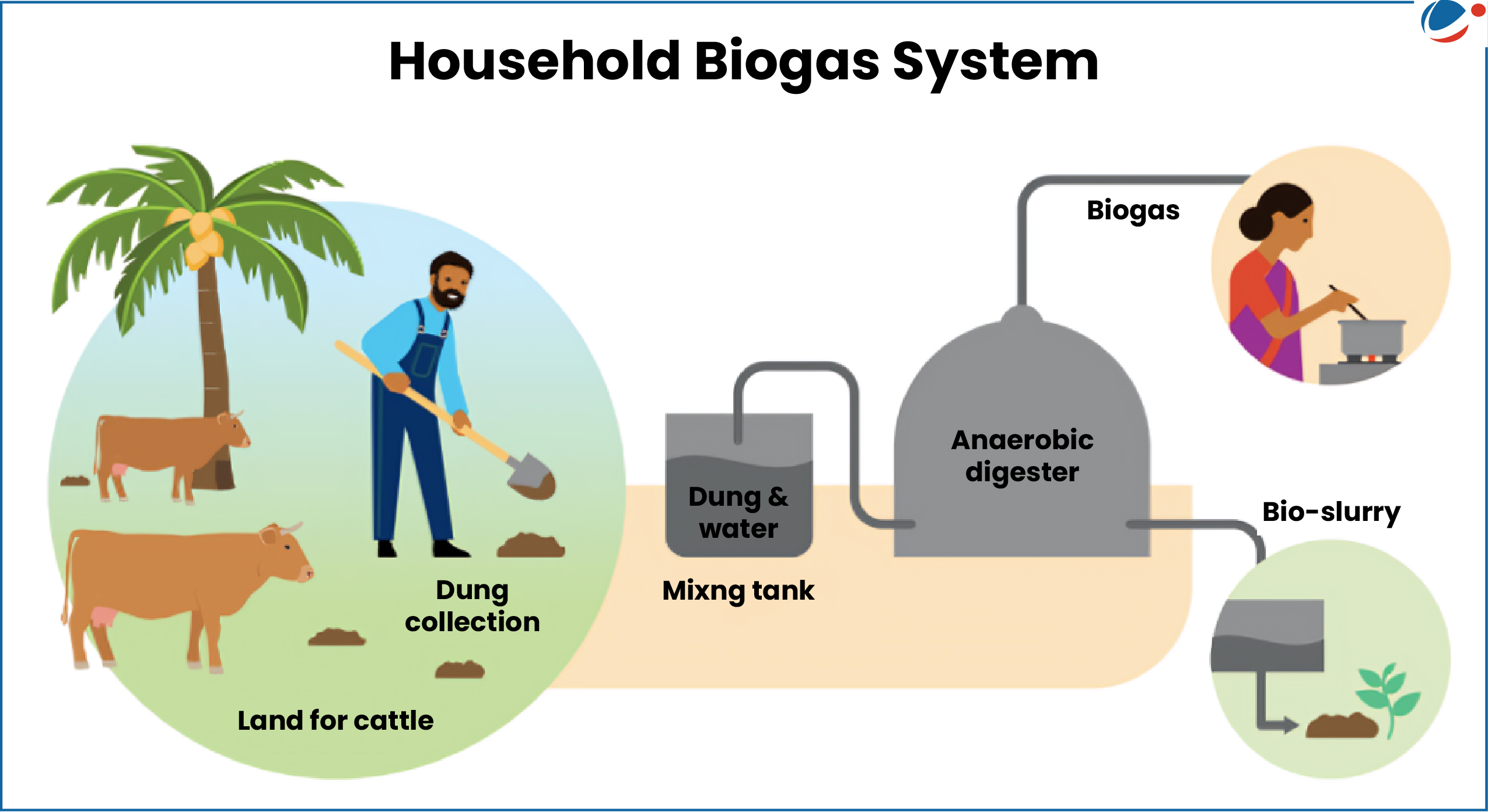
  • Composition: Methane (CH4) 55-60%, Carbon dioxide (CO2) 35-40%, Trace elements of Ammonia Hydrogen Sulphide (H2S) and moisture.
  • Main Technologies Involved in Production:

o Biodigesters: Airtight systems (e.g. containers or tanks) where organic material, diluted in water, is broken down by naturally occurring microorganisms.

o Landfill gas recovery systems: Involves decomposition of municipal solid waste (MSW) under anaerobic conditions at landfill sites.

o Wastewater treatment plants: These could recover organic matter, solids, and nutrients from sewage sludge,which could be used as input to produce biogas.

Relevance of Biogas as Alternative Cooking Fuel

  • Diversifying energy mix: Heavy reliance on imported fuels increases vulnerability to global shocks.
  • Reduce Chemical Fertilizer Dependence: Biogas production also yields bio-slurry, a nutrient-rich byproduct, could be used as organic fertilizer.
  • Benefits for Rural Areas: Enhances rural energy access, improves waste management, and offers cleaner alternative to using fossil fuel based resources.

Key Initiatives taken for Biogas promotion in India

  • Galvanizing Organic Bio-Agro Resources Dhan (GOBARdhan) Scheme: Launched under  Swachh Bharat Mission (Grameen) in 2018,  aims at converting bio-waste into biogas.
  • National Bio Energy Programme (NBP):  comprises sub-schemes related to BiogasWaste to Energy Programme: Energy from Urban, Industrial, Agricultural Wastes and Municipal Solid Waste  in the form of Biogas/BioCNG, etc.
  • Processes like incineration, gasification, or pyrolysis are involved in waste to energy technologies.
  • Biogas Programme (2021-22 to 2025-26): Setting up of biogas plants for clean cooking fuel, lighting, etc.
Watch Video News Today

Explore Related Content

Discover more articles, videos, and terms related to this topic

RELATED TERMS

3

Waste to Energy

A broad category of technologies that convert various forms of waste, such as municipal solid waste, industrial waste, and agricultural waste, into usable energy forms like biogas, bio-CNG, or electricity through processes like incineration, gasification, or pyrolysis.

BioCNG

Biogas that has been purified and upgraded to a high methane content, making it comparable to compressed natural gas (CNG) and suitable for use as a fuel in vehicles and for industrial purposes.

Waste to Energy Programme

An initiative that aims to generate energy, including biogas, bioCNG, and electricity, from various forms of urban, industrial, and agricultural waste, as well as municipal solid waste.

Title is required. Maximum 500 characters.

Search Notes

Filter Notes

Loading your notes...
Searching your notes...
Loading more notes...
You've reached the end of your notes

No notes yet

Create your first note to get started.

No notes found

Try adjusting your search criteria or clear the search.

Saving...
Saved

Please select a subject.

Referenced Articles

linked

No references added yet
