


India’s SPRs currently have a capacity of 5.33 million metric tonnes (MMT).
- These are enough to last around 9.5 days of India’s crude oil supplies at their full capacity.
What are SPRs?
- About: These are stockpiles of crude oil, maintained by the government to ensure energy security to be used during supply disruptions.
- These exist in addition to the commercial stocks held by oil companies.
- Implementing Agency: under Special Purpose Vehicle called Indian Strategic Petroleum Reserves Limited (ISPRL), established in 2004.
- Ministry: Ministry of Petroleum and Natural Gas.
- Storage Technology: Crude oil is stored in underground rock caverns, located deep below the ground, usually near coastal areas.
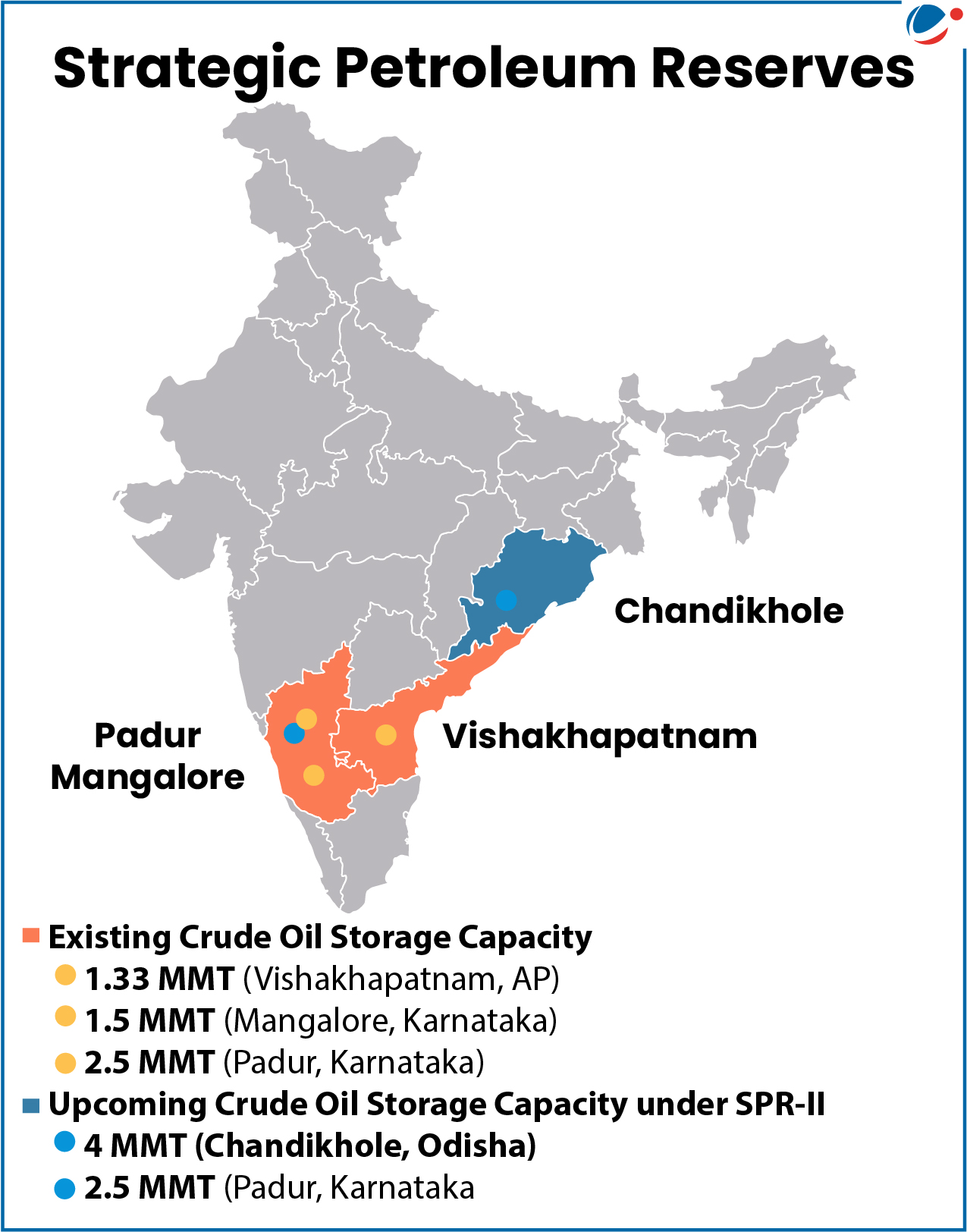
- Locations (refer map)
- Phase-I SPR Facilities (5.33 MMT): Currently operational at three locations
- Visakhapatnam (Andhra Pradesh)
- Mangaluru (Karnataka)
- Padur (Karnataka)
- Phase-II (approved in 2021, with additional 6.5 MMT): Future expansion planned at
- Chandikhol (Odisha)
- Padur Phase-II
- Phase-I SPR Facilities (5.33 MMT): Currently operational at three locations
Significance of SPRs
- Energy Security: Provides protection against wars, supply disruptions, shipping blockades, etc.
- Economic Stability: Prevents the nation from sudden inflationary shocks as it acts as a market stabilization tool.
- Strategic Autonomy: Reduces dependence on external geopolitical dynamics.
Challenges to overcome by India
|


