
National Quantum Mission achieves 1,000-km secure communication | Current Affairs | Vision IAS

Upgrade to Premium Today

Start Now
MENU
Home
Quick Links

High-quality MCQs and Mains Answer Writing to sharpen skills and reinforce learning every day.

Watch explainer and thematic concept-building videos under initiatives like Deep Dive, Master Classes, etc., on important UPSC topics.

A short, intensive, and exam-focused programme, insights from the Economic Survey, Union Budget, and UPSC current affairs.

ESC

In Summary

  • India achieved a milestone in secure quantum communication with one of the longest Quantum Key Distribution (QKD) deployments globally.
  • Quantum communication uses quantum properties like QKD to encode and transmit information, detecting interceptions via quantum state changes.
  • The National Quantum Mission (2023-24 to 2030-31) aims to develop quantum computers, satellite-based secure communication, sensitive quantum devices, and next-gen quantum materials.

In Summary

The milestone represents one of the longest Quantum key distribution (QKD) deployments globally, a landmark advancement in secure quantum communication.
  • The development is expected to strengthen India’s secure communication capabilities across defence, financial systems and critical infrastructure

What is Quantum Communication?

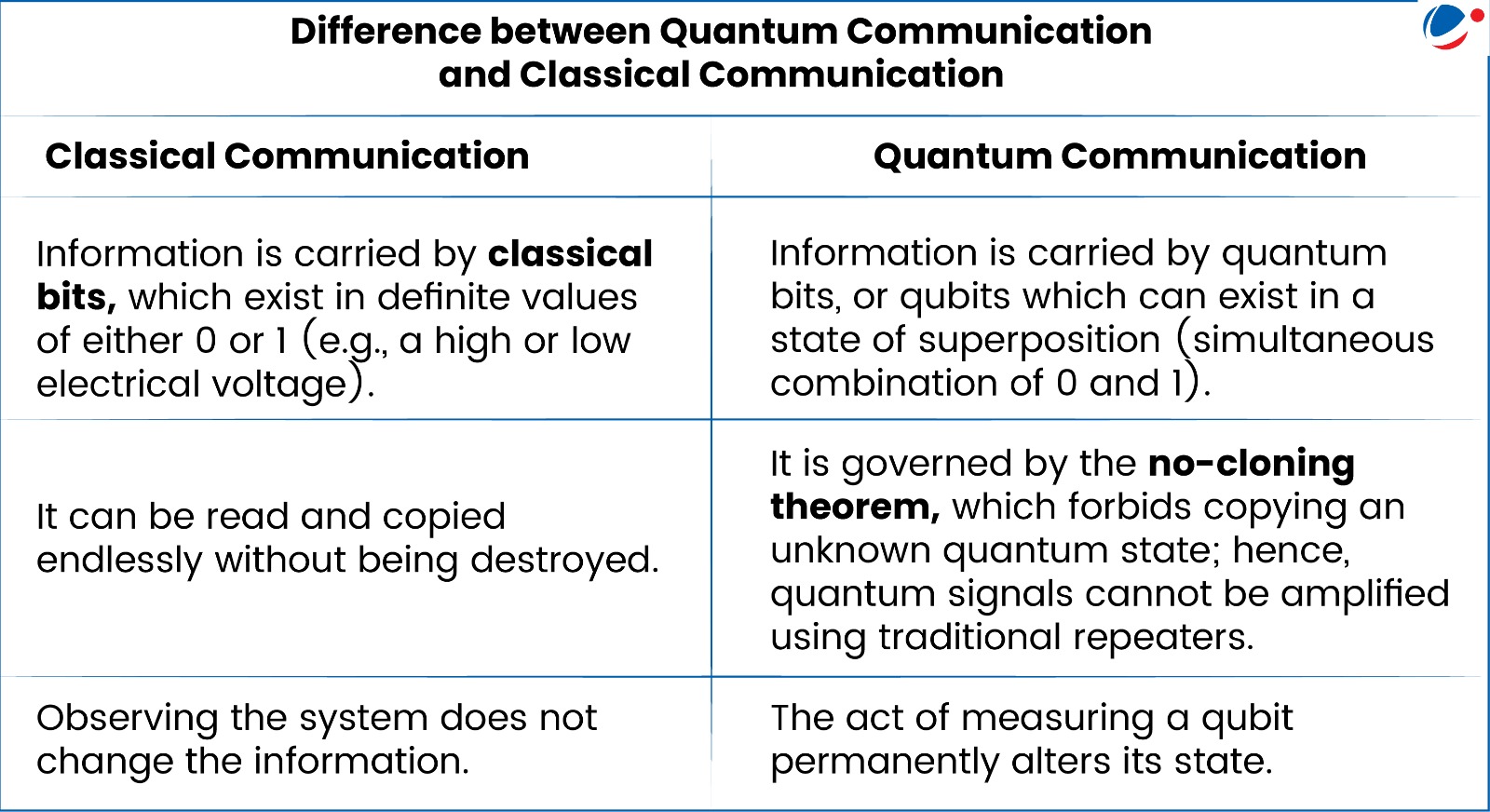
  • Definition:  Quantum communication is the study of encoding and transmitting information between distant quantum systems.
  • Physical Basis: It takes advantage of peculiar quantum properties such as Quantum key distribution (QKD).
    • QKD is a method for creating and sharing secret encryption keys using the principles of quantum mechanics.
      • It relies on quantum states that change when observed, allowing any interception attempt to be detected. 
  • Medium:  similar to classical communication, quantum communication primarily uses light (single photons) to encode information, enabling fast and low-error transmission.

About National Quantum Mission

  • Launched: For a period from 2023-24 to 2030-31 by Department of Science and Technology (DST).
  • Key Objectives:
    • Develop intermediate-scale quantum computers.
    • Establish 2000 km satellite-based quantum-secure communication.
    • Design highly sensitive quantum devices including magnetometers, gravity sensors and atomic clocks.
    • Develop and synthesize next-generation quantum materials such as superconductors, novel semiconductor structures and topological materials.
Watch Video News Today

Explore Related Content

Discover more articles, videos, and terms related to this topic

RELATED TERMS

3

Topological Materials

A class of materials that exhibit unique electronic properties due to their topological nature. They are being researched for their potential in creating stable and robust qubits for quantum computing.

Superconductors

Materials that can conduct electricity with zero electrical resistance when cooled below a certain critical temperature. They have applications in advanced technologies, including the fabrication of qubits for quantum computers.

Quantum computers

A type of computer that uses quantum-mechanical phenomena, such as superposition and entanglement, to perform calculations. These computers have the potential to solve certain complex problems exponentially faster than classical computers.

Title is required. Maximum 500 characters.

Search Notes

Filter Notes

Loading your notes...
Searching your notes...
Loading more notes...
You've reached the end of your notes

No notes yet

Create your first note to get started.

No notes found

Try adjusting your search criteria or clear the search.

Saving...
Saved

Please select a subject.

Referenced Articles

linked

No references added yet
