
ISRO successfully conducted the second Integrated Air Drop Test for the Gaganyaan mission | Current Affairs | Vision IAS

Upgrade to Premium Today

Start Now
MENU
Home
Quick Links

High-quality MCQs and Mains Answer Writing to sharpen skills and reinforce learning every day.

Watch explainer and thematic concept-building videos under initiatives like Deep Dive, Master Classes, etc., on important UPSC topics.

A short, intensive, and exam-focused programme, insights from the Economic Survey, Union Budget, and UPSC current affairs.

ESC

In Summary

  • The Gaganyaan Mission aims to demonstrate human spaceflight capability by sending a 3-member crew to a 400 km LEO for 3 days, returning them safely to Indian waters.
  • The mission comprises a Human Rated Launch Vehicle (LVM3), an Orbital Module (Crew and Service Modules), and a Crew Escape System for astronaut safety.
  • Significance includes India becoming the fourth nation with independent human spaceflight capability, fostering space diplomacy, and advancing technology for future exploration.

In Summary

The test validates the safe descent and landing systems of the Crew Module, specifically testing the parachute deployment sequences under simulated flight conditions. 

About Gaganyaan Mission
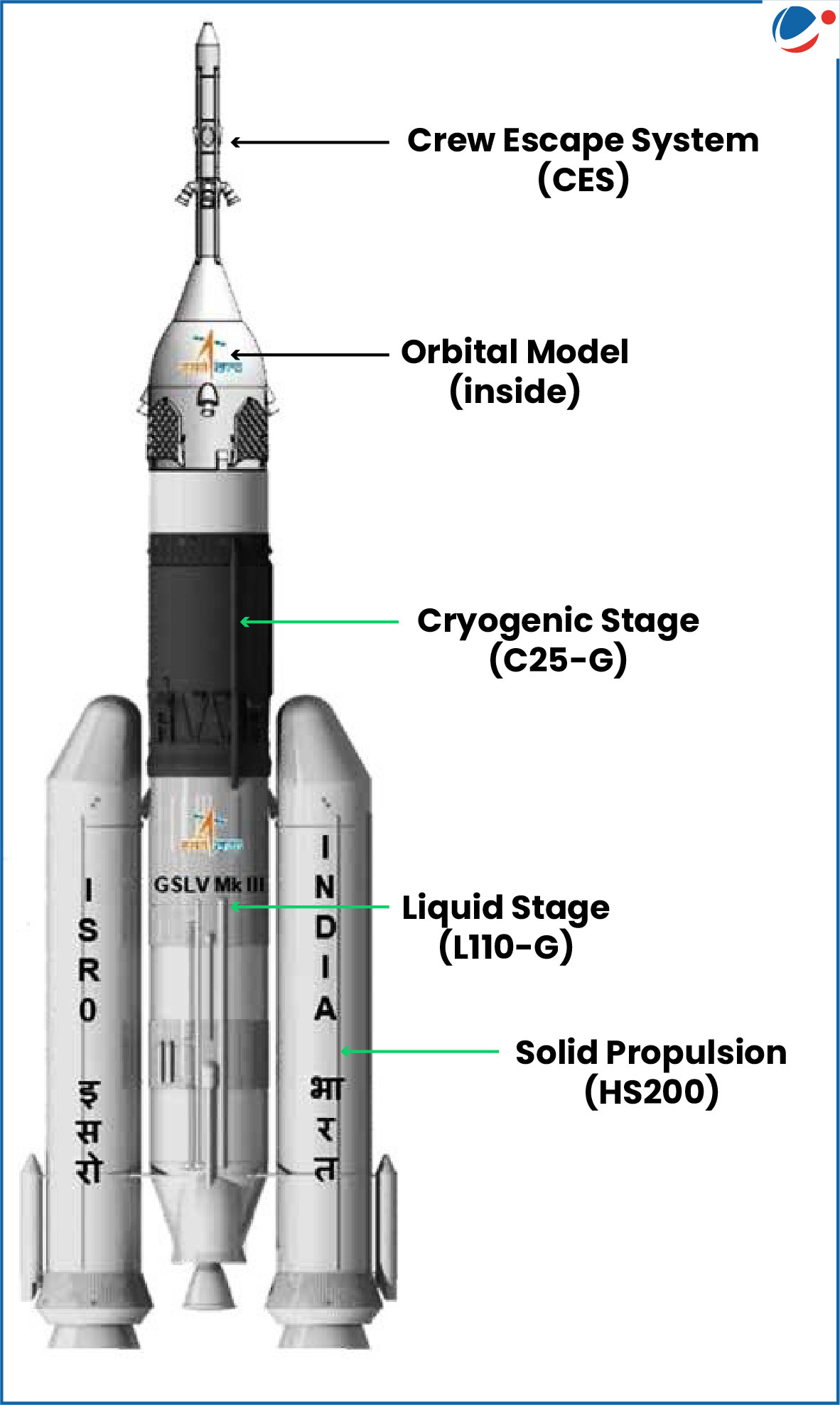
  • Objective: Demonstration of human spaceflight capability by launching a crew of 3 members to a Low Earth Orbit (LEO) of 400 km for a 3 days mission and bringing them back safely to earth, by landing in Indian sea waters.
    • Two unmanned missions and one manned mission will be undertaken by ISRO.
  • Three Components of the Mission
    • Human Rated Launch Vehicle (HLVM-3): ISRO's reliable heavy-lift launcher, LVM3, has been re-configured to meet human rating requirements. It is a three-stage rocket:
      • First stage: Two solid-fuel boosters strapped to the rocket core.
      • Second stage: Powered by two liquid-fuelled, clustered Vikas 2 engines.
      • Third stage: Equipped with the CE-20 indigenous cryogenic engine, using liquid hydrogen and liquid oxygen as fuel and oxidiser, respectively.
  • Orbital Module: A habitable space with Earth like environment in space for the crew that will be orbiting Earth comprises of
    • Crew module: Include environmental control and life support systems (ECLSS), parachutes.
    • Service module: An unpressurised bus carrying propulsion, power, thermal radiators, and water and oxygen tanks.
  • Crew Escape System (CES): CES is a safety mechanism designed to save the astronauts’ lives if something goes wrong during launch.

Significance of the Gaganyaan Mission for India

  • Space Diplomacy: India will become only the fourth nation (following the US, Russia, and China) to possess an independent human spaceflight capability opening doors for space collaborations.
  • Advanced technology capability for undertaking sample return missions and further space and scientific exploration  (like Bharatiya Antariksh Station).
  • Other: Economic Growth & employment creation; framework for wider Academia – Industry partnership in taking up development activities for national development.
Watch Video News Today

Explore Related Content

Discover more articles, videos, and terms related to this topic

RELATED VIDEOS

3
News Today (Feb 22, 2024)

News Today (Feb 22, 2024)

YouTube HD
Simplified: Aditya-L1: India’s Solar Sojourn

Simplified: Aditya-L1: India’s Solar Sojourn

YouTube HD
Simplified | National Space Day: India's Space Journey

Simplified | National Space Day: India's Space Journey

YouTube HD

RELATED TERMS

3

Space Diplomacy

The use of space exploration and related activities to foster international cooperation, build partnerships, and enhance a nation's global standing and influence in space affairs.

Crew Escape System (CES)

A critical safety mechanism designed to ensure the survival of astronauts in case of any malfunction or emergency during the launch phase of a space mission.

Service Module

An unpressurised section of the orbital module that houses critical systems such as propulsion, power generation, thermal control radiators, and tanks for consumables like water and oxygen.

Title is required. Maximum 500 characters.

Search Notes

Filter Notes

Loading your notes...
Searching your notes...
Loading more notes...
You've reached the end of your notes

No notes yet

Create your first note to get started.

No notes found

Try adjusting your search criteria or clear the search.

Saving...
Saved

Please select a subject.

Referenced Articles

linked

No references added yet
